
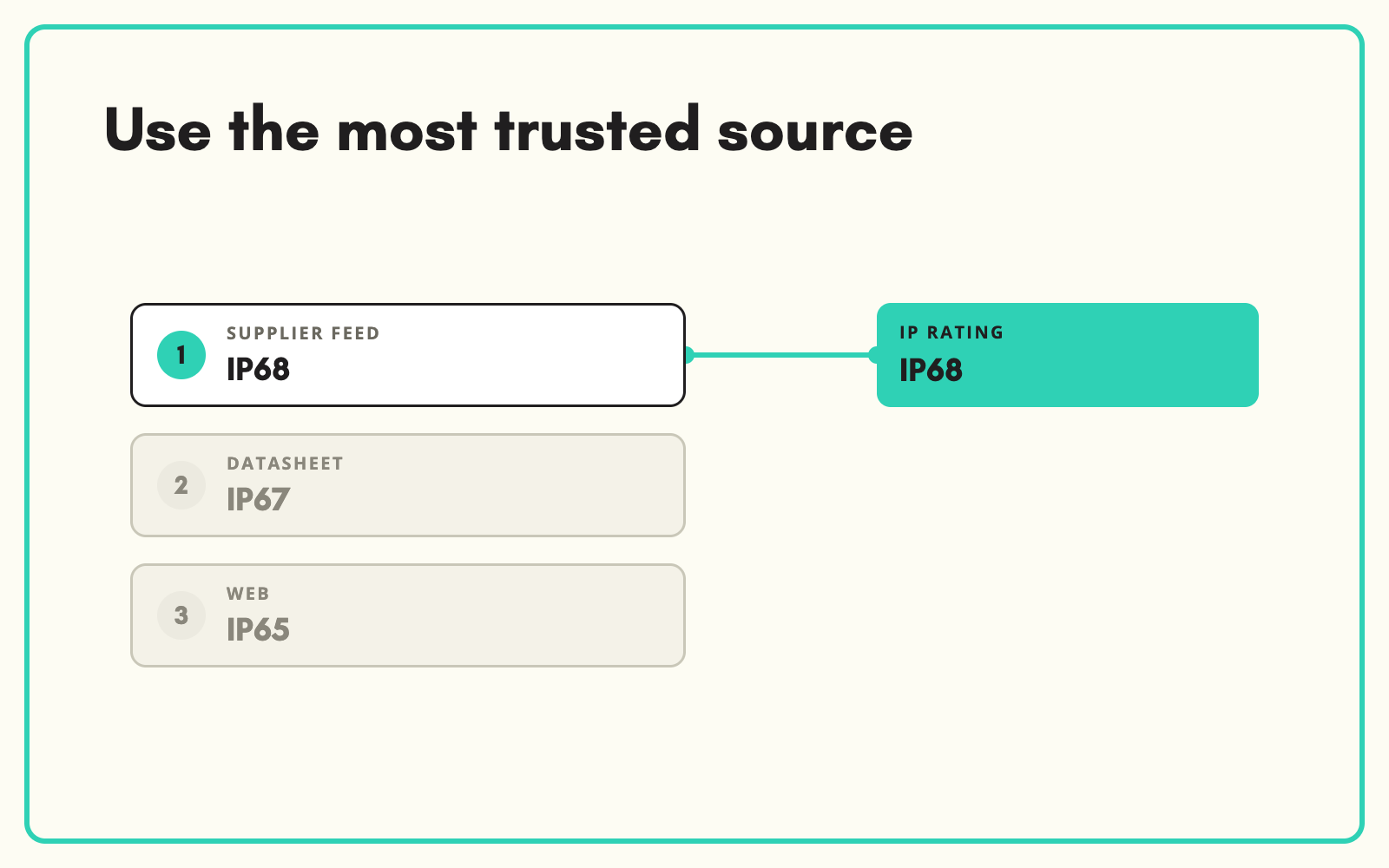
When the supplier feed, the datasheet and the website disagree, something has to decide which value is right. Survivorship rules do that job: they set which source wins for each attribute, so conflicting values are resolved by rule instead of by whoever edited last. SKULaunch applies a source hierarchy, supplier feed first, then datasheet, then web, and puts material disagreements in front of a reviewer.
The problem
Enrichment pulls from many sources, and they rarely agree. A weight differs by 300 grams between the supplier file and the manufacturer site. A dimension is rounded on one and precise on another. Without a rule, the catalogue ends up with a mix of values from different sources, and nobody can explain why a product shows the figure it does.
The cost shows up later. A courier surcharge on a parcel that was heavier than listed. A return because the dimensions on the page were from an old model. A customer query nobody can answer because the value has no known origin.
Before and after
An illustrative example from a garden equipment catalogue, for a single attribute.
Before: three sources, three values
Supplier feed: 8.9 kg. Datasheet: 8.9 kg net, 9.6 kg packed. Retailer listing found online: 9 kg.
After: in SKULaunch
- Weight set to 8.9 kg from the supplier feed, the highest-ranked source
- Datasheet agrees, so no conflict raised
- Web value ignored because a higher source exists
- Packed weight held separately where your model has that attribute
How it works in SKULaunch
- Rank your sources. By default: supplier feed, then datasheet, then web. Change the order to suit your suppliers.
- Enrich from every source. AI Tools gather values from each available source.
- Apply the hierarchy. The highest-ranked source with a value wins for each attribute.
- Review differences. Material disagreements between sources are visible in review, so a person can decide.
What survivorship rules are
The term comes from master data management. When several records describe the same thing, survivorship rules decide which value survives into the single trusted version, often called the golden record. Source precedence is the most common rule: rank the sources and let the highest one with a value win. For product data the idea is the same, applied attribute by attribute rather than to the whole record. The supplier feed might be the best source for a pack quantity and the datasheet the best source for an IP rating. See how to consolidate ERP, PIM and supplier data into one product record.
Survivorship rules for product attributes
Four rules cover most product catalogues. Write them down before you enrich, not after the first argument about a weight.
- Source ranking. The default rule. Decide the order once, and use it for every product. In SKULaunch this is the source hierarchy.
- Precision over rounding. When two sources agree once rounding is allowed for, keep the more precise value. 8.94 kg and 9 kg are not a conflict.
- Recency, with care. A newer datasheet usually beats an older one from the same supplier. A newer web page from a reseller does not beat the manufacturer.
- Manual override, recorded. A reviewer can set a different value during approval. That is the escape hatch for the cases no rule covers, and it should stay the exception.
Normalise before you compare
Many apparent conflicts are not conflicts at all. The feed says 60 x 40 x 25 cm, the datasheet says 600 x 400 x 250 mm. The feed says "GRY", the web says "Anthracite grey". Compare those raw and you raise a dispute for nothing. Map attributes and normalise units and values first, then apply the hierarchy. What is left is a real disagreement worth a person's time. See how to normalise units of measure across every supplier.
Why the supplier ranks first, usually
The supplier made or specified the product and is accountable for its data, so their feed and datasheet usually win. The exceptions are known weak spots: rounded dimensions, outdated weights and generic descriptions. Some teams rank the datasheet above the feed for technical attributes because it is more precise. The point is not which order you choose, but that you choose one and apply it consistently.
Common mistakes
- Letting the last import overwrite everything, so the rule becomes "whoever ran a file most recently".
- Ranking web sources above the supplier because the web page looks more complete.
- Treating net and packed weight as the same attribute, then calling them a conflict.
- Overriding by hand so often that the hierarchy no longer means anything.
What changes
Every value on a product has a reason, and conflicts are resolved the same way every time. Reviewers spend their time on genuine disagreements, not on rounding.
Common questions
What is the difference between survivorship rules and source precedence?
Source precedence is one survivorship rule: rank the sources and the highest wins. Survivorship rules is the wider set, including how you treat rounding, recency and manual overrides.
What is a golden record for product data?
The single trusted version of a product, built from every source you hold, with each value chosen by rule.
Can we change the order?
Yes. Rank sources to suit your data and suppliers.
Can a person override the rule?
Yes. Reviewers can set a different value during approval. See how to approve AI values before they go live.
Should the newest value always win?
No. Recency matters within a source, such as a revised datasheet from the same supplier. It should not let a lower-ranked source beat a higher one.
Can we see where a value came from?
Source tracking is shown during review. Full provenance on every value is on the roadmap.
More on product data extraction accuracy and AI product data extraction.

