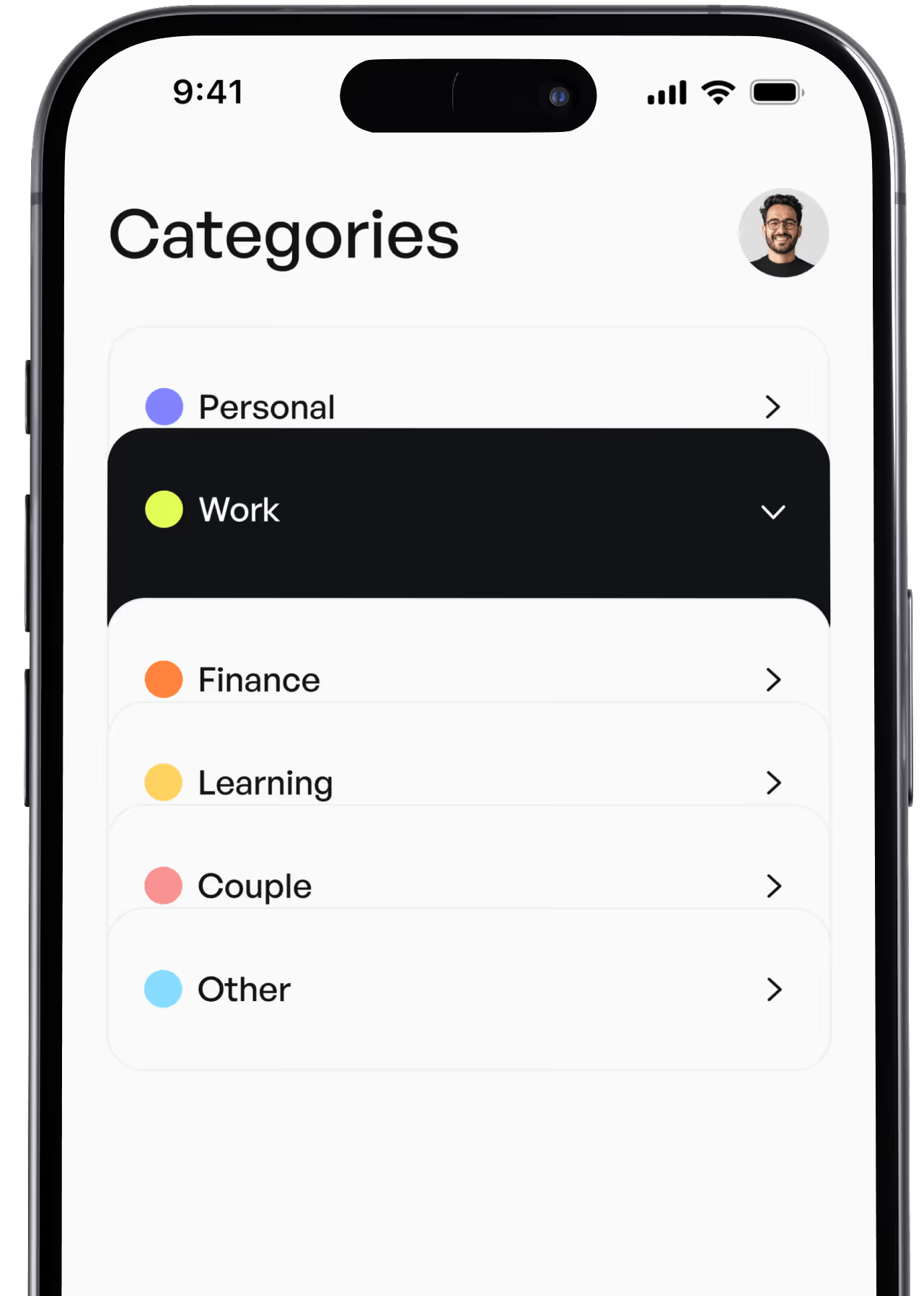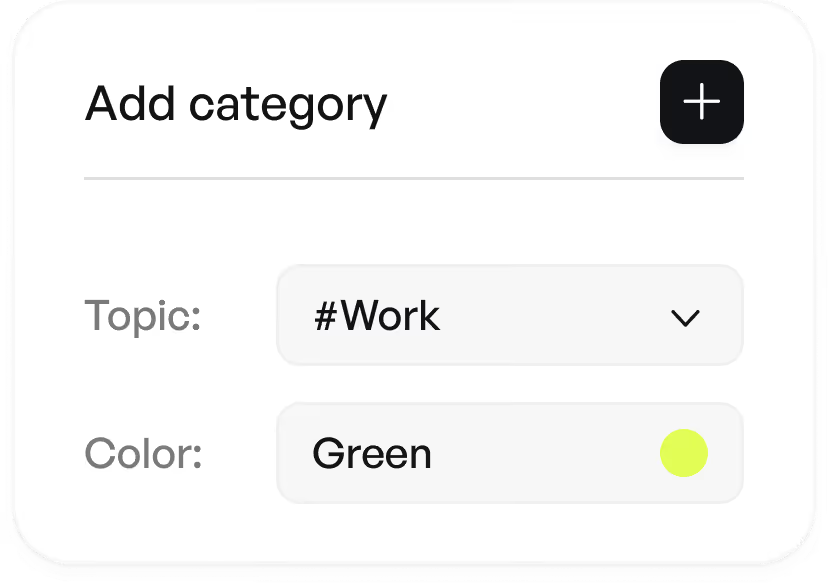
SKULaunch gives every supplier a single link and a guided submission form — built around your attribute schema, your product types, and your validation rules. No spreadsheet templates to email. No format negotiation. Just clean, validated supplier data onboarding that arrives in your review queue ready to approve.
.avif)
A supplier portal is a web page where suppliers submit product data directly to a retailer or distributor, instead of emailing spreadsheets back and forth. The portal shows each supplier exactly which attributes are required, validates what they enter as they type, and blocks submission until the record is complete.
The difference shows up in completion rates. Chasing suppliers by email and spreadsheet typically gets around 12% of records back complete. A portal that validates on entry gets over 80%. The work does not disappear, it moves from your team to the supplier who already has the data.
A supplier portal turns supplier data collection from an inbox problem into a workflow with a finish line.
Collecting the data is one step inside a wider process. For how the whole of it runs, see the full guide to supplier onboarding.
| Email and spreadsheets | Supplier portal | |
|---|---|---|
| How suppliers submit | Attachment sent to an inbox, format up to them | One link, one form, your fields |
| When errors are caught | After your team opens the file, often days later | As the supplier types |
| Who does the chasing | Your team, every time | The portal, automatically |
| Typical completion rate | Around 12% | Over 80% |
| What lands in your PIM | Whatever arrived, reformatted by hand | Approved records in your schema |
Most teams do not choose email onboarding. They inherit it, then discover that every new supplier makes it worse. A portal fixes the format problem at source, which is the only place it can be fixed cheaply.
Where approved records have to land in a particular system, there are dedicated walkthroughs for the supplier portal for Shopify and the supplier portal for Akeneo.
Stop chasing emails. Stop fixing spreadsheets. Give suppliers a portal that guides them to submit data the way you actually need it.
Define required fields, accepted values, and guidance per product type. Suppliers only see what's relevant to them — no clutter, no confusion.
Every submission routes through your review queue. Approve, reject, or request changes — with a full audit trail of every decision.
As suppliers type, AI checks formats, flags missing values, and suggests corrections — so issues get caught at entry, not at review.
Control exactly which product types, categories, and fields each supplier account can see and edit. Nothing bleeds across supplier boundaries.
Suppliers can update existing products, add new SKUs, and fill missing fields over time. SKULaunch tracks every change with a clear history.
Suppliers can attach supporting files — spec sheets, images, certifications — directly alongside their product data submissions.
Instead of emailing suppliers a spreadsheet and hoping they fill it in correctly, SKULaunch gives you template builder where you define exactly what to collect — field by field, product type by product type.

.avif)
AI checks every field as the supplier types — flagging format mismatches, missing values, and out-of-range numbers in real time. Suppliers fix issues before they submit, so your review queue stays clean.
.avif)
Every supplier submission lands in your review queue — not your PIM. Approve what's ready, push back on what isn't, and keep a full record of every decision.
.avif)
Supplier portals fail when suppliers can't get in. SKULaunch uses magic links — a single click in their email and they're straight into their submission view. No account setup, no password reset loop, no friction.
.avif)
When a supplier has hundreds of SKUs to onboard at once, field-by-field entry doesn't scale. SKULaunch lets suppliers upload their own line card or product catalogue — AI handles the column mapping, deduplication, and validation automatically.
.avif)
Not every supplier needs to see every field. SKULaunch lets you control permissions at the attribute level — so logistics partners see weight and dimensions, but never cost price. And some fields can be visible but locked from editing.
.avif)
Source Onboarding is one feature. See what comes next.
You're here.
Upload any file in any format - AI maps columns, detects issues and structures records fast.
Explore →Ingest ETIM and other data standards, with AI support for mapping & matching.
Explore →A supplier portal is a web page where suppliers submit product data directly to a retailer or distributor. It replaces the cycle of emailing a template, waiting, receiving an incomplete spreadsheet, and sending it back. The portal presents your required attributes, validates entries against your rules, and only accepts a record once it is complete. Retailers and distributors use one to onboard new suppliers, collect data for new ranges, and fill gaps in an existing catalogue without adding headcount to the data team.
Supplier portal software is the tool that creates and runs those portals. It holds your attribute schema, generates a submission link per supplier, applies validation rules, and routes completed records into your PIM or ecommerce platform once someone approves them. The useful ones also pre-fill what they can from a supplier website or PDF, so the supplier is correcting a draft rather than filling a blank form. SKULaunch connects to Akeneo, Shopify, Plytix, Magento and Mirakl, so approved records land where you already work.
In practice the two terms describe the same thing, and which one you hear depends on the industry. Retailers and marketplaces tend to say vendor portal. Distributors and manufacturers tend to say supplier portal. Procurement teams sometimes use vendor portal to mean something narrower, a place for invoices, purchase orders and compliance documents rather than product data. If you are collecting attributes, images and specifications, you want a product data portal whatever it is called locally.
No. SKULaunch sends each supplier a single link that opens their own portal directly, with no account to create and no password to reset. This matters more than it sounds. Every login you ask for is a reason for a supplier to postpone the job, and the person filling in the form is often not the person you emailed. Access is scoped per supplier, so each one sees only their own products and only the attributes you have asked them for.
Most SKULaunch customers have their first supplier portal live within a day, without a system integrator. The setup work is defining which attributes you need for which categories, which SKULaunch can generate from your existing catalogue rather than asking you to write from scratch. After that, adding a supplier is sending a link. Compare that with a PIM implementation, where supplier onboarding typically arrives as a separate module several months into the project.
A portal can check anything you can express as a rule. Required attributes present, values within an allowed list, units in the format your systems expect, numbers inside a plausible range, images at the right resolution, and identifiers matching the correct pattern. SKULaunch also flags records that are complete but implausible, for example a dimension an order of magnitude out from the rest of the category. Catching that at submission is far cheaper than catching it after it reaches a live product page.
Book a demo and we'll set up a live supplier portal with your fields — in under 30 minutes.

The AI product data platform that turns messy supplier files into sales-ready content. Run it upstream of your PIM, or run it as one.
.avif)