

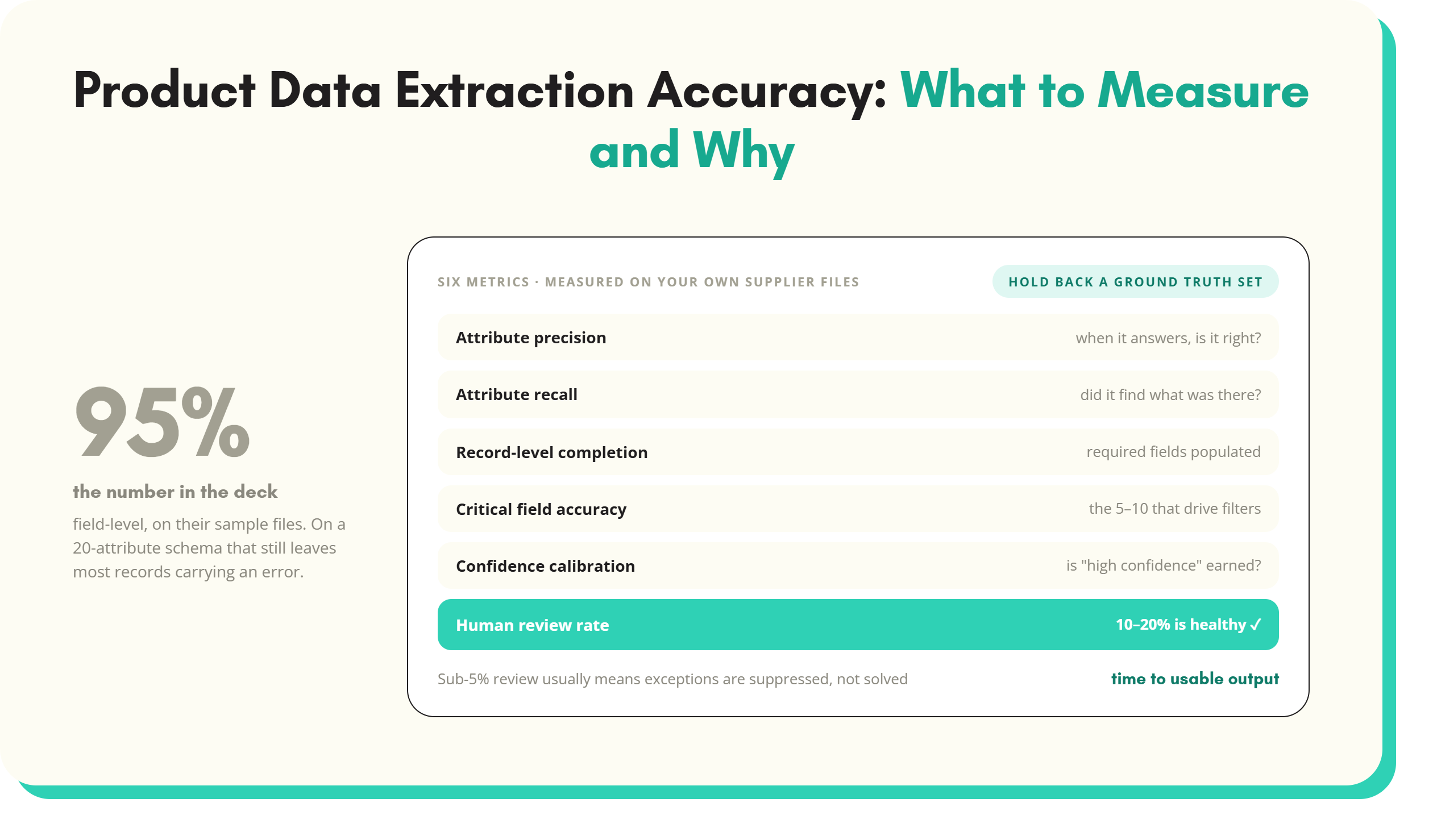
Most vendors quote a single accuracy number. Often 95%. Sometimes higher. Then you run a pilot on your real supplier data and that figure collapses.
Most vendors quote a single accuracy number. Often 95%. Sometimes higher. Then you run a pilot on your real supplier data and that figure collapses. Product data extraction accuracy is not one metric, but six, and the headline number rarely reflects what your team sees in production. Here is how to measure it in a way that maps to actual business impact, not the vendor’s best-case demo.
Why the headline accuracy number lies
The first problem with any single accuracy figure is that nobody defines it the same way. Two vendors can both claim 95% and mean entirely different things. One counts a record as accurate if the model populated any value in any field, regardless of whether the value is right. Another counts only fields where the predicted value matches a ground-truth value exactly, character for character. A third uses fuzzy matching, so "200V" and "200 volts" both count as a hit. The same supplier PDF run through three vendors will produce three different accuracy numbers, and none of them will tell you what you need to know.
Field-level vs record-level accuracy
Field-level accuracy asks: across every individual attribute extracted, how many were correct? Record-level accuracy asks: across every product, how many had every attribute correct? These two numbers can be wildly different.
A platform with 95% field-level accuracy on a 20-attribute schema produces records where, on average, one attribute per record is wrong. That sounds tolerable until you realise it means roughly 64% of records have at least one error (1 minus 0.95 to the power of 20). If the vendor only quotes the field-level number, you aren’t seeing the record-level picture.
Critical attributes vs nice-to-have attributes
Not every attribute carries equal weight. Wattage on an electrical product, dimensions on a furniture SKU, voltage on industrial components: these are the fields that customers filter on, integrations break without, and search depends on. A platform that gets the colour right but the wattage wrong is not 95% accurate to your business, even if the maths says it is.
Any honest assessment of extraction accuracy weights critical attributes higher than descriptive ones. Vendors who quote a flat average across all fields are giving you a number that’s good for marketing materials but tells you nothing about commercial risk.
Six metrics that define product data extraction accuracy
To benchmark properly, you need six numbers. Each one measures a different failure mode.
1. Attribute-level precision
When the AI says an attribute value is X, how often is X actually correct? High precision means low noise in the extracted data. A precision of 0.92 means 8% of the values the model emitted are wrong.
2. Attribute-level recall
When the source document contains an attribute value, how often does the AI find it? Recall measures completeness. A model with 0.95 precision but 0.60 recall is conservative: when it answers, it is usually right, but it leaves 40% of available data on the table.
3. Record-level completion
What percentage of required attributes are populated per record? A schema with 30 required fields and an average completion of 92% means roughly 2.4 missing fields per record. Decide your threshold for usable before you start.
4. Critical field accuracy
A weighted version of the above. Define which 5 to 10 attributes carry commercial weight (the ones that drive search, filters, and downstream integrations) and measure accuracy on those separately. This is the number that maps to revenue impact.
5. Confidence calibration
When the model says "high confidence", how often is it right? If high-confidence predictions are correct 99% of the time, you can auto-approve them and save review effort. If they are right only 85% of the time, the model is overconfident and the labels cannot be trusted.
6. Human review rate
What percentage of records need a person to check or correct them before they go live? This is the metric that turns extraction accuracy into operational reality. A platform with 90% accuracy and a 10% review rate is materially different from one with 90% accuracy and a 30% review rate, because the second hides the cost of corrections in review labour.
_-_v1_-_20260522.png)
How to benchmark a vendor on extraction accuracy
Pilots that use the vendor’s sample data prove nothing. Their model has seen those documents, the schema is tuned to them, and the ground truth was probably written by someone who built the demo. Real benchmarking looks different.
Give them your actual supplier data
Pick a stratified sample: 50 PDFs from your messiest supplier, 50 from a typical supplier, and 50 from a structured supplier (someone using BMEcat or a clean Excel template). Mix in any image-only catalogues if those exist in your pipeline. Here, vendor claims either survive or fall apart. Our guide to extracting attributes from PDFs goes deeper into why supplier variance is the real test, not the cleanest layout in the deck.
Hold out a ground-truth set
Before the vendor runs anything, have a category manager or data analyst manually extract attributes from 100 to 200 records. This is your reference set. Compare the vendor’s output field by field. Don’t let the vendor see this set in advance, otherwise the pilot reduces to overfitting.
Measure the six metrics above
Run the same data through any other shortlisted vendors. Now you have a comparable benchmark, not a vendor-controlled demo.
Count time to usable output, not extraction time
A platform that extracts in seconds but needs 30% manual review per record is slower than one that takes longer to extract but produces records that can ship as-is. Cycle time from raw supplier file to publishable record is the number that matters operationally, and it captures the cost of human review that pure extraction accuracy hides.
For a deeper view of how modern models handle the underlying problem, our pillar on AI product data extraction covers the techniques that produce these numbers and where each one breaks down.
What is realistic for product data extraction accuracy
Vendors who quote a flat 95% across all source types are either testing on clean data or being economical with the truth. Realistic ranges, based on what production platforms typically deliver, look like this:
- Clean spec sheets: 95% or higher attribute accuracy. Documents with consistent layout, labelled fields, and machine-readable text. Most modern platforms hit this comfortably
- Messy multi-supplier data: 85 to 92%. Mixed-layout PDFs, inconsistent attribute naming, partial information. The variance reflects how well the model handles supplier-specific layouts
- Free-text descriptions: 75 to 90%, depending on attribute type. Categorical attributes (colour, material) are easier than continuous ones (wattage, dimensions). Inferring numeric values from prose is the hardest case
- Image-only sources: 70 to 85%. This depends on the vision model and how clearly attributes are visible on the image. Product photos rarely show wattage; spec-sheet images often do
Pin down which of these source types dominates your supplier mix before evaluating vendors. A platform excelling on clean spec sheets may be the wrong choice if 60% of your suppliers send free-text emails and PDF brochures.
The human review question
No platform is 100% accurate and chasing that number is the wrong project. The right question is not "is it perfect?" but "how much human review does it actually need?".
For a well-implemented platform running on realistic supplier data, expect a human review rate of 10 to 20%. That covers exception cases the model flags as low confidence, conflicts between source documents, and records where the extracted value falls outside expected ranges. A vendor claiming sub-5% review rates is either running on very clean inputs or suppressing exceptions, which is worse than catching them.
SKULaunch’s product data extraction flow is built around this pattern: extract, flag exceptions, present them for review in batches. The platform side gets you to 80 to 90% straight-through. The 10 to 20% exception flow is where data managers spend their time, and it should be designed for that work rather than treated as a failure to optimise. See the full picture of how this fits together in our overview of AI product data extraction.
Key takeaways
- A single accuracy figure hides more than it reveals. Field-level and record-level accuracy on the same dataset can differ by 30 to 40 percentage points.
- The six metrics that define product data extraction accuracy are attribute precision, attribute recall, record-level completion, critical field accuracy, confidence calibration, and human review rate.
- Benchmark on your own supplier data, not the vendor’s samples. Hold out a ground-truth set the vendor never sees.
- Realistic ranges: 95% or higher on clean spec sheets, 85 to 92% on messy multi-supplier data, 75 to 90% on free-text, 70 to 85% on image-only sources.
- A 10 to 20% human review rate is normal for a good platform. Lower numbers usually mean exceptions are being suppressed, not solved.
See these numbers on your own data
Reading vendor accuracy claims is one thing. Seeing them on your real supplier files is another. Contact us so we can run a benchmark on a sample of your PDFs, spreadsheets, and images, then report precision, recall, completion, and review rate against your schema. Bring your messiest supplier file!
See it in practice: extract product data from PDF datasheets, approve AI-generated product data before it goes live and use the most trusted source when product data sources disagree.
See SKULaunch in action
Watch how we handle AI enrichment, supplier onboarding, and catalogue scale in a live 30-minute demo.


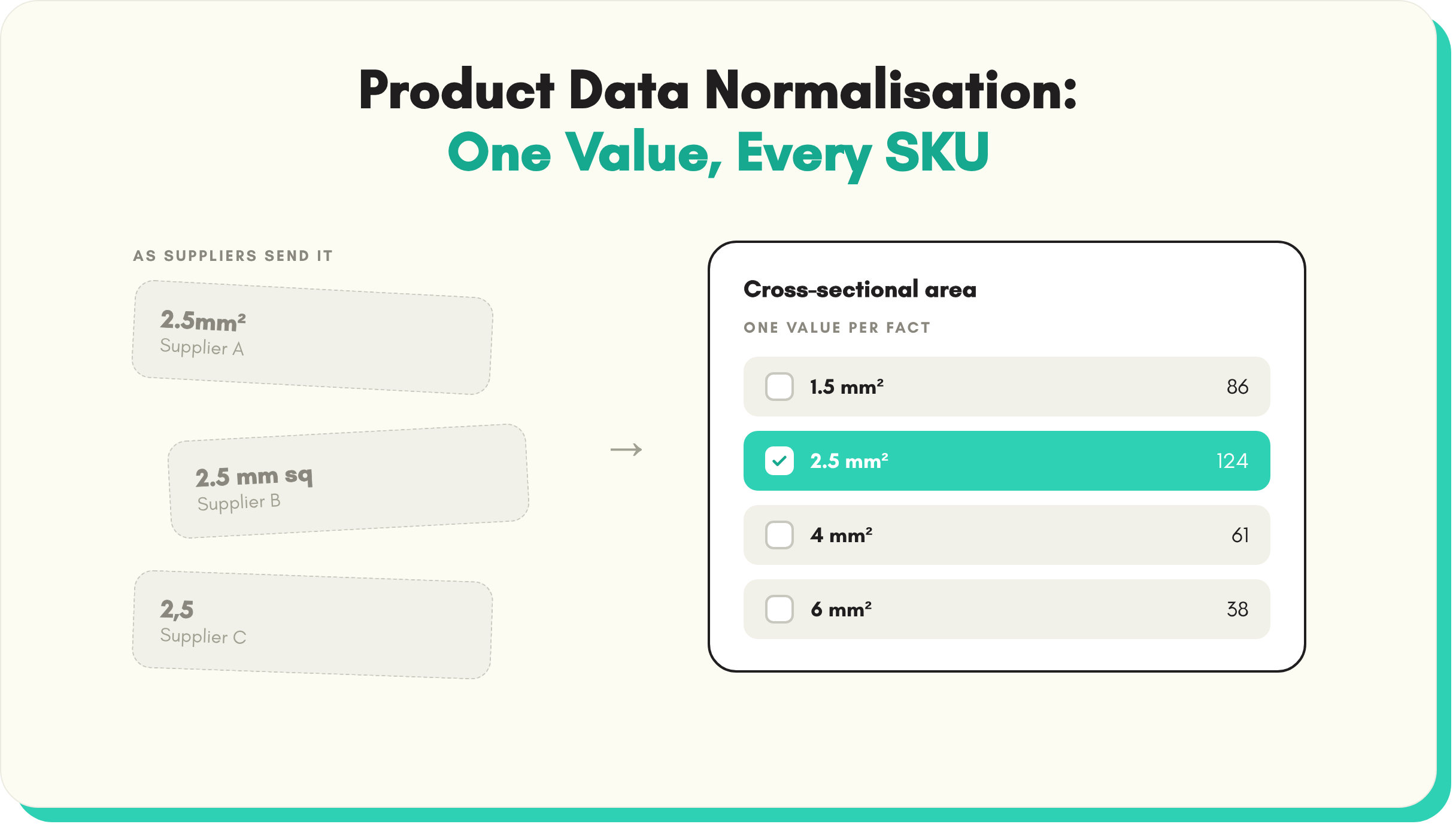

.avif)