
Everything retail, distribution, and marketplace teams need to understand about the tools and workflows that turn supplier data collection from a weeks-long nightmare into a days-long routine.
Product onboarding software collects, validates and enriches product data from your suppliers until every SKU is ready to sell. The category is also called supplier onboarding software, and in North America vendor onboarding software. It replaces the email and spreadsheet workflow with a portal: data arrives in any format, is validated at the point of entry, and is enriched to your schema before your team touches a record.
Most retailers still run this process through email and master spreadsheets. The results are predictable: low completion rates, weeks of back-and-forth, data quality problems that surface at import time, and supplier teams who never want to do it again. Modern supplier onboarding software replaces that pattern with portals, AI mapping, and validation at entry.
Supplier identity verification, commercial terms capture, product data submission, categorisation, enrichment, and activation in downstream systems. Modern platforms handle all six in one workflow rather than splitting them across multiple tools.
Onboarding speed directly affects time to sell. Time to sell directly affects revenue. A six week onboarding cycle on 200 new suppliers a year is 1,200 weeks of lost selling time across the business.
The 200-column master template, 12% completion rates, format mismatch between supplier and retailer systems, and no validation until import fails. Familiar to anyone who has tried it.
Supplier-friendly format. Pre-fill from web research. Validation at entry. AI mapping from any format the supplier sends, including PDFs, spreadsheets, URLs, and images.
Every modern supplier onboarding software platform combines three capabilities. Without all three, the workflow falls back to email and spreadsheets within months.
Replacing email-based submission with a portal that suppliers can use without training. The portal pre-fills what's already known, accepts data in whatever format the supplier sends, and shows clear progress towards completion.

.png)

Catching errors when the supplier submits data, not weeks later when import fails. Real-time validation tells suppliers what's missing or incorrect before they walk away from the screen.
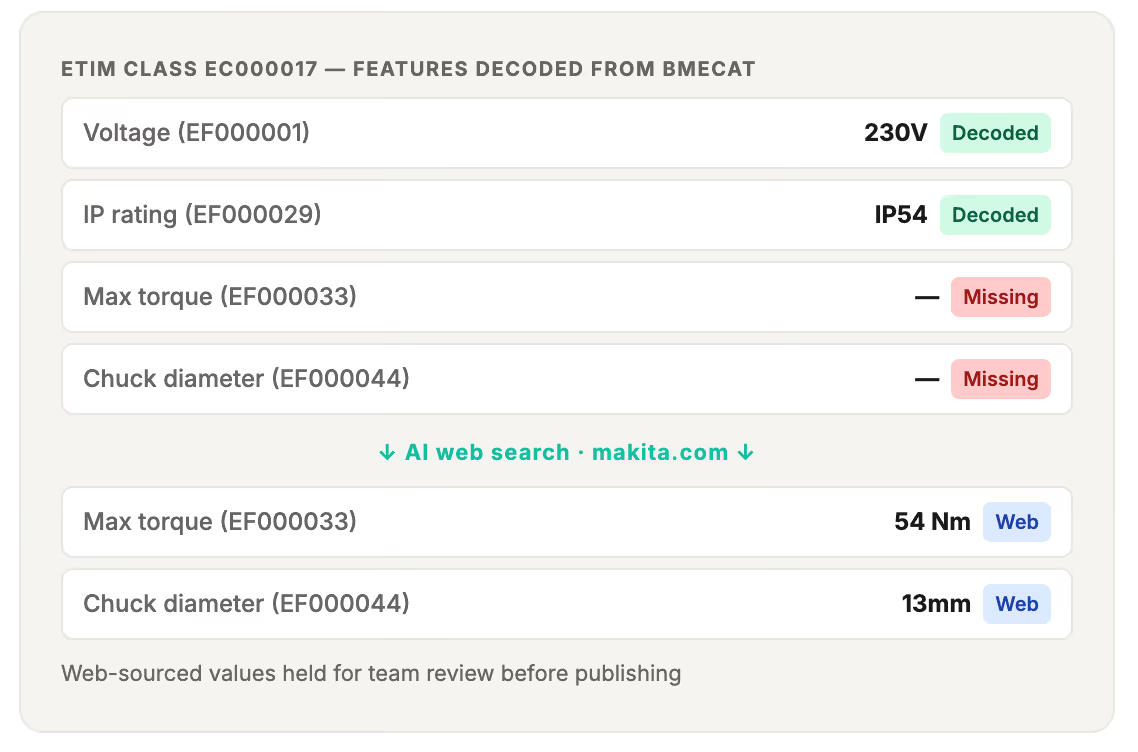
Even the best supplier portal cannot fully solve the problem alone, because suppliers send what they have, not what's required. AI enrichment fills the gaps automatically by extracting attributes from documents, images, and product URLs.
A modern onboarding workflow runs through four stages. Each stage takes minutes rather than days, and most can run unattended.
A retailer team member sends a portal invitation. The supplier receives a secure link with no login required. They click through and start submitting data within minutes.
The supplier pastes a URL, uploads a PDF, fills in a form, or sends a spreadsheet. AI maps whatever format they send into the retailer's structured schema. Pre-filled fields appear automatically based on web research and historical data.
The retailer team reviews submitted data by exception, focusing on low-confidence fields or commercial details. Most data passes through without manual touch.
Approved supplier data flows into the PIM, ecommerce platform, and marketplace listings. The supplier sees confirmation. The product goes live.
The platforms exist for any business onboarding suppliers continuously. Six audiences benefit most.
For retail businesses with continuous category expansion or marketplace seller acquisition. The volume makes manual onboarding impossible.
Industrial, electrical, and building materials distributors typically work with 200 to 500 active suppliers. Every product update is an onboarding event.
Marketplaces have to validate seller catalogues before listing. Without automated validation and enrichment, the seller queue becomes the bottleneck.
Category teams need to see comparable, structured data from multiple suppliers in one place. Email and spreadsheet submissions make comparison impossible.
Operations leaders measured on onboarding time use these platforms to cut cycle times by 5 to 10 times.
Data quality teams use entry-time validation to stop bad data from entering downstream systems, where it costs ten times more to fix.
The cost difference between manual and modern onboarding is dramatic. Most retailers underestimate it because the manual cost is hidden across multiple teams.
Cost per SKU in staff time using manual email-based onboarding.
Cost per SKU using AI-powered supplier portals.
Typical payback period on supplier onboarding software investment.

Suppliers should be able to submit data without creating accounts, downloading software, or attending training. The bar is 'less effort than the email it replaces'.
Real supplier data arrives as CSVs, Excel files, PDFs, URLs, and images. The platform should handle all of these natively, not require suppliers to translate into a fixed format.
When a supplier provides a product URL or part number, the platform should pre-fill what it can find. This cuts data entry time by 60 to 80% on common categories.
Errors should be caught at submission, not at import. Suppliers should see what's missing before they finish.
Suppliers should only see fields relevant to the categories they're submitting. Showing 200 fields when only 30 apply kills completion rates.
Both supplier and retailer should be able to see exactly how complete each submission is, what's outstanding, and what's blocking activation.
The platform should know that a power tool needs different attributes than a shirt. Generic schemas don't work for retailers with diverse catalogues.
Approved supplier data should flow into Akeneo, Shopify, Magento, Plytix, and other downstream systems without manual export and import.

Once supplier data is collected, enrichment turns it into structured records ready for any commerce channel.
Read More →How modern AI extracts structured attributes from supplier PDFs, images, and unstructured text.
Read More →How Mole Valley Farmers onboarded 35,000 SKUs in three weeks using SKULaunch.
Read More →
The AI product data platform that turns messy supplier files into sales-ready content. Run it upstream of your PIM, or run it as one.
.avif)