
Buyers now get product answers straight from AI Overviews, ChatGPT, and Perplexity, not blue links. If your product data is not structured for machines to read, you do not get surfaced.
Answer engine optimisation for products is the work of making your product data structured, complete, and machine-readable enough that AI answer engines will read it, trust it, and cite it. Where classic SEO optimised a page to rank as a blue link, AEO optimises the underlying product record so that an AI Overview, a shopping assistant, or a chat answer can pull the right attribute, the right price, and the right comparison straight out of your catalogue.
It sits downstream of clean product data, not on top of it. An answer engine cannot cite a dimension, a material, or a compatibility fact that you never structured in the first place. The pages that win in this environment are not the ones with the most keywords. They are the ones whose product records are complete, consistent, marked up with schema, and fresh. That is a data problem before it is a content problem, which is why AEO for products starts with enrichment.
SEO optimises for a ranking position and a click. AEO optimises for being the answer the engine returns, with or without a click. You can rank well and still be invisible inside an AI Overview if your product data is thin.
You cannot answer-optimise a product you have not structured. Rewriting a title does little if the attributes, specifications, and classification behind it are missing. The lever is the completeness and structure of the record.
ChatGPT, Perplexity, Gemini, and the new shopping agents all read product data to build answers. Optimising only for Google misses the engines where buyers increasingly start. The same structured data serves all of them.
Answer engines favour fresh, complete data and quietly drop stale records. A catalogue that was AEO-ready last year decays as products change, suppliers update specs, and gaps reappear. It has to be maintained, not fixed once.
Product data enrichment is often described as a single activity. It is actually three distinct operations, each requiring different inputs, different techniques, and different governance. Most teams handle them in separate tools. The leading platforms bring all three together in one pipeline.
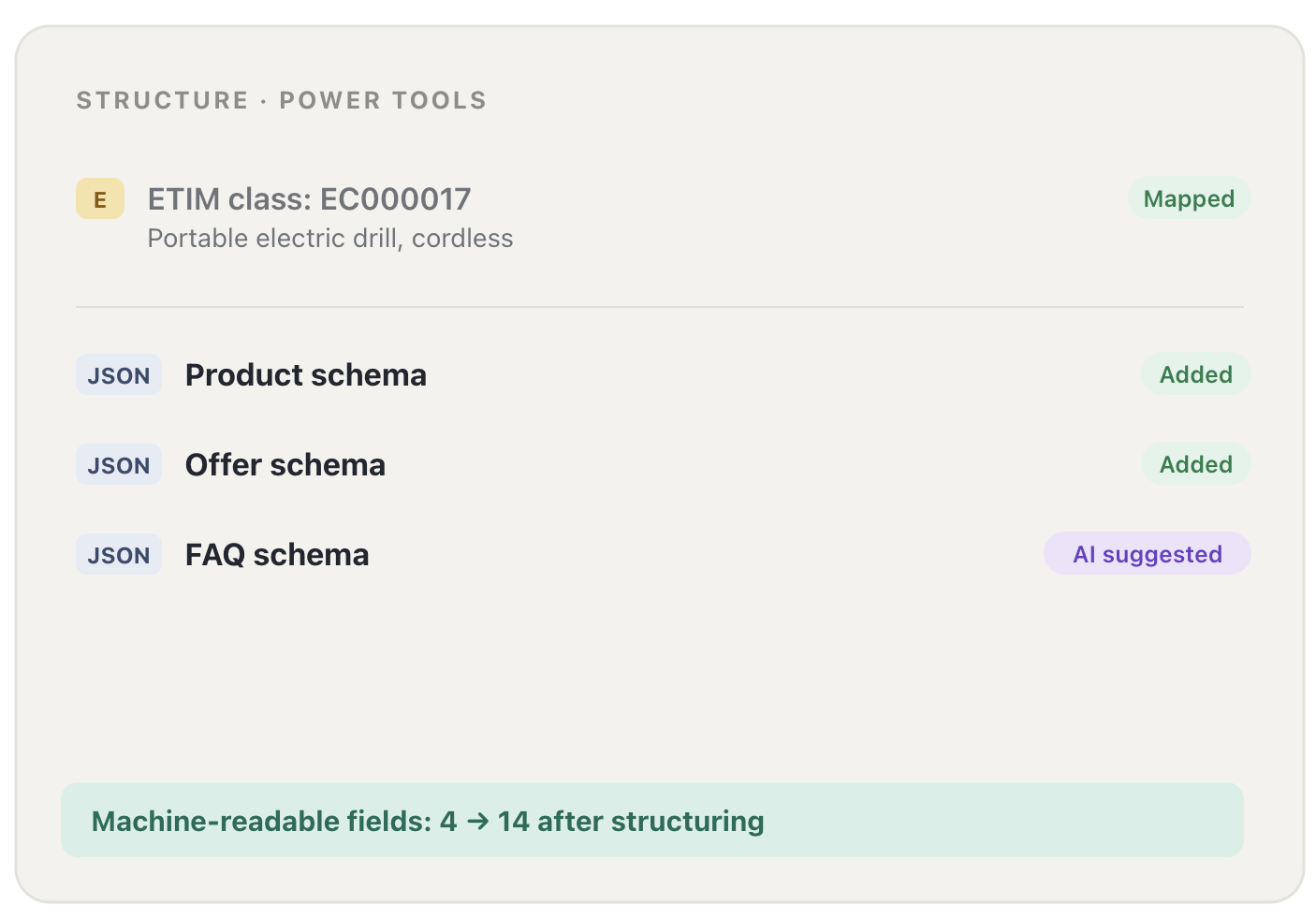
The base layer. Every product needs a machine-readable record: a consistent attribute set, a classification against a recognised taxonomy, and structured markup (Product, Offer, and FAQ schema) so engines can parse it without guessing. Without structure, an answer engine sees prose it has to interpret rather than facts it can quote. Structure is what turns a product page into a product record an engine can trust.
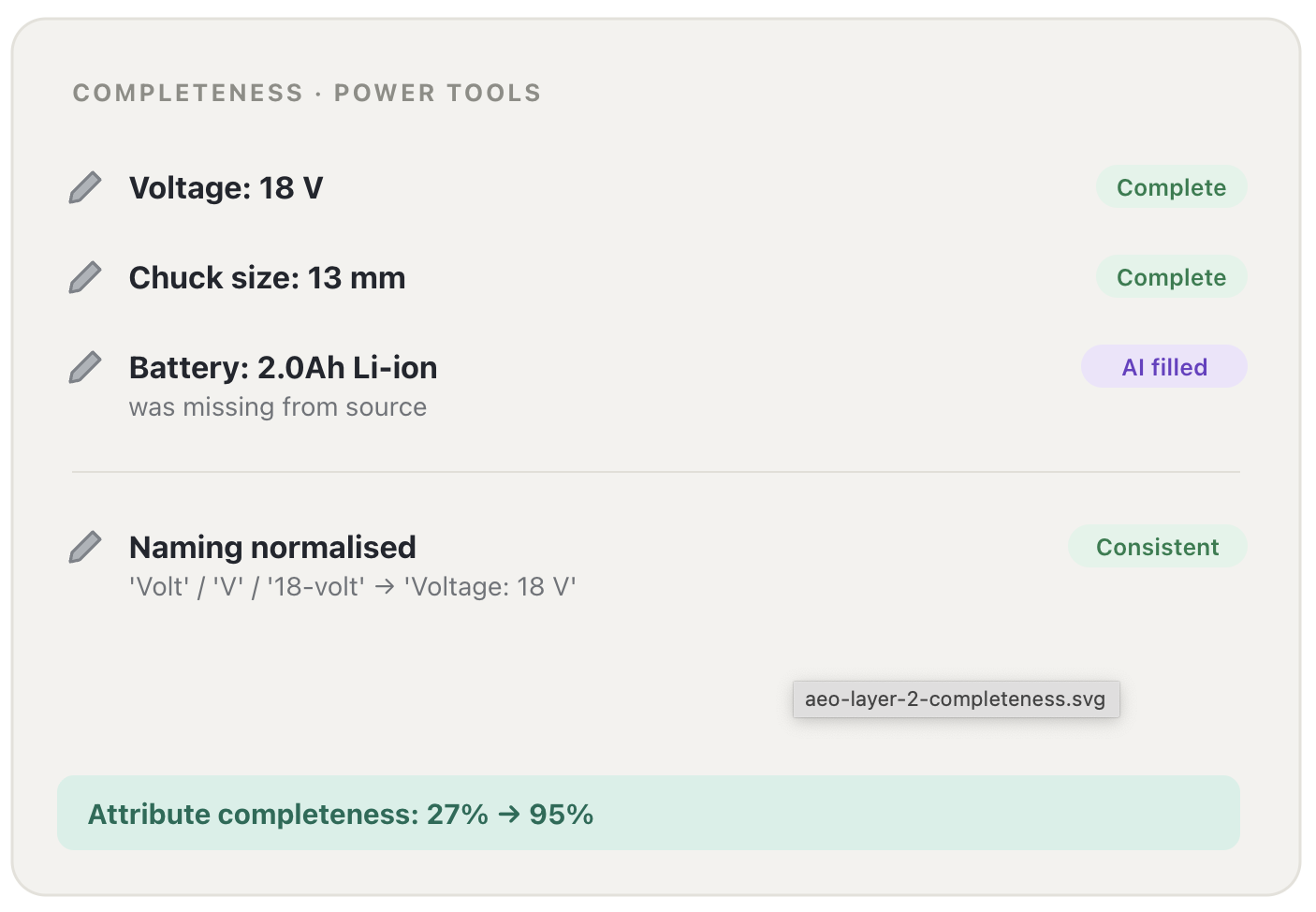
The middle layer. Answer engines reward records that are complete and consistent, and they pass over the ones with gaps. If half your catalogue is missing materials, dimensions, or compatibility data, those products simply do not get cited when a buyer asks a question that depends on those facts. Consistency matters as much as coverage: the same attribute named ten different ways across a catalogue reads as ten different things to a machine.
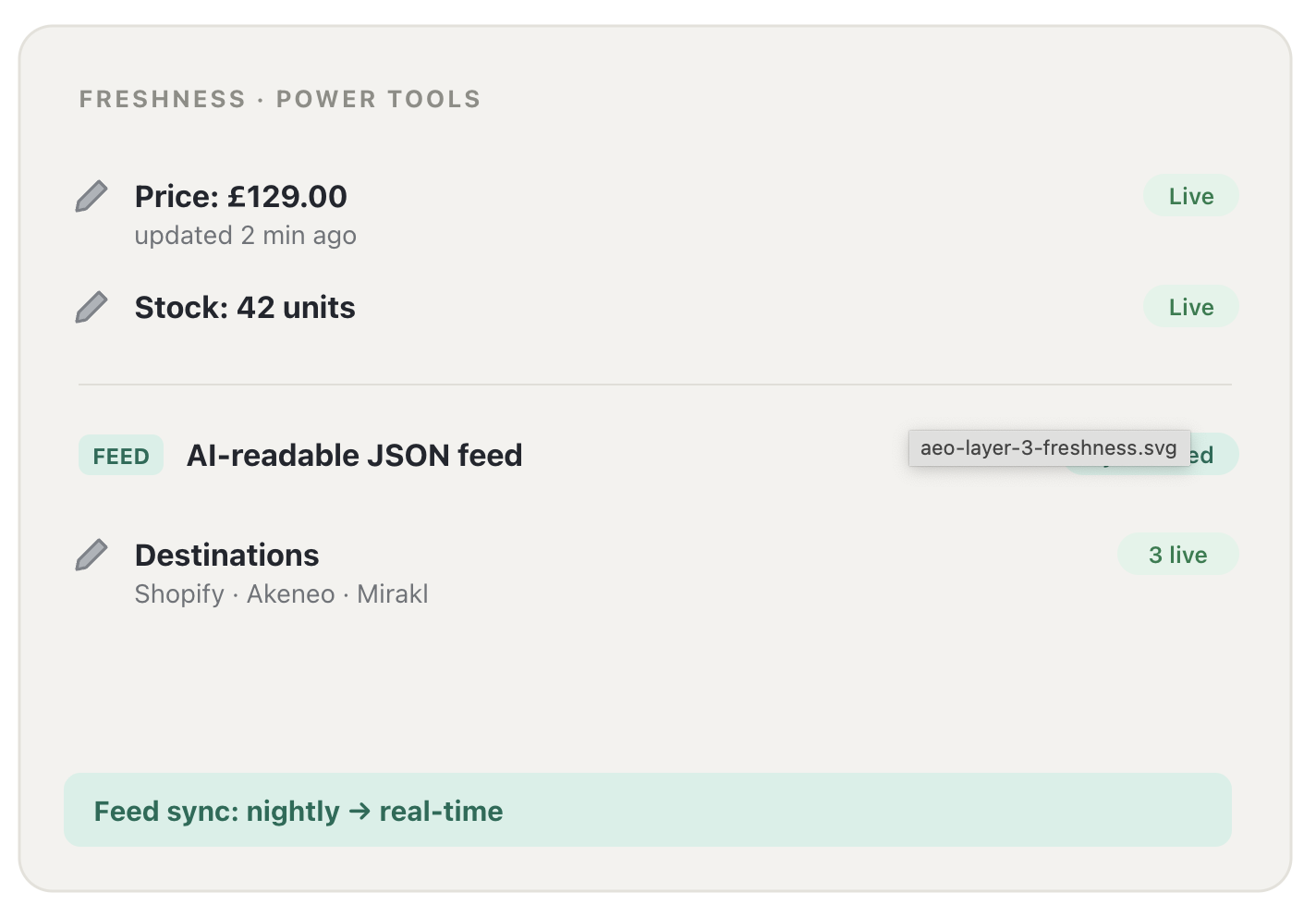
The top layer. A complete, structured record is only useful if it reaches the surfaces answer engines read, and stays current. Prices change, stock changes, ranges change. Freshness is now a ranking factor in its own right, so AEO is not a one-time publish. It is a feed that keeps your structured product data flowing to the places engines and agents look, kept accurate as the catalogue moves.
Start by checking what an answer engine can actually read in your catalogue. SKULaunch profiles your existing product data, finds the gaps in attributes, the inconsistencies in naming, and the records with no structured markup at all. You get a clear picture of which products are citable today and which are invisible.
SKULaunch reads your source data (supplier PDFs, spreadsheets, images, and URLs) and fills the gaps. It extracts structured attributes, classifies each product against your taxonomy, and produces a complete, consistent record. Every attribute is confidence-scored so review focuses on the uncertain ones, not the whole catalogue.
Clean attributes become machine-readable output. SKULaunch generates the Product, Offer, and FAQ schema that answer engines and AI Overviews look for, plus question-and-answer content per product so the engine has a direct answer to pull. This is the step that turns a complete record into a citable one.
Enriched, marked-up data flows out to the destinations that answer engines and agents read, and is kept current as prices, stock, and ranges change. Because the data is maintained continuously rather than published once, your products stay eligible to be cited rather than dropping out as they go stale.
You have seen organic clicks decline even where rankings held, because AI Overviews now answer the query before the user reaches you. AEO for products is how you stay in the answer rather than the discarded blue links, by making your catalogue the source the engine cites.
Your playbook was built for ten blue links and it no longer matches how buyers search. You need product data that earns citations in AI Overviews and chat answers, which is a data-structure problem your content team cannot solve alone.
You run a large, technical catalogue where most products depend on attributes (compatibility, dimensions, ratings) to be found. Those are exactly the facts answer engines need and exactly the ones most likely to be missing across 100,000-plus SKUs.
You own ranges that need to be discoverable when a buyer asks a specific question. If the attributes that answer that question are incomplete, your products are passed over no matter how good they are. Completeness is your visibility.
You feed product data to retailers and now to their AI surfaces too. Structured, complete data is what lets your products be represented accurately when an engine or a retailer agent assembles an answer about your category.
You onboard thousands of seller products and your discoverability depends on their data quality. AEO at the catalogue level decides whether your marketplace gets surfaced as a source when buyers ask AI engines where to buy.
The cost of poor AEO is not a line item, it is lost demand you never see. When an answer engine cannot cite your products, the buyer is served someone else and you get no impression, no click, and no chance to convert. The three numbers below frame the size of the shift and what citable data is worth.
CTR drop at position 1 with AI Overviews
Source: Ahrefs, 300,000-keyword study, 2025
CTR lift for brands cited in AI OverviewsSource: Seer Interactive, 2025
enrichment time per SKUSource: APS Industrial case study
Operations Director, UK industrial and electrical distributor
SKULaunch is used by retailers, distributors, and manufacturers across the UK, Europe, North America, and Australia. The common thread is catalogues large and technical enough that data completeness, not copywriting, decides whether products get found. That is the same data foundation answer engines reward.
Trusted by
APS Industrial
Mole Valley Farmers
RS Group
Bowens Australia
Maxiparts

Generates Product, Offer, and FAQPage structured data from your enriched records, the markup answer engines and AI Overviews look for when deciding what to cite. Output is ready to publish through your CMS or feed.
Profiles every product against the attributes its category needs and scores completeness, so you can see exactly which records are citable and which have gaps that keep them out of AI answers.
Produces structured product feeds in the formats answer engines and shopping agents consume, so your catalogue is legible to machines rather than locked inside human-facing pages.
Classifies every product against your taxonomy and recognised standards (ETIM, UNSPSC, GS1), giving engines the category context they use to match products to questions.
Generates accurate question-and-answer content per product from the structured attributes, giving answer engines a direct, citable response to common buyer questions rather than prose to interpret.
Pushes enriched, marked-up data to Akeneo, Plytix, inRiver, Shopify, Magento, and BigCommerce, so AEO-ready data lands in the systems that publish to the web.
Tracks completeness and currency over time and flags records that have gone stale or incomplete, because answer engines drop data that decays. Maintenance is built in, not bolted on.

The commercial deep-dive on SKULaunch as a product catalog enrichment platform.
Read More →Turn messy supplier data into the complete, structured records AEO depends on.
Read More →How SKULaunch handles the volume, supplier count, and technical complexity specific to B2B distribution.
Read More →
The AI product data platform that turns messy supplier files into sales-ready content. Run it upstream of your PIM, or run it as one.
.avif)