

What ETIM is, how the model is built, the MCB class in practice, the release cycle to ETIM 11.0, the formats around it, and what ETIM is not.
Updated 25 September 2026. ETIM 10.0 is the current release; ETIM 11.0 is planned for 1 December 2026. Facts below are taken from ETIM International's own publications, with dates.
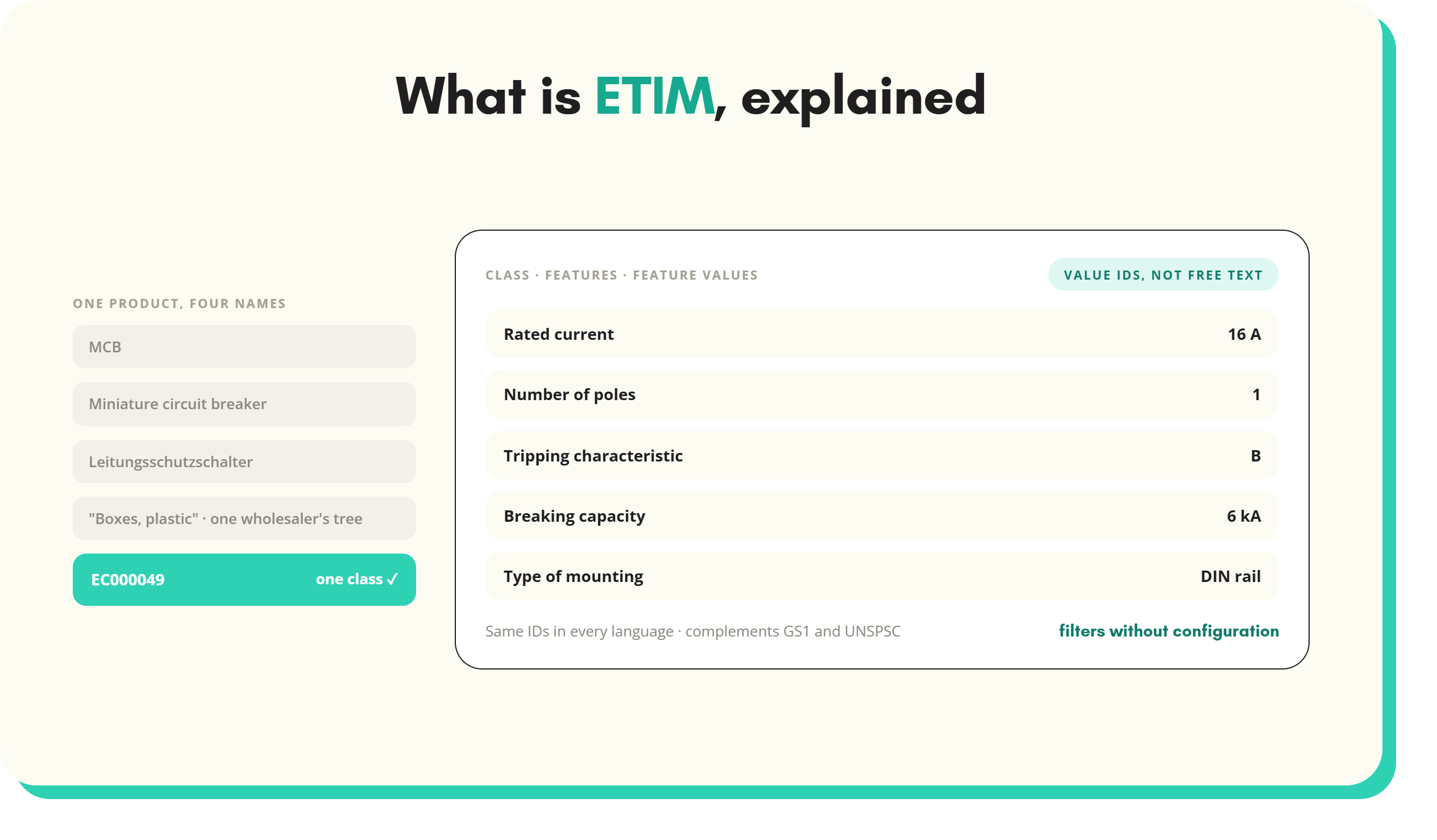
ETIM is the open classification standard for technical products. It gives manufacturers, wholesalers and installers in electrical, HVAC, plumbing, building materials, tools and shipbuilding one shared way to say what a product is and which technical features it has. Two trading partners on ETIM do not argue about whether a circuit breaker is a "miniature circuit breaker" or an "MCB": it is class EC000042 in both systems, with the same 47 features attached. This explainer covers where ETIM came from, how the model is built, what a class looks like in practice, the release cycle, the formats that carry ETIM data, who uses it, and what it is not.
What ETIM stands for, and where it came from
ETIM International no longer expands the acronym. The model began in 1991 as a Dutch electrotechnical information model, and the name has outgrown that origin: you will see "ETIM Technical Information Model" and "European Technical Information Model" in circulation, and neither is the official form. ETIM is simply the name of the standard.
The history matters because it explains the shape of the model. In 1991 the Dutch electrical installers' association started the ETIM project; the wholesalers followed. HVAC and plumbing joined in 1998, shipbuilding in 2009, building materials in 2014, and tools, hardware and site supplies in 2020, when the proficl@ss model was folded into ETIM 8.0. ETIM Germany was founded in 1999, and in 2008 the national organisations founded ETIM International, the non-profit association that now develops, maintains and publishes the model. Its official seat is in Margraten in the Netherlands.
As of the 2026 membership directory, ETIM International has member organisations from 21 countries: most of Western and Northern Europe, plus Hungary, Poland, Slovenia, and ETIM North America covering the United States, Canada and Mexico. The UK and Ireland are represented by ETIM UK and Ireland Ltd, a sector-neutral not-for-profit run by two sector leads, the EDA for electrotechnical and the BMF for HVAC, plumbing and building materials. Ten manufacturers and distributors sit alongside the national organisations as Global Industry Members, among them ABB, Schneider Electric, Siemens, Legrand, Signify, Eaton, Prysmian, Grundfos, Rexel and Sonepar. That list is a fair proxy for who has already standardised on ETIM.
What problem ETIM solves
Before ETIM, every wholesaler classified products in its own way. A junction box sat under "Enclosures, outdoor" at one and "Boxes, plastic" at another. A manufacturer with 500 distributor customers maintained, in effect, 500 catalogues, and a change to one product had to be applied 500 times in 500 schemas. Buyers comparing products across distributors could not filter on the same attribute, because the attribute had a different name, unit and value list everywhere.
ETIM removes that overhead by publishing one agreed model. Every participant uses the same class IDs, the same feature IDs and the same allowed values. On an MCB, a rated current of 16 A is feature EF000227 with the numeric value 16 wherever you are, whether the product is sold as a Leitungsschutzschalter in Germany or an MCB in Leeds. ETIM International's own summary of the division of labour with GS1 is the cleanest one available: "ETIM describes the product. GS1 identifies the product."
How the ETIM model works
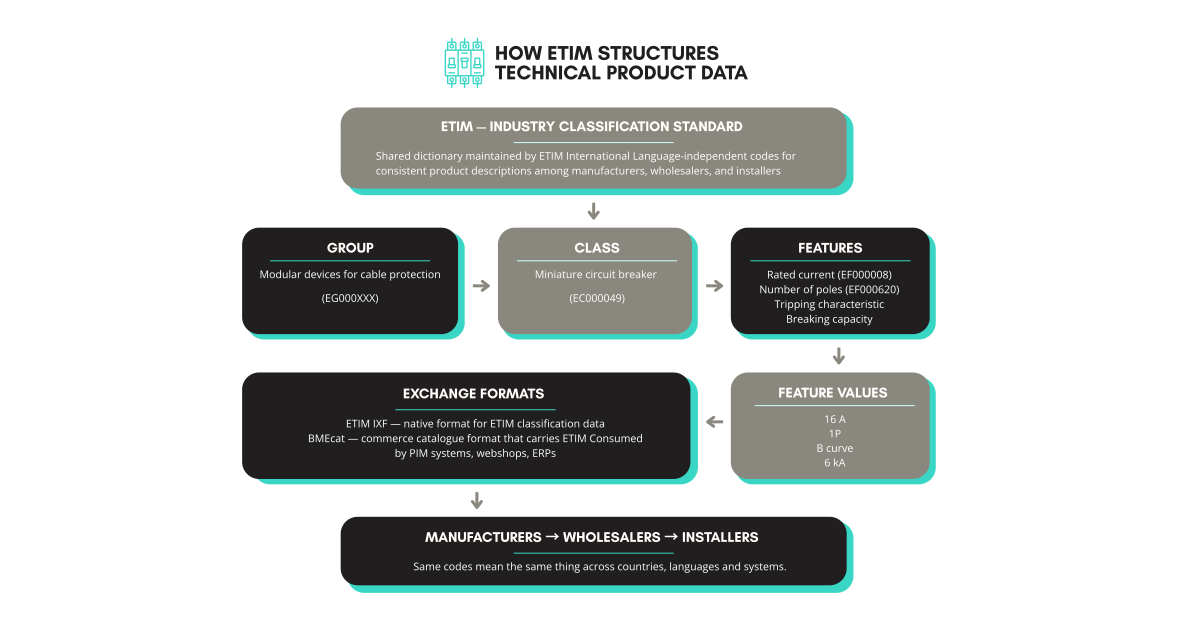
ETIM is a two-level classification model. Each product class belongs to exactly one product group, and each class carries its own list of features, values and units. The building blocks, with the ID prefixes you will see in every file:
- Product groups (EG) collect related classes, for example EG000020, "Circuit breakers and fuses". Groups are a navigation aid, not a hierarchy you classify against.
- Product classes (EC) are the unit of classification. A product is assigned to one class, for example EC000042, "Miniature circuit breaker (MCB)". ETIM 10.0 contains more than 5,600 classes.
- Features (EF) are the attributes attached to a class. Each feature has a type: alphanumeric (a value from a list), logical (yes or no), numeric (a number with a unit) or range (two numbers with a unit). A feature ID is reused wherever the same attribute appears, so an attribute like rated current keeps one EF code across the classes that use it.
- Values (EV) are the allowed entries for alphanumeric features. Values are coded too, so a value translated into Polish points to the same EV code as the English original.
- Units (EU) are fixed per feature. That is why ETIM unit codes normally do not travel in data files: the receiver derives the unit from the feature definition.
- Synonyms are alternative names attached to a class to make it findable. EC000042 carries "MCB", "Mini circuit breaker", "Over current switch" and a handful of trade names. Synonyms have no ID.
- Feature groups (EFG) arrived in ETIM 10.0. They bundle a class's features under headings, which is why 10.0 needed a new release file format.
The model is published in 17 languages. Because the IDs are the same in every language, classification done once in English is valid in Swedish, Italian or French without re-mapping. Translation is a labels problem, not a data problem, which is the whole point.
An ETIM class in practice: the miniature circuit breaker
Take a single-pole 16 A type B MCB, the kind found in a domestic consumer unit. In ETIM 10.0 it is classified as EC000042, "Miniature circuit breaker (MCB)", in group EG000020. The class has 47 features. A category manager populating the record captures, among others:
- Rated current (A), EF000227, numeric: 16
- Number of poles (total), EF008618, numeric: 1
- Tripping characteristic (type/curve), EF000889, alphanumeric: B
- Rated short-circuit breaking capacity Icn at 230 V AC (kA), EF027114, numeric: 6
- Width in number of modular spacings, EF002950, numeric: 1
Two things are worth noticing. First, every value is either a number against a fixed unit or a coded list entry, never free text, so a search engine sitting on this data can offer filters on rated current, breaking capacity and tripping curve with no per-product configuration, and a procurement system can compare three manufacturers' MCBs without normalising attribute names. Second, the feature list is what the class defines it to be. There is no "mounting method" feature on EC000042; width in modular spacings is there instead. If your internal schema has an attribute the class does not, that attribute either maps to nothing or needs a change request.
ETIM releases and the two-year cycle
ETIM is versioned. Each major release adds classes and features, deprecates others, and is what a receiver means when they ask which ETIM you are on.
| Release | Date | What changed |
|---|---|---|
| ETIM 7.0 | September 2017 | The working version for most of the late 2010s |
| ETIM 8.0 | 3 November 2020 | 8,780 change requests processed, 690 new classes, tools sector absorbed |
| ETIM 9.0 | 5 December 2022 | 4,879 change requests, 203 new classes |
| ETIM 10.0 | 10 December 2024 | 5,264 change requests, 119 new classes, feature groups introduced, IXF 3.1 |
| ETIM 11.0 | Planned 1 December 2026 | Change request deadline was 30 June 2026; beta in November 2026 |
The gap between releases was three years until October 2021, when the ETIM International board and Standardization Committee decided that was too long and moved to two years. Between major releases there is the ETIM Dynamic release: an export of the full current model plus every class already approved and marked ready to publish, tagged with change codes. It is refreshed continuously, so a supplier who needs a class that was approved in March does not wait until December.
Countries and companies adopt new versions on their own timelines, and that is where the real work is. A wholesaler on ETIM 9 trading with a supplier on ETIM 10 needs a mapping between the two, because class and feature codes move between versions. The changes between ETIM 8 and 9 are a good illustration of how much a single step can move, and the same pattern will repeat with 11.0.
The formats and tools around ETIM
ETIM is a classification, not a file format, and the vocabulary around it trips people up. Four things sit next to the model:
ETIM IXF is the XML format in which ETIM International publishes the classification model itself. When you download ETIM 10.0, you get IXF (currently version 3.1), plus Excel and CSV exports. IXF carries the model, never your product data.
ETIM xChange is the JSON format for exchanging product data classified in ETIM, and the first exchange standard fully controlled by ETIM International. Version 1.0 was released on 19 February 2024 and version 2.0 on 27 November 2025, adding environmental and life-cycle fields, packaging data for the EU packaging regulation and serial number support. ETIM International now recommends xChange where it used to recommend BMEcat.
BMEcat is the XML catalogue format from BME e.V. that has carried ETIM data for two decades and still does. ETIM International maintains an ETIM BMEcat Guideline for how classes and features sit inside a BMEcat file; the current revision is 5.0.2, dated 12 December 2024, and no successor is planned because xChange is the recommended route. The installed base of BMEcat importers is large enough that you will be asked for it for years. What is BMEcat covers the versions and the four elements that carry ETIM inside it.
ETIM MC, the Modelling Classes, extends the classification with parameters for representing products as 3D geometric objects, developed around level of detail 200 for BIM and other geometry use cases. It covers 360 classes. Guidelines version 2.0 was released on 9 December 2025, and from ETIM 11 onwards MC moves to the same two-year release cycle as the classification, with the next MC release expected in early 2027.
The tooling is the Classification Management Tool (CMT), the online database where members raise and process change requests; the ETIM Viewer, a free browser front end to every class and feature with no login; and the ETIM API for direct access to the model. Validation tools for xChange files and certification for BMEcat files are for members.
Who uses ETIM, and how you get it
ETIM covers five sectors: electrotechnical, HVAC and plumbing, building materials, shipbuilding, and tools, hardware and site supplies. Electrical wholesale is still the largest user community and the one where ETIM is closest to a condition of trade: most large electrical manufacturers maintain ETIM-classified data as a default, and electrical wholesalers expect it in every supplier feed.
Companies join through their national organisation rather than ETIM International directly. Manufacturers, wholesalers, contractors and software vendors become members of ETIM UK and Ireland, ETIM Deutschland, ETIM North America and so on, paying a basic fee plus sector fees. The model itself is more open than people assume: the English release files, and a handful of other languages, can be downloaded from ETIM International without logging in, and the Viewer is free. Membership buys the remaining languages, the change request process, the validation tools and a vote in what goes into the next release.
What membership does not buy is classified data. Classifying a 40,000-line catalogue against the right classes, populating typed feature values from supplier datasheets and keeping it current across releases is the actual project, and the reason ETIM data mapping software exists as a category. How to implement ETIM walks through the sequence: scope, pilot, classification, feature population, validation and governance.
What ETIM is not
Most confusion about ETIM comes from mistaking it for one of its neighbours.
It is not a file format. ETIM is the vocabulary. IXF carries the vocabulary, xChange and BMEcat carry product data expressed in it. "Send me your ETIM" is a request for a data file in one of those formats, and you should ask which.
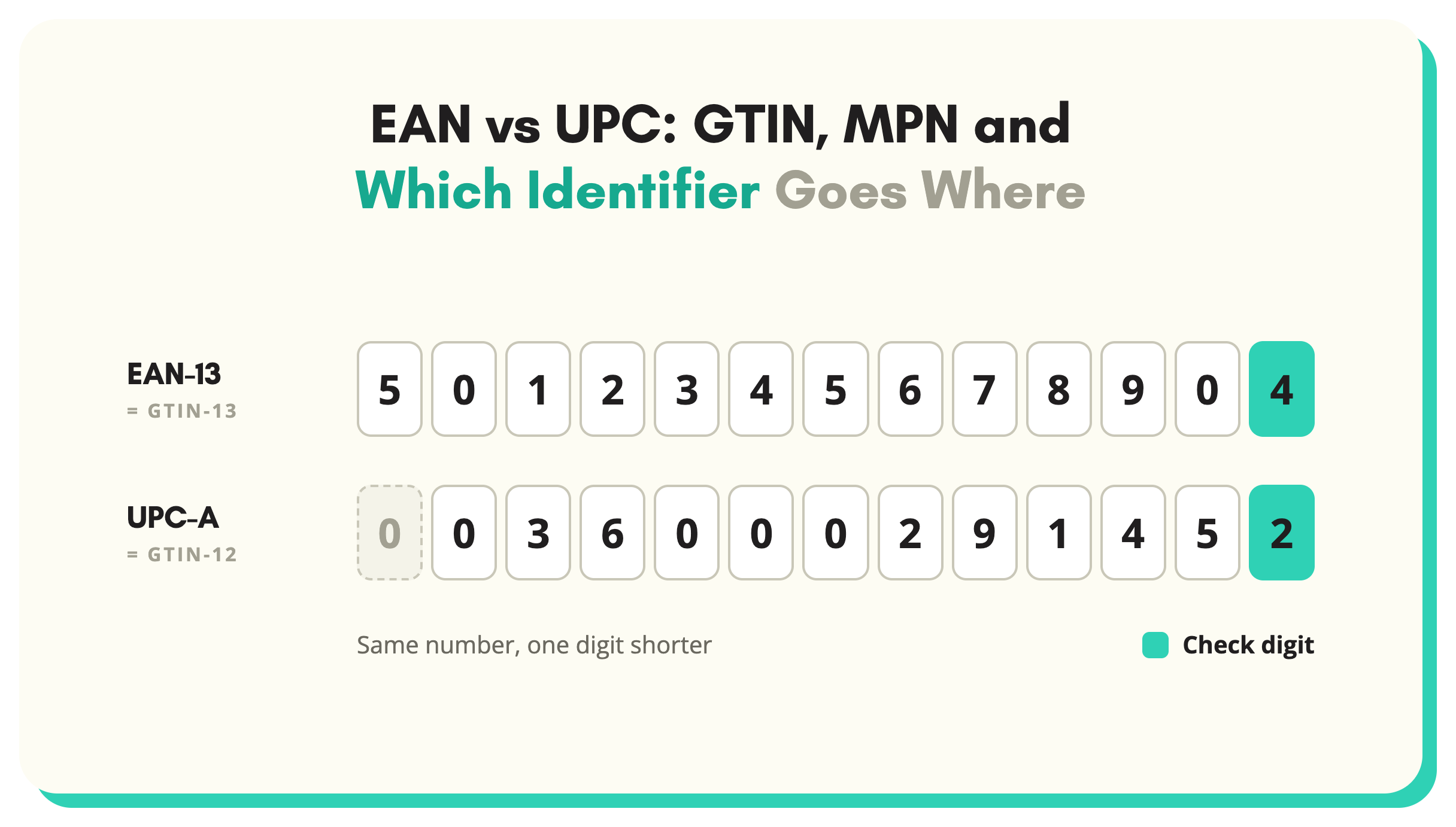
It is not an identifier. ETIM says what a product is; a GTIN says which product it is. A record carries both, and the identifier guide covers how to store them.
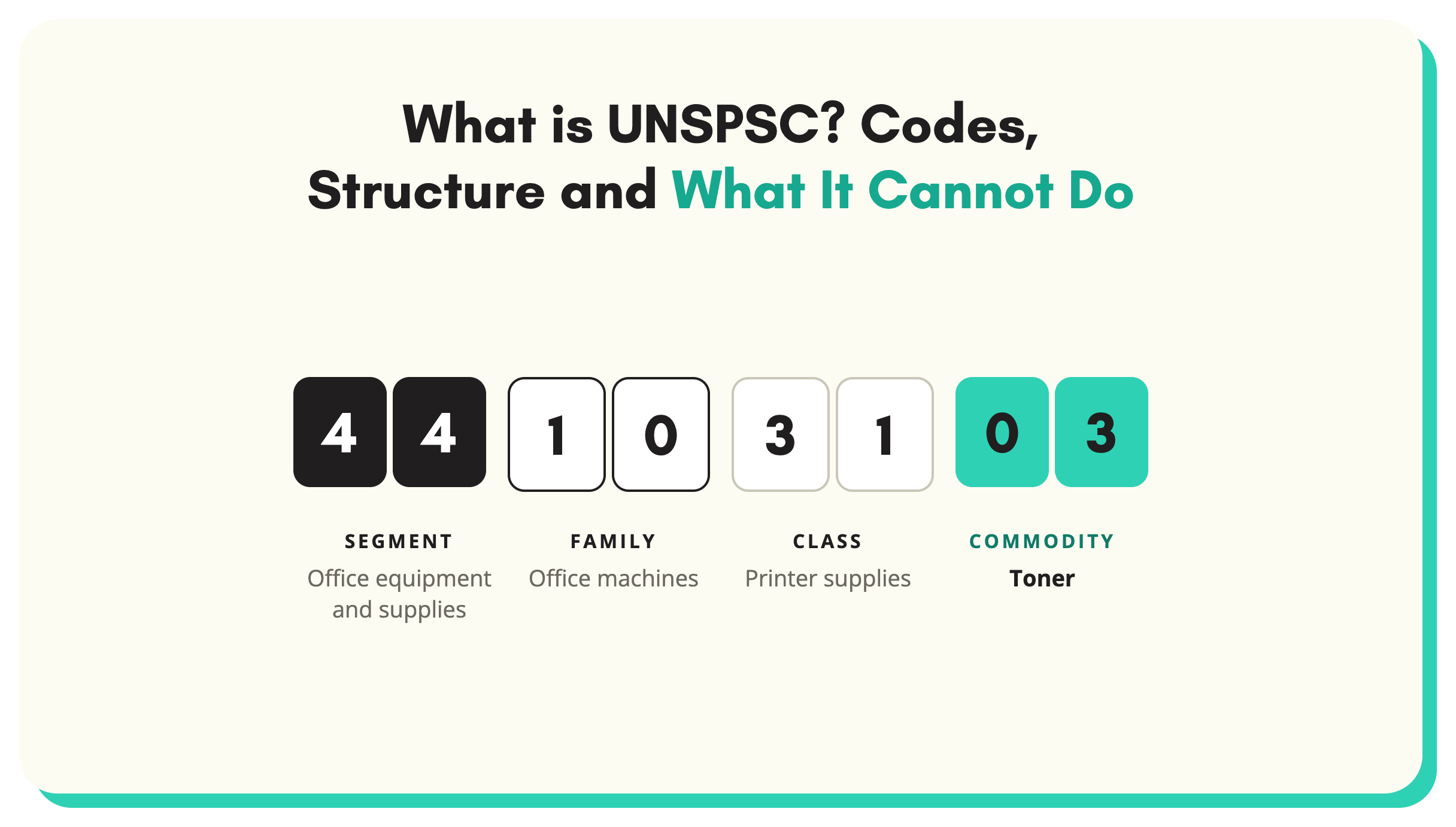
It is not UNSPSC or ECLASS. UNSPSC is a procurement commodity code with no attributes. ECLASS is a classification with attributes, like ETIM, and the two initiatives cooperate: ETIM Germany maintains a mapping table from ETIM 10.0 to ECLASS 15.0. A product can carry ETIM, ECLASS, UNSPSC and a GTIN without conflict.
It is not the whole product record. ETIM covers technical features. Marketing copy, images, documents, prices, packaging and logistics data live elsewhere in the record and travel in the exchange format, not in the classification.
It is not automatically compatible across versions. An ETIM 9 file is not an ETIM 10 file. Store the release alongside the class on every product and be able to output against more than one.
It is not compliance on its own. Receivers narrow the standard with their own profiles: which features are mandatory, which release, which format version. A perfectly classified catalogue can still fail the wholesaler's import. Get the receiver's profile before you build.
ETIM and the digital product passport
The EU digital product passport is the reason ETIM is being talked about outside the trades that already use it. The passport regulation does not define how product information should be structured, and ETIM International's position paper, updated in August 2026, argues that the existing ecosystem already does: ETIM for the technical description, GS1 for identification, and xChange as the exchange format for classification, sustainability and commercial data together. The environmental and life-cycle fields added in xChange 2.0 are the practical expression of that position. If your products fall under one of the passport's product groups, the attribute work you do for ETIM is the same work the passport will draw on; the digital product passport guide has the dated timeline.
Key takeaways
- ETIM is the open classification standard for technical products, run by ETIM International, a non-profit with member organisations in 21 countries. It started in Dutch electrical installation in 1991 and now covers five sectors.
- The model is two levels: product groups (EG) hold product classes (EC), and each class defines its own features (EF) with typed values (EV) and fixed units (EU). ETIM 10.0 has more than 5,600 classes in 17 languages, and the IDs are the same in every language.
- ETIM 10.0, released 10 December 2024, is current. ETIM 11.0 is planned for 1 December 2026. Releases are now every two years, with a continuously updated Dynamic release in between.
- ETIM is not a file format. IXF distributes the model; xChange (JSON, 2.0 since November 2025) and BMEcat (with guideline 5.0.2) carry product data classified in it.
- Membership runs through national organisations such as ETIM UK and Ireland. The English model files and the Viewer are free.
- The cost is never the standard. It is classifying the catalogue, populating typed feature values, and keeping both current across releases and receiver profiles.
Where to go next
If you are planning a first rollout, how to implement ETIM covers scoping, the pilot and governance. If you already have ETIM data and the problem is keeping it complete across suppliers and releases, that is the work ETIM and standards mapping software is built to absorb: classifying products to the right class, extracting feature values from supplier PDFs, and generating BMEcat output per receiver profile.
Talk to SKULaunch
SKULaunch reads supplier PDFs, spreadsheets and websites, maps each product to its ETIM class, populates the typed feature values with a confidence score against every suggestion, and pushes the result to your PIM, storefront or wholesaler feed. Book a demo to see it run on your own catalogue.
See it in practice: ETIM classification for your whole catalogue, import ETIM data from suppliers without parsing XML and map products to GS1 GPC classification.
See SKULaunch in action
Watch how we handle AI enrichment, supplier onboarding, and catalogue scale in a live 30-minute demo.

.avif)