.avif)

Sales Layer is a European PIM used by manufacturers, distributors and retailers to centralise and distribute product content. SKULaunch solves a different part of the problem: collecting, structuring and enriching supplier data before it reaches a PIM. This page walks through where each platform leads and when the two work together.
Sales Layer is a well-regarded PIM with real strengths: a clean, centralised catalogue, a wide set of channel connectors, quality and completeness reporting, and a reputation for being fast to get live for a PIM. For teams that need one source of truth feeding many channels, it is a strong choice.
What sends distributors looking for alternatives is usually the work upstream of the PIM. A PIM is at its best when clean, structured data flows in. For a distributor with 200 suppliers sending spreadsheets, PDFs and price lists in 200 formats, getting to that clean feed is a project in itself. That intake and enrichment work is the job SKULaunch was built for.
Operations Director, UK industrial and electrical distributor
Before comparing features, compare jobs. SKULaunch and Sales Layer solve neighbouring problems, and for some distributors the right answer is both.
Right for you if...

.avif)
Right for you if...
.avif)
Five dimensions that show how the platforms differ, and where they meet in the middle.
Sales Layer brings product data in through imports, feeds, and its API, and gives your team a centralised catalogue to organise it once it arrives. As a PIM, it assumes your team owns the import and mapping step.
Built specifically for distributor intake. Suppliers receive one magic link. AI pre-fills the portal from the supplier's own product website, so suppliers confirm rather than type. 200 different supplier formats normalise to one schema automatically. No cleaning rules to write.
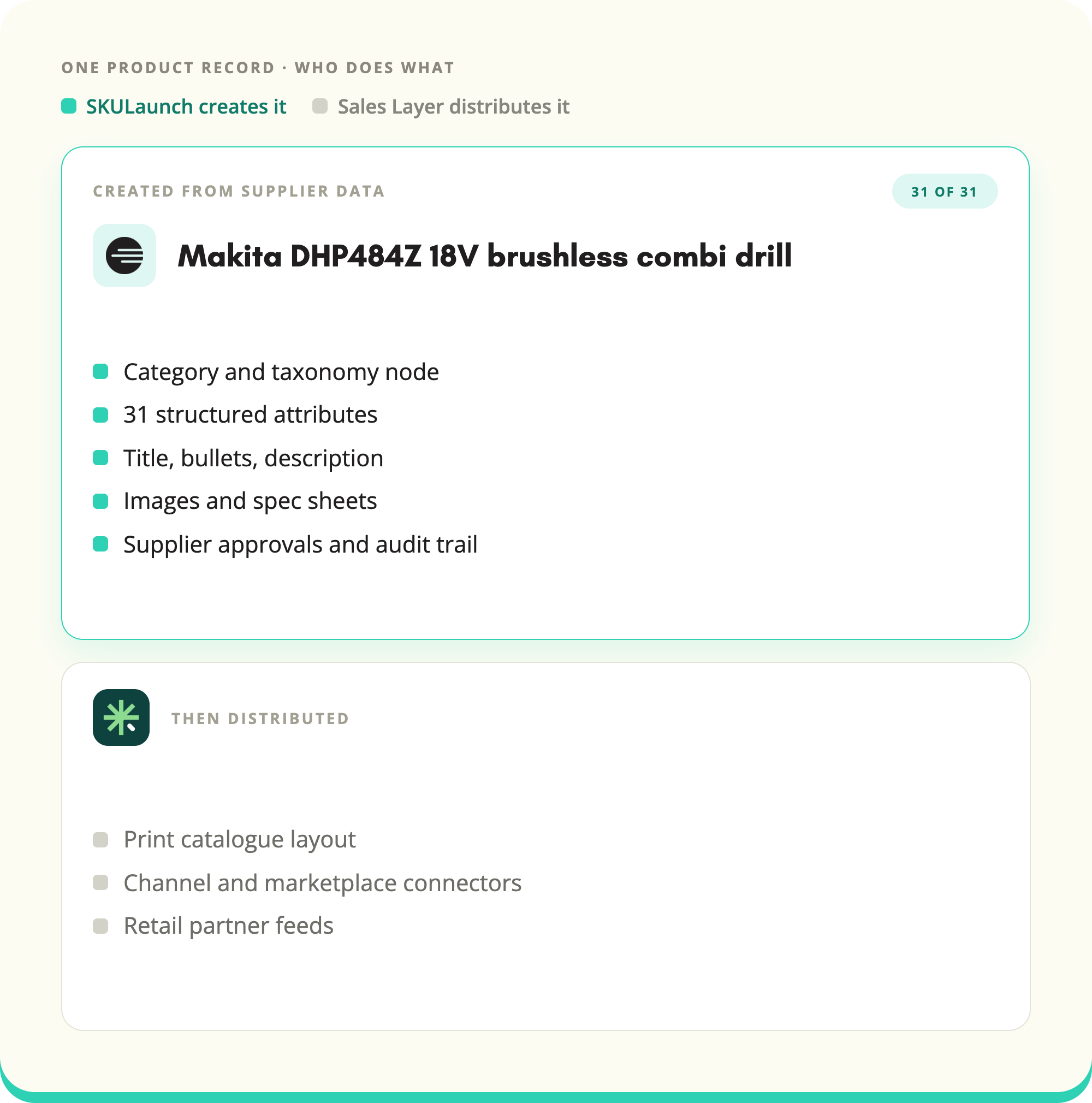
Implication: the two platforms meet at the import step. Sales Layer organises what arrives. SKULaunch makes sure what arrives is complete, structured and validated, then pushes it into your PIM automatically.
Sales Layer has a reputation for getting live quickly for a PIM, with guided onboarding and ready-made connectors that shorten the path from empty workspace to published catalogue.
Most distributors have their first supplier portal live within a day. The enrichment pipeline runs its first batch within 48 hours of setup. No SI partner required. Your team is reviewing enriched data by the end of the first week, not the end of the first quarter.
Implication: if you have an urgent data problem, a range launch, a PIM go-live with empty fields, or a backlog of unenriched SKUs, time to value is the number to test first.
Sales Layer handles structured catalogues well for manufacturers and distributors, with flexible attribute models and quality reporting that shows where records fall short.
Built with technical distributor catalogues as a primary use case. Ingests ETIM, BMEcat, and GS1 natively with a 95% attribute match rate. Extracts voltage, IP rating, thread standard, cable cross-section, and other technical attributes from supplier PDFs and spec sheets automatically.
Implication: for electrical, industrial, HVAC, or technical categories where attribute precision drives search and filter, native ETIM and BMEcat handling is the capability to look for, and it is core to SKULaunch.
Sales Layer pricing is structured for mid-market teams and tailored to catalogue size and connector needs, with plans that scale as your channel footprint grows.
Transparent tiered pricing designed for mid-market distributors. No SI costs. No module-based upselling for core supplier onboarding functionality. Pricing is published on the website, so you can evaluate the economics before a sales call.
Implication: match the pricing model to the size of your team and catalogue. SKULaunch publishes its pricing and is built around distributors with one to five people managing product data.
Sales Layer gives teams strong in-PIM tools for improving records: bulk editing, quality scoring, and completeness tracking that keep a growing catalogue consistent.
The enrichment pipeline runs overnight across your entire catalogue, confidence-scoring every extraction and routing exceptions to your team the next morning. 80,000 SKUs enriched in one run. Completeness from 52% to 93%. The AI keeps running as new supplier data arrives.
Implication: if you have a backlog of enrichment work, a catalogue at 50% completeness that needs to reach 90% or more, SKULaunch clears the backlog and your PIM keeps the results organised.
An honest comparison. The ticks reflect two platforms built for different layers of the product data stack.

Sales Layer ticks reflect genuine strengths: it is a capable PIM with connectors and quality tooling built in. SKULaunch is built to feed the PIM layer, not replace it.
This is the section most comparison pages skip. We're including it because recommending the wrong platform helps no one.
Choose Sales Layer as your PIM if you need a centralised catalogue feeding many channels, ready-made connectors matter to your team, and you want a PIM with a reputation for getting live quickly. If your supplier data arrives reasonably clean, a strong PIM may be all you need.
Use both together if the PIM layer is right but the data feeding it is not. SKULaunch sits upstream, collects supplier submissions through the portal, enriches and validates them, and pushes approved records into your PIM. The PIM stays the system of record. Your team stops cleaning spreadsheets.
SKULaunch customers are B2B distributors and retailers managing large supplier networks, some with an established PIM in place, some without one at all.
Trusted by
APS Industrial
Mole Valley Farmers
RS Group
Bowens Australia
Maxiparts
GSF Car Parts
Operations Director, UK industrial and electrical distributor
The PIM is live, the team is trained, but the catalogue is incomplete because supplier data still arrives by email and spreadsheet. SKULaunch enriches the existing catalogue in a batch run and routes new supplier submissions straight into the right fields. The PIM fills up without extra headcount.
Distributors with a backlog, a catalogue that is 50% complete and needs to reach 90% or more before a digital channel launch, use the enrichment pipeline to process tens of thousands of SKUs overnight. AI extracts technical attributes, scores confidence on every extraction, and routes exceptions to your team for morning review.
Electrical and industrial distributors working with ETIM-classified product data use SKULaunch to ingest ETIM feeds and map them to their internal schema automatically. Suppliers who do not provide ETIM-formatted data can still feed an ETIM-aligned catalogue: SKULaunch extracts the relevant technical attributes from whatever the supplier sends.
When a supplier launches a new range, the distributor who gets it live first takes the early orders. SKULaunch gives distributors that window: from supplier invite sent to enriched, validated data in your PIM in under 48 hours.
One link per supplier. AI pre-fills from their own website. Supplier confirms. Validated, structured data lands in your review queue. Completion rates go from 12% to 80%+.
Entire catalogue enriched overnight. 80,000 SKUs. Confidence-scored. Your team reviews the exceptions, not every record. Completeness from 52% to 93% in a single run.
ETIM, BMEcat, GS1, automatically mapped to your schema. 95% attribute match rate. No manual mapping required. Gaps filled by AI from supplier content.
Nothing goes live without your sign-off. Every submission routes through your review queue. Full audit trail of who approved what, when, and what changed.
200 supplier formats normalised to one schema automatically. No cleaning rules to write. The supplier calls it operating voltage, you call it voltage, and AI resolves it without configuration.
Real-time completeness scoring by supplier, category, and attribute. Flags gaps. Controls publishing. You see exactly where the data gaps are before they reach your customers.


The AI product data platform that turns messy supplier files into sales-ready content. Run it upstream of your PIM, or run it as one.
.avif)