

Here is what each system actually does, where they overlap, and how to work out which one you need first.
PIM, DAM and MDM get confused more than any other acronyms when buying product data management tools. They sound similar, vendors blur the boundaries, and a single sales call rarely makes the difference clear. The PIM vs DAM vs MDM question is crucial because the wrong choice is expensive. You spend six figures, run a year-long implementation, and still have the problem you started with.
Here is what each system actually does, where they overlap, and how to work out which one you need first.
PIM, DAM and MDM: the three systems, defined
All three manage some form of enterprise data, but they solve different problems. If the terms here are unfamiliar, the product data glossary covers them and the rest.
PIM (Product Information Management)
A PIM manages product data: attributes, descriptions, variants, categorisation, and the rules that keep them consistent. It is the system of record for what a product is, its dimensions, its materials, its compatibility, its selling copy. A PIM exists to get clean, complete product records out to the channels that sell them.
DAM (Digital Asset Management)
A DAM manages files:
- Images
- Videos
- Packaging shots
- Brand assets
- The metadata that lets people find them
It is the library, not the catalogue. A DAM exists so the right image, in the right format, reaches the right place without someone digging through a shared drive full of folders called Final_v3_USE_THIS.
MDM (Master Data Management)
An MDM governs master records across every data domain in the business:
- Customers
- Suppliers
- Products
- Locations
And more. It is less a working tool and more a referee. An MDM exists so that when three systems disagree about a supplier’s address or a product’s identifier, there is a single authoritative answer.
What each system covers
The quickest way to keep them apart is by what sits inside each one.
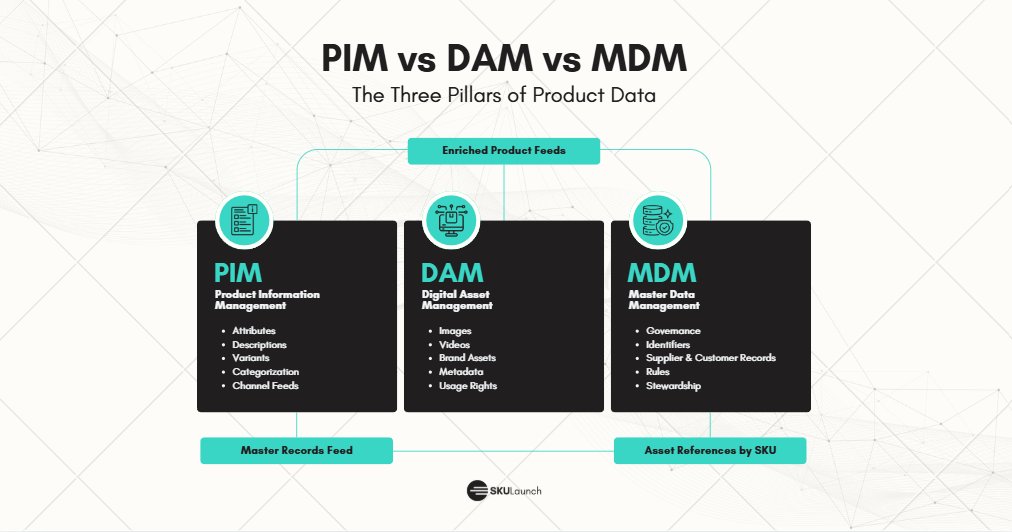
PIM covers product attributes, descriptions, variant structures, category trees, and syndication to sales channels. It holds the text and numbers that describe a product, plus references to where the images live.
DAM covers the image and video assets themselves: the actual files, their renditions, usage rights, and asset-level metadata. It holds the binary files, not the product records.
MDM covers the master versions of records that several systems share, plus the governance around them:
- Matching
- De-duplication
- Survivorship rules
- Stewardship workflows
It holds the single source of truth for identifiers and core fields, and it usually owns the product master that a PIM then consumes.
Where they overlap
The overlap is where most of the confusion comes from, because each system touches the edges of the others.
A PIM usually contains image URLs, the pointers that say where a product’s photographs live, but not the image files themselves. People see images in a PIM and assume it is doing the DAM’s job. It is not. It is referencing assets stored elsewhere.
A DAM sometimes carries product metadata attached to its assets, a SKU here, a product name there, so images can be found by product. That makes it look like a lightweight PIM. It is not. The metadata exists to organise files, not to describe products for sale.
An MDM often owns the product master the PIM works from. The PIM enriches and channels that record, but the authoritative version of the core identifiers lives in the MDM. This is the overlap that causes the most expensive mistakes, because two systems appear to own product data and nobody has agreed which one wins.
Which do you need first?
Start from the problem you can describe in one sentence.
If your biggest problems are:
- Inconsistent or incomplete product records
- Attributes missing
- Skimpy descriptions
- The same product is described in three different ways
Then you need a PIM. This is the most common starting point for retailers and distributors, and it is the problem product data enrichment feeds directly.
If your biggest problems are:
- Finding and using images
- Teams emailing each other for the latest pack shot
- The wrong resolution going to print
- No single place where assets live
Then you need a DAM.
If your biggest problems are:
- Duplicate or conflicting master records across systems
- Finance and ecommerce disagreeing on what a supplier is called
- Two SKUs that are really one product
Then you need MDM. This problem tends to appear on a larger scale, when there are many systems, each holding their own version of the truth.
Do you need all three?
Most businesses do not, at least not at once. The answer scales with size and the number of systems in play.
Enterprise retailers usually end up with all three. At that scale there are enough products, enough channels, enough source systems, and enough images that each tool earns its place.
Mid-market companies often start with PIM only, and that is the right call. The product record is usually the bottleneck, and a PIM solves the most visible pain first. DAM and MDM come later, if and when those problems become acute.
Small businesses often have none of them and run everything in spreadsheets. That works until the SKU count, the channel count, or the supplier count breaks it. The trigger for buying anything is usually a specific failure, a marketplace rejecting a feed, a launch slipping because nobody could find the images, not a general sense that the data is messy.
How PIM, DAM and MDM fit together
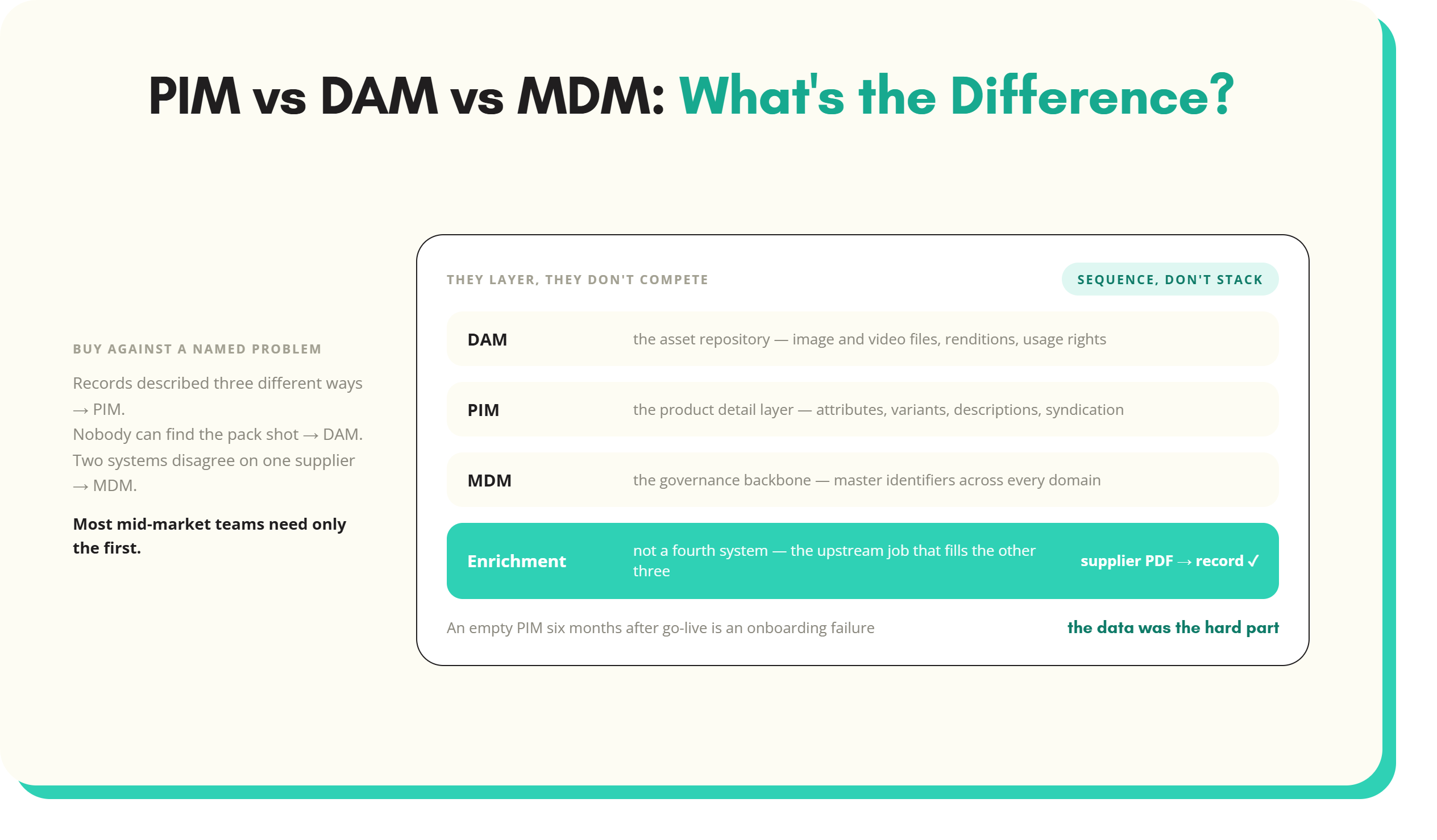
When a business runs all three, they layer rather than compete.
- Think of MDM as the governance backbone. It holds the authoritative master records and the rules that keep them clean, and it feeds trusted core data to the systems that use it.
- The PIM is the product detail layer. It takes the product master, adds the hundreds of attributes, descriptions, and channel-specific variations that selling requires, and pushes complete records out to ecommerce, marketplaces, and print.
- The DAM is the asset repository. It stores the images and videos, serves the right rendition to each channel, and links assets back to the products in the PIM by SKU or product ID.
Where product data enrichment sits
Enrichment is not a fourth system. It is the work that happens upstream of the PIM, turning messy supplier input into structured records the PIM can actually hold.
Supplier data arrives as PDFs, spreadsheets, web pages, and images, in whatever format each supplier happens to use. A PIM expects clean, structured, mapped attributes. The gap between those two is the enrichment problem, and it is where most product data projects stall. The distinction is worth understanding in full: see product data enrichment vs PIM.
This is the layer SKULaunch works in. It reads supplier PDFs, spreadsheets, and URLs, extracts structured attributes, classifies products against your taxonomy, generates descriptions, and pushes the result into a PIM such as Akeneo or Plytix, a store such as Shopify or Magento, or a marketplace feed for Mirakl. It can push extracted images through to a DAM, and it respects the governance rules an MDM sets, writing to the fields each system owns rather than fighting them. For mid-market teams with no PIM in place, SKULaunch's own built-in PIM layer can hold the governed product record itself, so the enrichment layer and the system of record arrive as one tool.
The point is simple. A PIM, DAM, or MDM gives you somewhere to put good data. However, none of them creates good data out of a supplier’s PDF. That is a separate job, and skipping it is the reason so many systems sit half empty.
The practical decision framework
Buy against a problem you can articulate, not against a category. The PIM vs DAM vs MDM choice gets much simpler once the problem is named. Start with the one sentence:
1. Name the failure you can see today. If you cannot describe the problem in plain terms, you are not ready to buy a system to fix it.
2. Add capability as problems emerge. A PIM first for most. A DAM when image chaos becomes a measurable cost. An MDM when cross-system record conflicts start causing real errors.
3. Do not buy all three at once unless the scale genuinely requires it. Three implementations running in parallel is how a data programme collapses under its own weight.
Sequence them. Solve the loudest problem, stabilise, then move to the next.
Finally, whichever you buy, sort out the data going into it. An empty PIM six months after go-live is the most common outcome of skipping the enrichment step.
The system was never the hard part. The data was.
Key takeaways
- PIM manages product records, DAM manages image and video files, MDM governs master records across every data domain.
- They overlap at the edges: a PIM holds image URLs not images, a DAM may hold product metadata, an MDM often owns the product master a PIM consumes.
- Choose by the problem you can name in one sentence. Inconsistent products means PIM, lost images means DAM, conflicting records across systems means MDM.
- Most mid-market businesses need only a PIM first. Enterprises tend to end up with all three. Sequence them, do not buy them together.
- None of these systems creates clean data from a supplier PDF. Product data enrichment is the upstream job that fills them.
Still unsure whether the answer is a PIM, a DAM, an MDM, or just cleaner data going in? SKULaunch has been used by retailers and distributors to scope exactly this decision. Book a short call to talk through your catalogue, your systems, and the one problem worth solving first.
See SKULaunch in action
Watch how we handle AI enrichment, supplier onboarding, and catalogue scale in a live 30-minute demo.


.avif)