

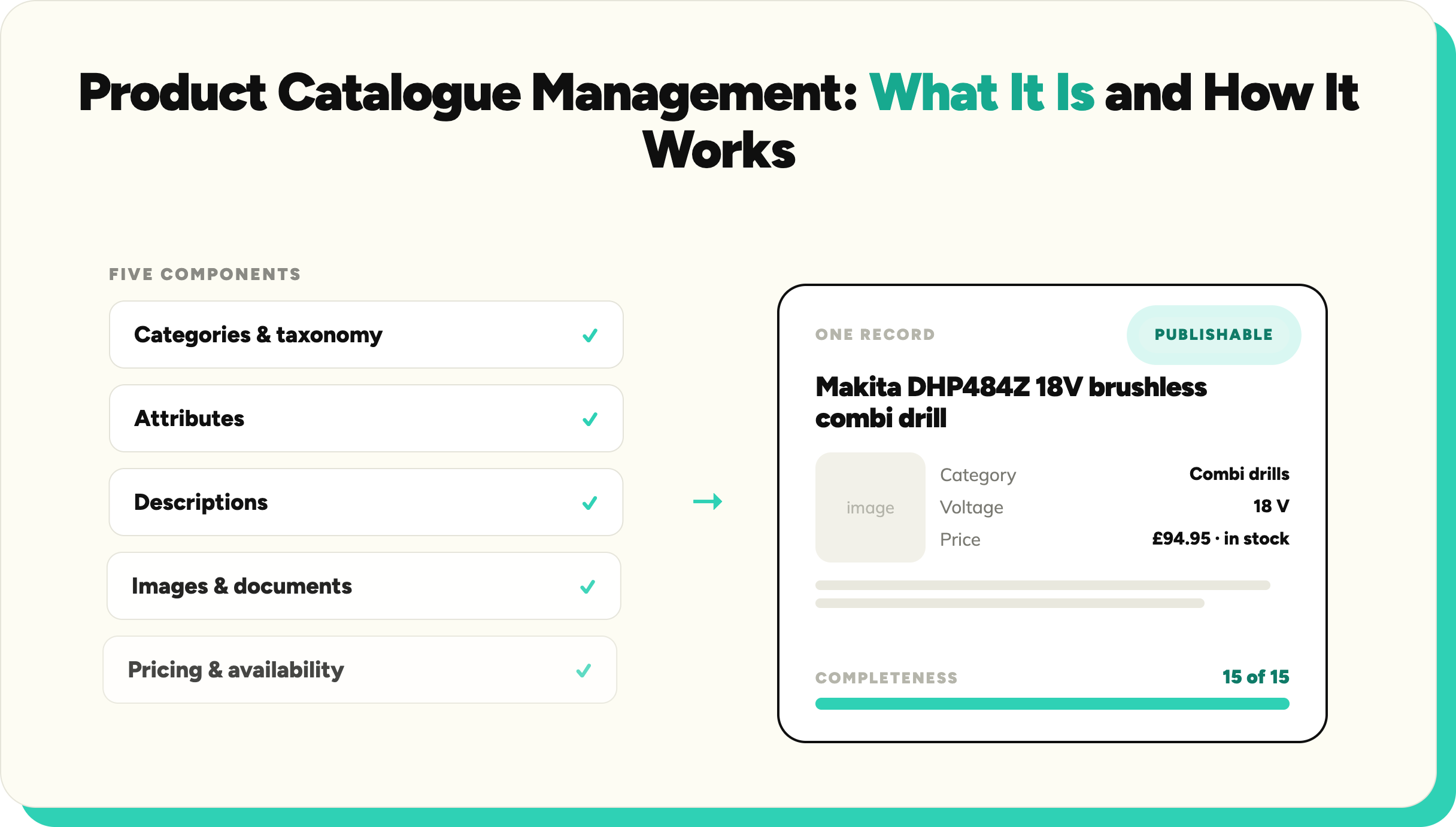
Product catalogue management is the work of keeping every product record complete, consistent, and publishable across the places you sell.
Product catalogue management is the work of keeping every product record complete, consistent, and publishable across the places you sell. It covers the categories products sit in, the attributes that describe them, the images and documents attached to them, and the prices and availability that make them sellable. Done well, it is invisible. Done badly, it is why filters return nothing, why listings get rejected, and why a team of capable people spends every week in spreadsheets.
What is product catalogue management?
Product catalogue management is the process of organising, maintaining, and distributing the product information a business sells from: categories, attributes, descriptions, media, pricing, and availability. The goal is a catalogue where every record is complete enough to be found, understood, and bought, on every channel it appears on.
That definition hides a practical distinction worth making early. Managing a catalogue is not the same as building one. Most catalogue management advice assumes the data already exists in reasonable shape and just needs organising. For most retailers and distributors, the data arrives from suppliers in whatever shape the supplier chose, and the real work is upstream: getting it complete and structured before there is anything worth managing.
The five components of catalogue management
Most descriptions of the discipline agree on five components. What matters is what actually breaks in each one.
1. Categories and taxonomy
The hierarchy products sit in, which drives navigation, filters, and reporting. What breaks: supplier categories never match yours, the same product fits three places, and every new range surfaces products the taxonomy was never designed for. Category mapping is a permanent job, not a setup task.
2. Attributes
The structured properties that describe each product: brand, size, voltage, material, certification. What breaks: completeness. A category needs 30 attributes filled and averages 18, so faceted search quietly fails and comparison becomes guesswork. Attribute completeness is the single most useful measure of catalogue health.
3. Digital assets
Images, datasheets, certificates, and video attached to each record. What breaks: coverage and consistency. Some products carry six images, others carry one supplier photo at the wrong resolution, and nobody knows which datasheet is current.
4. Pricing
Trade prices, retail prices, currencies, and customer-specific terms. What breaks: synchronisation. Price lives in the ERP, the catalogue lags behind it, and the gap between the two is where margin errors and customer complaints come from.
5. Inventory and availability
Stock levels and lead times shown at the point of sale. What breaks: trust. A listing that shows an out-of-stock item as available costs more goodwill than a missing listing ever does.
What catalogue management software does
Catalogue management software is a real category with several kinds of tool inside it, and it helps to name them honestly rather than pretend one tool does everything.
PIM platforms such as Akeneo, Plytix, and inRiver act as the system of record: they store clean product data, govern who can change it, and syndicate it to channels. Ecommerce platforms such as Shopify, Magento, and BigCommerce each carry their own built-in catalogue, which works as the only catalogue for smaller ranges and as a destination for larger ones. Syndication tools publish one catalogue to many marketplaces in each marketplace's format. And upstream of all of them sits the enrichment layer, which is where SKULaunch operates: collecting supplier data, extracting and completing attributes, classifying products, and pushing finished records into whichever of those systems you run. SKULaunch also includes a PIM layer of its own, so teams without a system of record can run the whole catalogue, storage included, in one place. A useful way to choose: if your data is clean and your problem is organising and distributing it, start with a PIM or your platform's own catalogue. If your data arrives messy and incomplete, no amount of management downstream fixes what never got captured, so start with the product catalogue enrichment software layer.
Why catalogue management fails at distribution scale
A brand managing 2,000 of its own SKUs can run catalogue management as a discipline: naming conventions, a review calendar, one person who owns the taxonomy. A distributor managing 50,000 SKUs from 200 suppliers cannot, because the inputs are not under its control. Every supplier sends a different spreadsheet, the technical categories need 30 to 200 attributes per product, and new ranges arrive weekly. At that scale the choice is between automation and a permanent backlog. This is the argument for treating product data enrichment as part of catalogue management rather than a separate project: extraction, classification, and completeness scoring have to run continuously, or the catalogue decays faster than the team can maintain it. The practical patterns for coping with this are covered in our guide to managing large SKU catalogues.
How to tell if your catalogue management is working
Four measures tell you most of what you need to know. Attribute completeness by category, because it predicts whether search and filters work. Time to list, from supplier data arriving to a sellable record being live, because it measures the whole pipeline rather than one step. Rejection rate on marketplaces and customer portals, because it measures whether your data meets external requirements rather than internal ones. And the share of records touched by hand, because it tells you whether the process scales or whether it is quietly consuming a team.
Frequently asked questions
What is the difference between catalogue management and product information management?
In practice the terms overlap heavily. Product information management usually refers to the system of record (the PIM) and its governance. Catalogue management is the broader operating discipline: keeping categories, attributes, assets, prices, and availability complete and consistent across channels, whichever systems are involved. You can run catalogue management with a PIM, with an ecommerce platform's built-in catalogue, or with an enrichment layer feeding either.
Do I need catalogue management software?
Below a few thousand SKUs with stable suppliers, a disciplined spreadsheet and your ecommerce platform's own catalogue can work. Past that point, and especially past 50 suppliers, manual processes stop scaling: completeness drops, listing times stretch, and errors reach customers. The right software depends on where your catalogue breaks: a PIM if the problem is governance and distribution, an enrichment platform if the problem is incomplete supplier data. Some tools, SKULaunch among them, now cover both jobs.
What does good product catalogue management look like?
Complete attributes per category, consistent classification, current media, synchronised pricing and stock, and a pipeline where new supplier data reaches a sellable state in days. The most reliable signal is negative: nobody in the business is maintaining a private spreadsheet because they do not trust the catalogue.
Key takeaways
Product catalogue management covers five components: categories, attributes, assets, pricing, and availability. The component that breaks first, and breaks everything else, is attributes, because completeness decides whether products can be found and compared. Software for the job splits into systems of record and enrichment layers, and most catalogue problems at distribution scale are enrichment problems wearing a management costume. Measure completeness, time to list, rejection rate, and manual touch rate, and the rest of the discipline follows.
To see how SKULaunch keeps a catalogue complete, request a demo.
See SKULaunch in action
Watch how we handle AI enrichment, supplier onboarding, and catalogue scale in a live 30-minute demo.


.avif)