
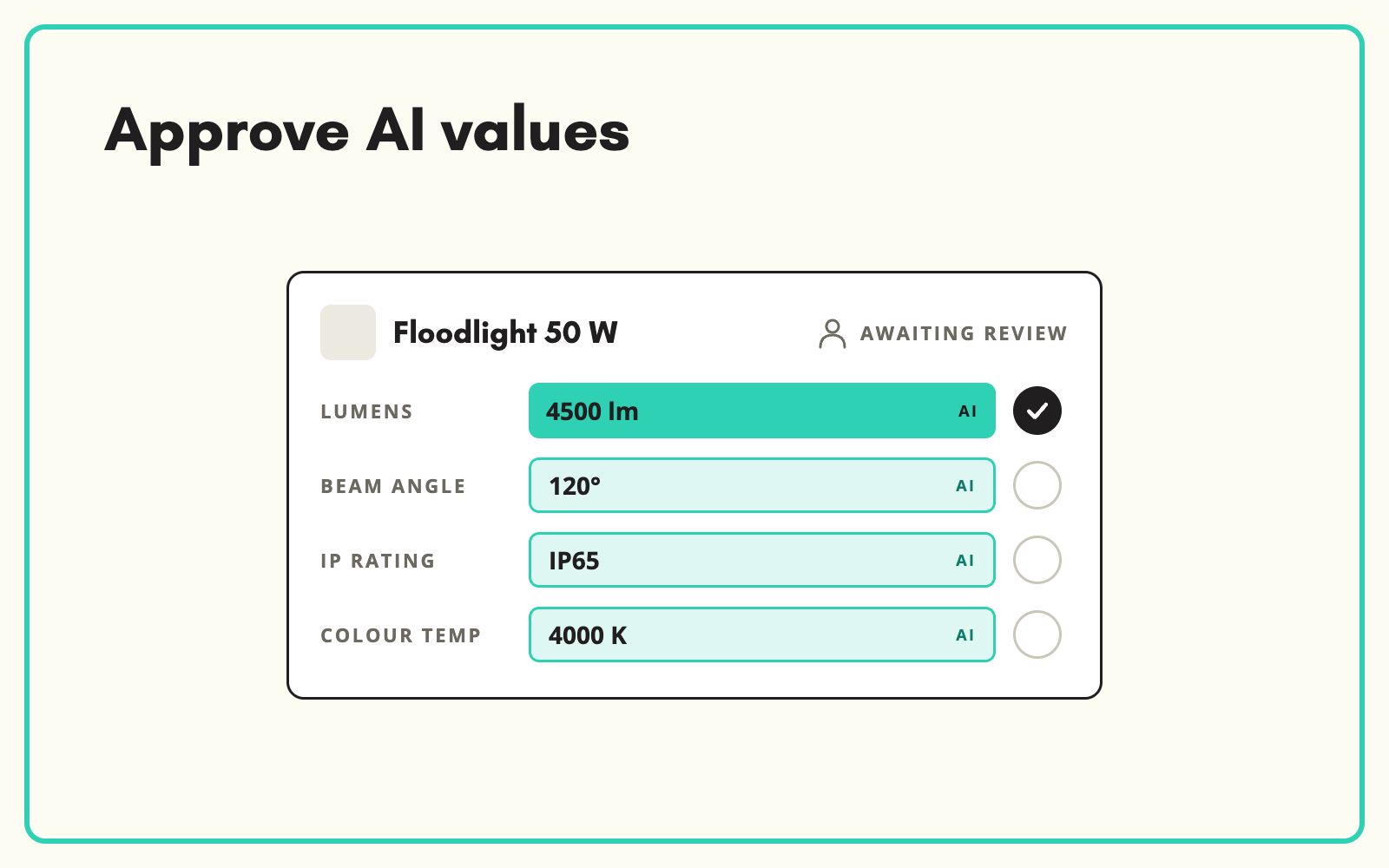
AI can fill thousands of attributes in minutes, but nothing should reach your website without a human decision. SKULaunch builds human review of AI product data into the workflow: AI-generated and AI-extracted values stay in review until someone approves them, so you get the speed of automation with control over what is published.
The problem
Teams worry about two failure modes. Publish AI output unchecked and one wrong rating on a safety-critical product causes real harm. Check every value by hand and automation saves nothing. Most tools offer neither a sensible middle path nor a clear record of what was checked.
Before and after
An illustrative example from an enrichment run on an electrical catalogue.
Before: the dilemma
8,000 values filled overnight by an AI tool and pushed straight to the website. Two weeks later a customer finds a wrong voltage on a charger.
After: in SKULaunch
- Enriched values held for review, not published
- Reviewer filters to safety-related attributes first and checks them fully
- Remaining values spot-checked by category, then approved in bulk
- Every approval recorded against the product
How it works in SKULaunch
- Enrich into review. AI Tools write values to products awaiting approval.
- Review in the grid. Choose columns, filter by category or attribute, and compare with sources.
- Approve or correct. Approve in bulk, edit values that need it, or reject.
- Publish approved data only. Channels receive approved records.
A practical standard for human review of AI product data
Review by risk, not volume. Check every value on attributes with safety, legal or compatibility consequences. Spot-check a fixed number of products per category for everything else, and widen the check if errors appear. Record the standard so every reviewer works the same way. That keeps accuracy high without turning review into the new bottleneck.
A workable split for most catalogues:
- Check every value: voltages, load ratings, pressure ratings, fitment, hazard information
- Sample per category: dimensions, materials, colours, finishes
- Read a few, then approve: generated descriptions and bullets, once the first batch in a category reads well
When a reviewer finds an error, look for the pattern. One wrong unit usually means a whole supplier file used a different convention, and that is a mapping fix, not an editing job. Fix the mapping, rerun the file, and review the affected rows again.
What changes
Automation does the volume, people make the decisions, and nothing unchecked goes live.
Common questions
Do we have to review every value?
No. Review by risk and sample the rest.
Who should do the review?
Someone who knows the category. A buyer or category specialist spots a wrong spec far faster than a general administrator, even when they only check a sample.
Can approval be done in bulk?
Yes, after review of the filtered set.
Will SKULaunch tell us which values to check first?
Not automatically today; that is on the roadmap. Today, review is by filter, source and sample.
More on review: approving supplier data, filling missing attributes, validation rules and product data quality.

