
New products sit in a queue for weeks.
Most of that time is waiting.
The bottleneck isn't your team, your PIM or your website. It's every manual step between a product existing and an approved record being ready, and there are more of them than anyone has counted.

This is a Problem for
Commercial Director
Watching revenue from new ranges land weeks after competitors who got to market first
Head of eCommerce
Managing go-live schedules that slip every quarter because product data isn't ready in time
Category Manager
Launching new categories where the data pipeline slows every product to a crawl
Product Data Manager
The person blamed for delays that were caused two steps upstream, before the data reached them
Weeks of elapsed time. Very little of it is work.
Ask anyone on the team where the time goes and they'll give you a different answer. Suppliers blame the template. The data team blames the suppliers. The ecommerce team blames the PIM. The PIM team blames the data. Everyone is right. Nobody owns the whole pipeline. So nobody fixes it.
Count the steps, not the people.
The hidden cost is not the time. It is the sales that never happen. A product that should have been live and selling is sitting in someone's import queue. Every week of delay is a week a competitor's listing is live and yours is not.
The instinct is to hire someone to go faster. Another data team member. Another project manager to coordinate the process. But you can't hire your way out of a structural problem. The steps themselves are the issue, not the speed at which people complete them.
1,000 SKUs
1 month
3 categories
Eliminate the waiting. Automate the reformatting. Keep the judgement.
The steps that take weeks aren't complex. They're just manual. SKULaunch takes on the reading, mapping and drafting, and leaves the decisions to your team.
Get supplier data without the spreadsheet chase
The supplier portal replaces the template. Each supplier gets one link, with no account and no training, and uploads the files they already have in any format. AI extracts the attributes and maps them to your schema.
Extract attributes from content that already exists.
Most enrichment work is finding data that already exists somewhere: a PDF spec sheet, a manufacturer URL, an image, a block of text. AI reads it and extracts the attributes into your schema. The data was always there. The manual work was finding and copying it.

Records with the copy already written
Content generation writes titles, descriptions, bullets, keywords and SEO meta from approved attributes. Missing attributes and values that break your schema rules are flagged. What reaches your team for sign-off is a finished record to check, with the gaps already marked.

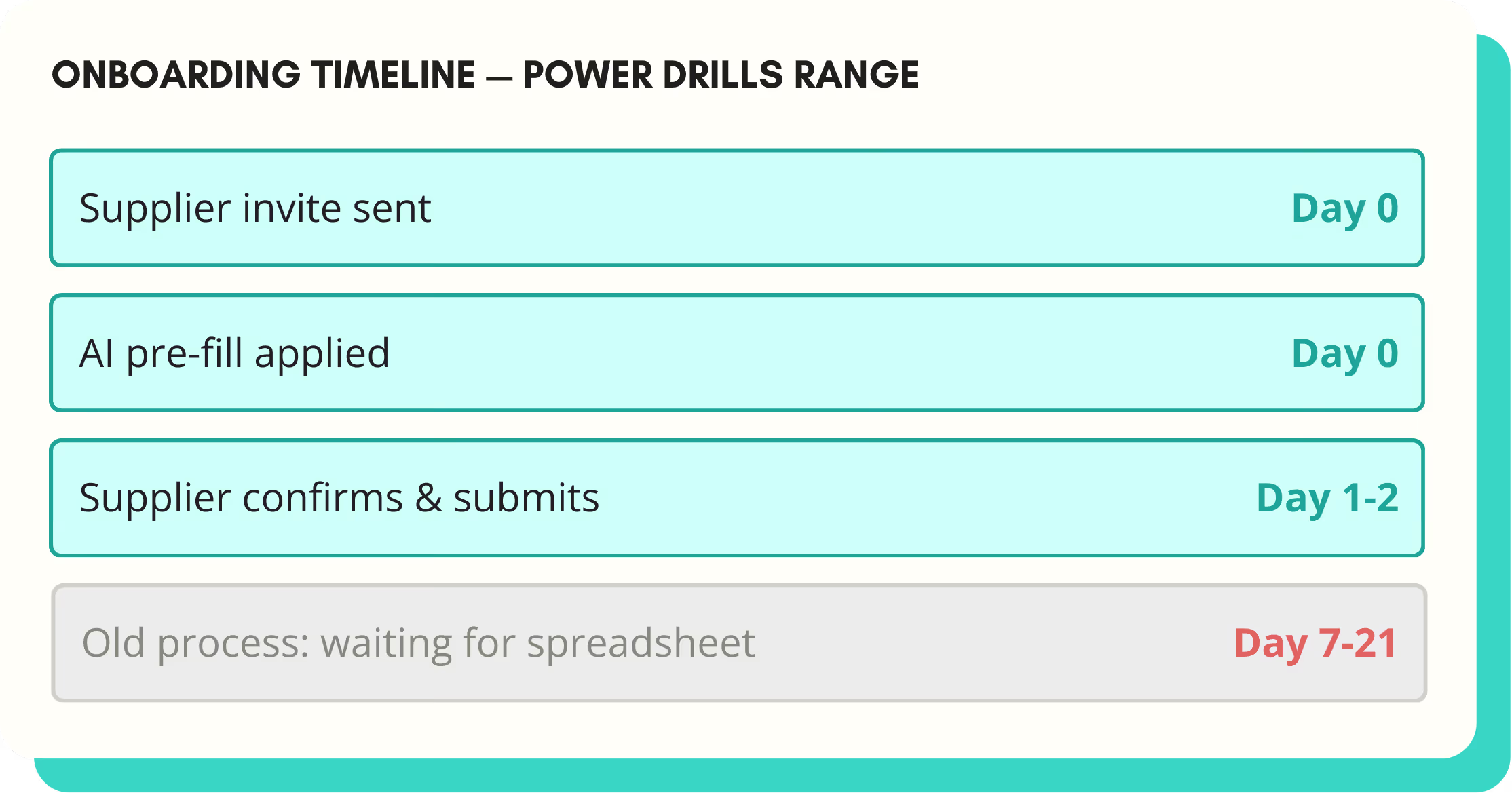
What the process looks like without the waiting
Every manual step, covered
Time to live is a pipeline problem. SKULaunch covers each stage of it.
Supplier Portal
One link per supplier. Any file format. No account or training.
Explore →Enrichment Studio
AI fills attribute gaps from your sources and shows the evidence for each value.
Explore →Content Generation
Titles, descriptions and bullets generated from approved attributes. Ready to review.
Explore →Product Data Quality
Missing attributes and rule breaks are flagged, so sign-off goes straight to what needs a decision.
Explore →The problems that come with it
Fast time to live exposes the next set of challenges. Here's what teams tackle next.
Your supplier onboarding is broken. You just can't see it yet.
The spreadsheet chase is where the timeline starts losing weeks. Fix the source first.
Read more →Your team is enriching the catalogue by hand. The backlog grows faster than they can clear it.
Once the pipeline is fast, the volume problem becomes visible. AI enrichment takes on the volume.
Read more →Products are live. But customers still can't filter by the specs they care about.
Speed without structure is just getting incomplete products live faster. Structured attributes are what makes speed valuable.
Read more →Run one of your own ranges through it
One month, 1,000 SKUs, up to three categories. No card needed.

The AI product data platform that turns messy supplier files into sales-ready content. Run it upstream of your PIM, or run it as one.
