

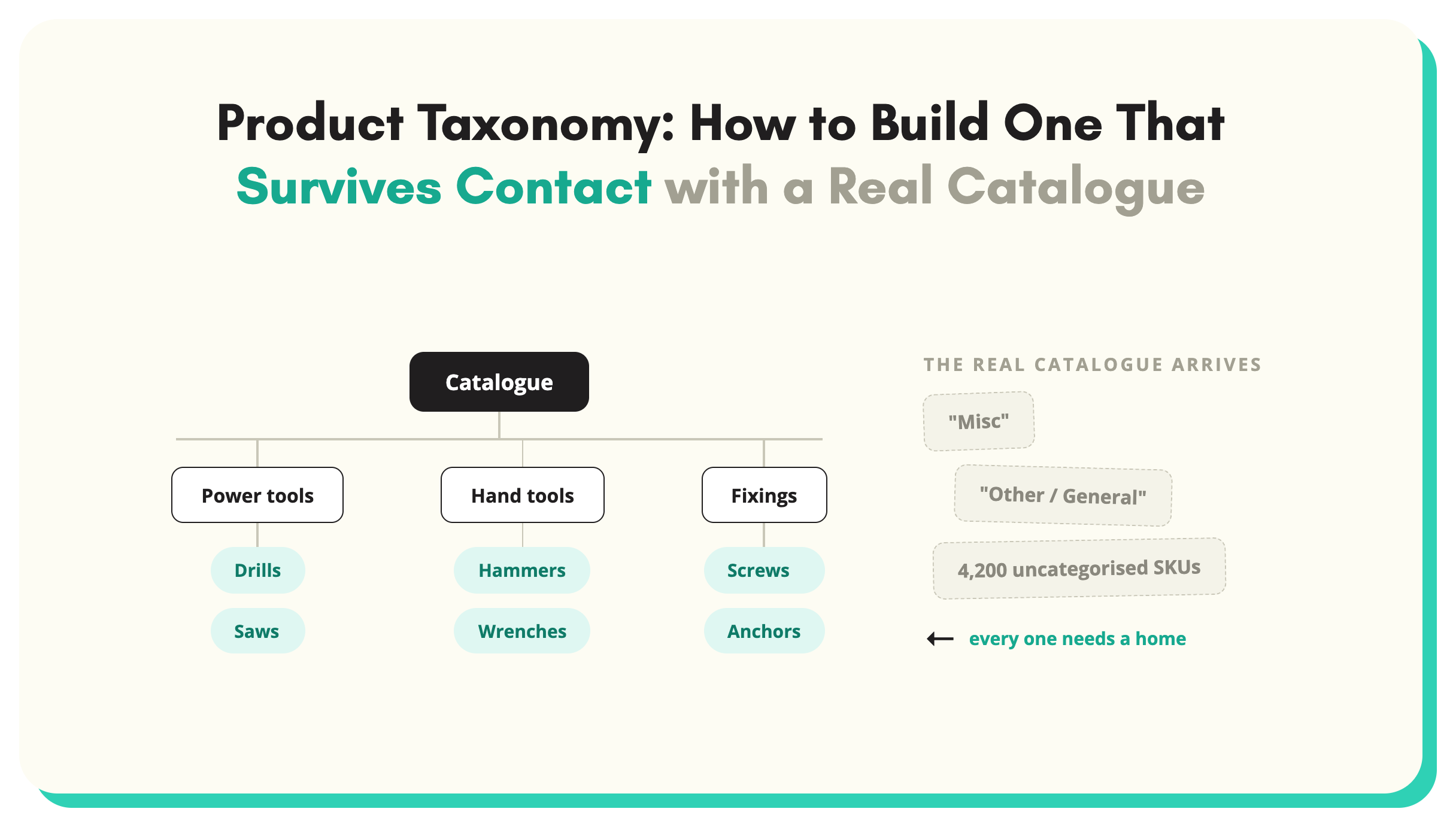
Most taxonomies are inherited, not designed. A six-stage workflow for building one from real catalogue data, and keeping it alive.
Most product taxonomies are inherited rather than designed. The tree started as one buyer's view of the range fifteen years ago, absorbed three supplier structures and a replatform, and now carries a Miscellaneous node with 4,000 SKUs in it. A product taxonomy decides what buyers can find, which filters exist and what reporting means, which makes it worth designing deliberately. This is the workflow for doing that.
What a product taxonomy is, and what it is not
A product taxonomy is the hierarchy of categories products are classified into: Power Tools > Drills > Combi Drills. It is the classification backbone that navigation, filtering, reporting and channel feeds all hang from.
It is not the supplier's structure, which reflects their range, not yours. It is not the buying team's org chart, though many trees are exactly that. And it is not necessarily the storefront navigation: navigation can be a curated view over the taxonomy, but there has to be one master classification underneath, or every consumer of the data invents its own.
Decide what the taxonomy serves before drawing trees
The tree has at least four consumers with different needs. Storefront navigation wants few levels and familiar words. Faceted search wants end nodes tight enough that their products share attributes. Reporting wants stability year over year. Marketplace and feed mapping wants nodes that translate cleanly to Amazon, Google and eBay categories. One structure cannot optimise all four, which is why the working pattern is a single master taxonomy with views derived from it, rather than four competing trees maintained by four teams.
The six stages of building a product taxonomy
Stage 1: Inventory the range from real data
Start from a full product export, not from memory. Count products per candidate grouping. The catalogue you think you sell and the catalogue in the export differ every time, and the tree has to fit the second one. This is also where duplicate and dormant SKUs surface, better now than after they are classified.
Stage 2: Draft the hierarchy, shallow
Three levels covers almost every retail and distribution catalogue: department, category, product type. Push detail into attributes, not into a fourth level. "Combi Drills 18V" as a node is an attribute wearing a category costume, and it will breed siblings every time a new voltage arrives. Siblings at each level should answer the same question: what kind of thing is this?
Stage 3: Define attributes per end node
The taxonomy and the attribute schema are one design decision, not two. An end node earns its place when its products share an attribute set a buyer would filter on. If two nodes need identical attributes, they are probably one node. If one node needs two unrelated attribute sets, it is two.
Stage 4: Map supplier and ERP categories to the tree
Every supplier file and the ERP each carry their own classification, and all of them have to land in yours. Build the mapping once per source, keep it, and treat its maintenance as a permanent job. This mapping layer is what lets the taxonomy change without every supplier needing to know.
Stage 5: Validate against search and filter behaviour
Walk the draft as a buyer. Does each end node produce a filter set that narrows usefully? Are node sizes workable, roughly between a dozen and a few hundred products, not three and not four thousand? A category structure that fails this walk quietly costs conversion long before anyone diagnoses it; why your category structure is quietly hurting ecommerce performance covers the symptoms, and faceted search for distributors covers the filter side in depth.
Stage 6: Set governance for change
Decide who can add, rename or merge nodes, and what happens downstream when they do: redirects for renamed storefront categories, re-mapping for feeds, reclassification for affected products. A taxonomy without governance returns to inherited chaos in about two years, one reasonable-sounding exception at a time.
The mistakes that sink taxonomies
- Mirroring supplier structures, which imports every supplier's inconsistencies as architecture.
- Going deep instead of wide: five levels where three levels plus attributes would do.
- The Miscellaneous node, which grows until it is the largest category in the business.
- Renaming storefront categories without redirects, which burns the search equity the old names had earned.
Keeping the taxonomy alive
New ranges arrive weekly, so classification is an intake step, not an annual project. The practical version: every incoming product gets classified against the tree at the point supplier data lands, automatically where confidence is high and queued for review where it is not. That is how enrichment platforms handle it; SKULaunch classifies incoming products against your taxonomy as part of catalogue enrichment, so the tree stays populated as the range moves. The alternative, classifying in bulk once a quarter, is how Miscellaneous nodes are born.
Key takeaways
- A product taxonomy is the master classification everything else derives from. Design it against the real export, not memory.
- Three levels, with detail pushed into attributes. Deep trees are attribute schemas in disguise.
- Taxonomy and attribute schema are one decision: an end node is defined by the attribute set its products share.
- Supplier and ERP structures map onto the tree through a maintained mapping layer. They never become the tree.
- Classify at intake, govern changes, redirect renames. A taxonomy without governance reverts to inherited chaos.
See SKULaunch in action
Watch how we handle AI enrichment, supplier onboarding, and catalogue scale in a live 30-minute demo.

.avif)