
Point SKULaunch at a supplier PDF, spreadsheet, image, or URL and get structured, schema-ready attributes back, scored for confidence and ready for your PIM.
.png)
AI product data extraction is the use of vision and language models to read unstructured source material, supplier PDFs, spec sheets, images, web pages, and spreadsheets, and turn it into structured product attributes. Instead of a person reading a datasheet and typing voltage, dimensions, and material into a PIM, the models read the document, find the values, map them to your schema, and record a confidence score for every attribute extracted. The output is not a summary or a paragraph of copy. It is structured data: named attributes with typed values, in your schema, ready to load.
SKULaunch was built around this capability. We ingest whatever your suppliers send, a 200-column spreadsheet, an image-only catalogue, a BMEcat file, a product URL, and extract the attributes your schema requires. Extraction runs at 90 to 95% accuracy across technical attributes, with every value scored so your team reviews the uncertain ones rather than checking everything. Retailers and distributors use it to fill PIMs, fix filters, and onboard supplier ranges in days rather than months.
OCR turns a scanned page into raw text. Extraction turns any source into named, typed attribute values mapped to your schema. OCR gives you words; extraction gives you a voltage field with 230V in it, flagged with a confidence score.
The same models read spreadsheets with inconsistent headers, product URLs, packaging photography, and standards files like BMEcat and ETIM. The messier and more varied the sources, the more the automation pays back.
Extraction is the opposite of asking a chatbot to write specs. Every value is pulled from a real source document and traceable back to it. Nothing is invented to fill a gap.
Confidence scoring decides what a human sees. High-confidence values pass straight through; low-confidence values queue for a check. Your team governs by exception instead of reading every datasheet.
AI product data extraction is not one operation. Sources come in, attributes come out, and three distinct stages sit in between. SKULaunch runs all three as a single pipeline.
SKULaunch ingests sources as they arrive: supplier PDFs and spec sheets, spreadsheets with inconsistent columns, product URLs, packaging images, BMEcat and ETIM files, and existing catalogue exports. No template to force suppliers into, and no pre-cleaning step before the pipeline starts.

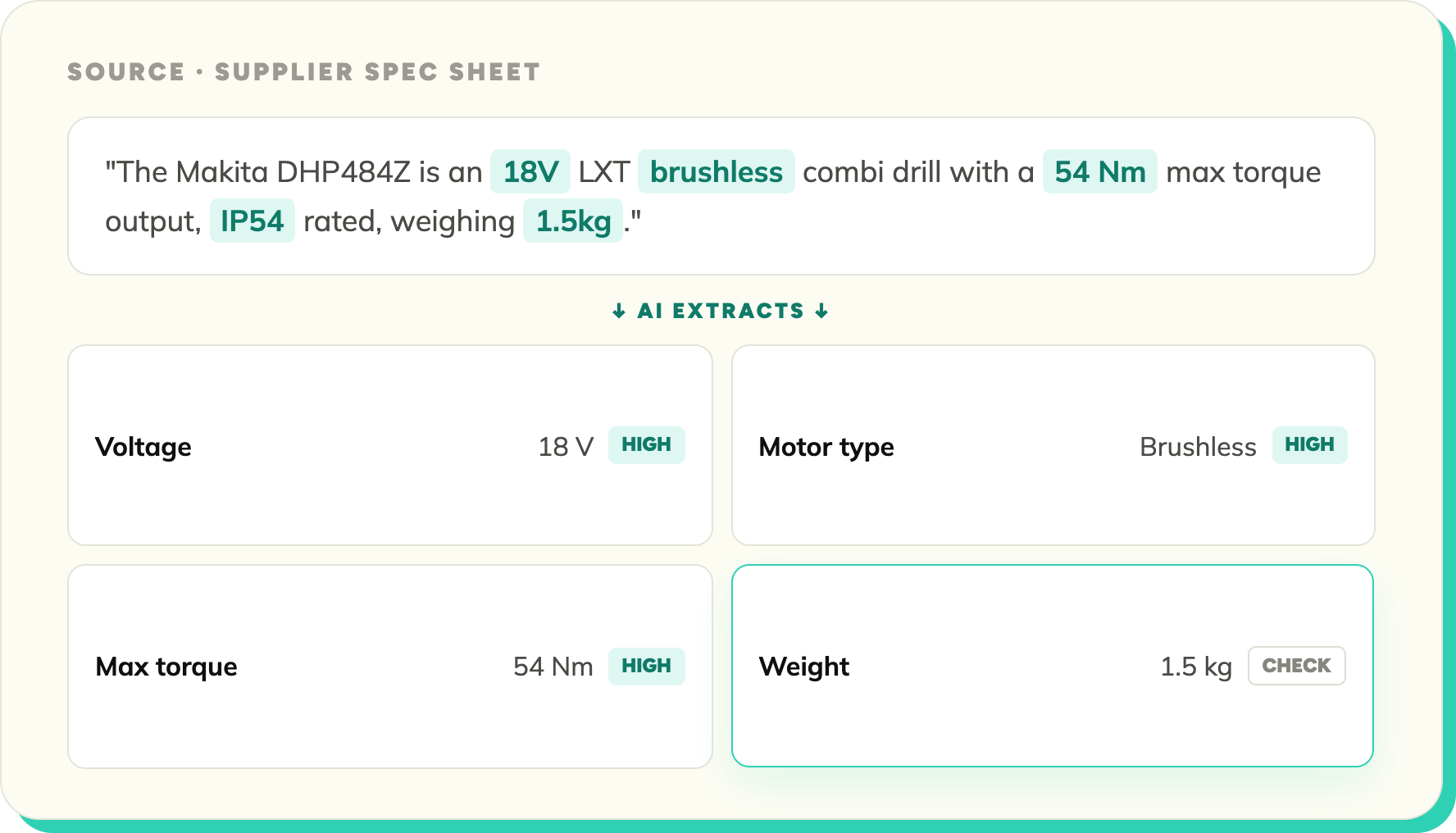
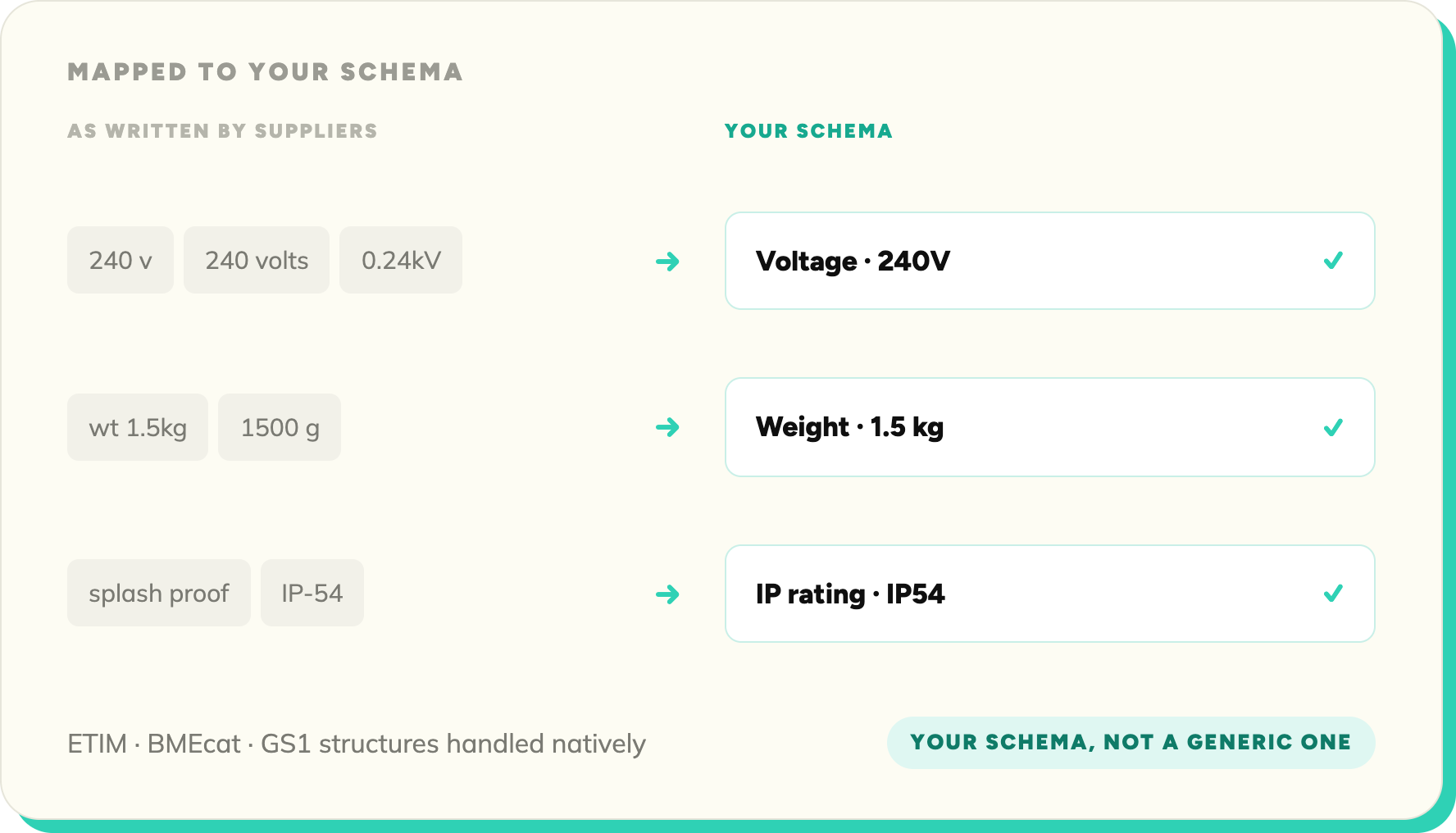
Vision and language models read every source together, find the attribute values, and map them to your schema: voltage, dimensions, material, IP rating, compatibility, whatever your categories require. Units and naming are normalised as values land, so 240 V, 240v, and 0.24kV become one clean value.
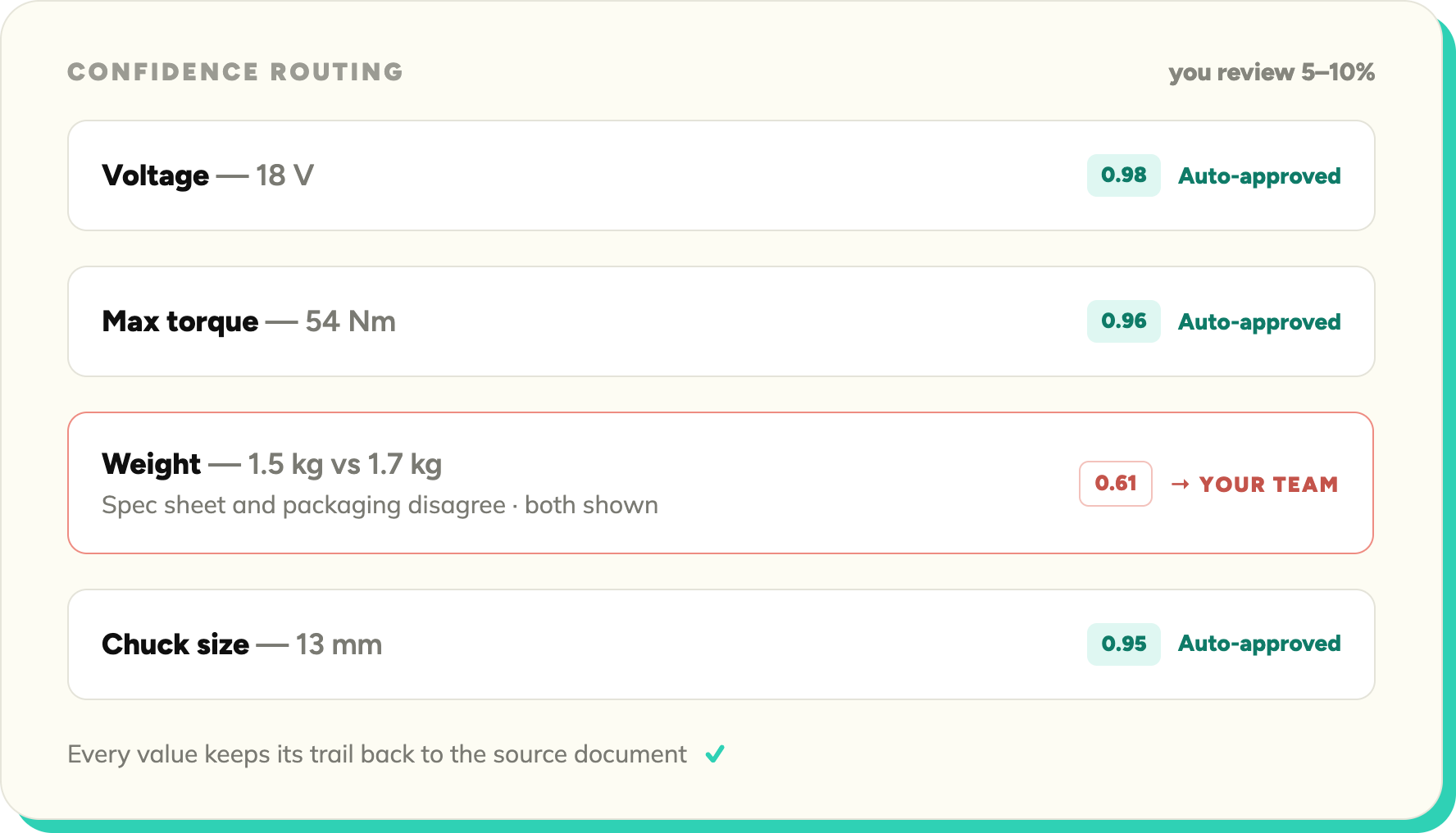
Every extracted value carries a confidence score. High-confidence values are approved automatically; low-confidence values, conflicts between sources, and missing required attributes are routed to your team. You review the 5 to 10% that needs judgement instead of checking every row.
No six-month implementation. Connect a source and your first batch of extracted, structured attributes is ready within 48 hours. Run extraction on demand, on a single supplier range or the full catalogue.
Upload supplier files, point SKULaunch at product URLs, connect your PIM, or have suppliers submit through the portal. Any format: CSV, Excel, PDF, image, BMEcat, or a data feed.
The models read every source, extract the attributes your schema requires, and fill gaps with targeted web research. Every value lands with a confidence score and a link back to where it came from.
High-confidence values pass automatically. Low-confidence extractions, source conflicts, and missing required attributes queue for review. Your team works a short exception list, not the whole catalogue.
Approved attributes push directly to Akeneo, Shopify, Plytix, Magento, or Mirakl, formatted for the destination. Structured data in your PIM, filters that work on your storefront.
Product data extraction software reads unstructured supplier material and returns structured attributes mapped to your schema. The distinction that matters when comparing tools is what happens after the reading. Anything can pull text off a page. The work is deciding that a number is a voltage rather than a wattage, that a value belongs in the field your PIM expects, and that the result is trustworthy enough to publish.
SKULaunch scores every extracted attribute for confidence, so review becomes a queue of exceptions rather than a full pass over the catalogue. Accuracy runs at 90 to 95% depending on source quality, and where a supplier sends ETIM or BMEcat the attribute match rate is 95%.
Supplier PDFs are the hardest common source, because one file usually mixes three formats at once: a specification table, narrative marketing copy, and an image carrying values that appear nowhere in the text. Rules-based parsers handle the first and fail the other two, which is why PDF extraction projects tend to stall at around the point the easy suppliers are done.
Vision and language models read all three together, so a dimension printed on a diagram is recovered alongside one sitting in a table. That is the practical difference between covering your top twenty suppliers and covering the long tail behind them.
A surprising share of technical product data exists only as pixels. Packaging shots carry certifications and safety marks. Line drawings carry dimensions. Photographed spec plates carry model numbers, ratings and compliance codes that never made it into any spreadsheet the supplier sent you.
Image extraction reads those values and writes them into the same schema as everything else, with the same confidence scoring. For categories where the filter your customers want is printed on the box rather than typed in a file, it is often the only route to a complete record.
Different teams arrive at extraction from different problems. The common thread is source documents that people are reading and retyping by hand, at a volume where that stops being a job and becomes a department.
New ranges stuck in onboarding queues because every product needs its specs keyed in before it can go live. Extraction clears the queue.
100,000+ SKU catalogues, technical categories, and suppliers sending PDFs. Attribute completeness decides whether search and filters work at all.
Own the range, not a data team. Extraction fills the attribute gaps that block products from listing, filtering, and converting.
The PIM is live and the data is not. Extraction fills Akeneo or Plytix with structured attributes without a re-implementation.
Hundreds of supplier line lists a year, each in a different format. Extraction at intake turns them into one consistent dataset.
Seller listings that fail category requirements. Extract and validate at onboarding, before bad listings reach the storefront.
The economics changed when extraction became reliable enough to govern by exception. When 90%+ of values pass automatically, the cost of a complete catalogue stops scaling with headcount. Here is what that looks like in practice.
The annual staff cost one UK industrial distributor puts on chasing, cleaning, and retyping supplier data across a 14-person team.
Of the manual steps between a product arriving and being publish-ready removed, with extraction, validation, and mapping running automatically.
Time to live for new products, down from six weeks, once specs stop being keyed in by hand.
Operations Director, UK industrial and electrical distributor
SKULaunch customers are ecommerce and product data teams who have tried the manual route, and know it stops scaling long before the catalogue stops growing.
Trusted by
APS Industrial
Mole Valley Farmers
RS Group
Bowens Australia
Maxiparts

Reads datasheets, line cards, and brochures in any layout. Tables, footnotes, and mixed narrative handled; attributes extracted with a confidence score per value.
Read More →
Vision models read packaging photography, label shots, and image-only catalogues, pulling attribute values no text parser can reach.
Read More →
Point at a manufacturer product page and extract the full attribute set, with targeted web search to fill values missing from your documents.
Read More →
Maps inconsistent supplier columns to your schema automatically. 200 supplier formats become one consistent dataset, with no mapping rules to write.
Read More →
Decodes standards files natively and maps their attribute structures to your schema, with a 95% attribute match rate.
Read More →
Assigns every product to the right node in your taxonomy, or to ETIM, GS1, and marketplace category trees, as part of the same run.
Read More →
A score on every value decides what publishes automatically and what queues for human review. Nothing reaches a channel without passing your thresholds.
Read More →
Pushes approved attributes to Akeneo, Shopify, Plytix, Magento, and Mirakl, formatted per destination, with a full audit trail.
Read More →
The extraction engine in detail: sources, confidence scoring, and accuracy benchmarks.
Read More →The full picture: extraction is stage one of enrichment. What the rest of the pipeline does.
Read More →Extraction at intake: collect supplier data through a portal that validates before submission.
Read More →
The AI product data platform that turns messy supplier files into sales-ready content. Run it upstream of your PIM, or run it as one.
.avif)