
You do not control your product data. Your suppliers do. SKULaunch turns what they send into complete, structured, sales-ready records in days, not months.
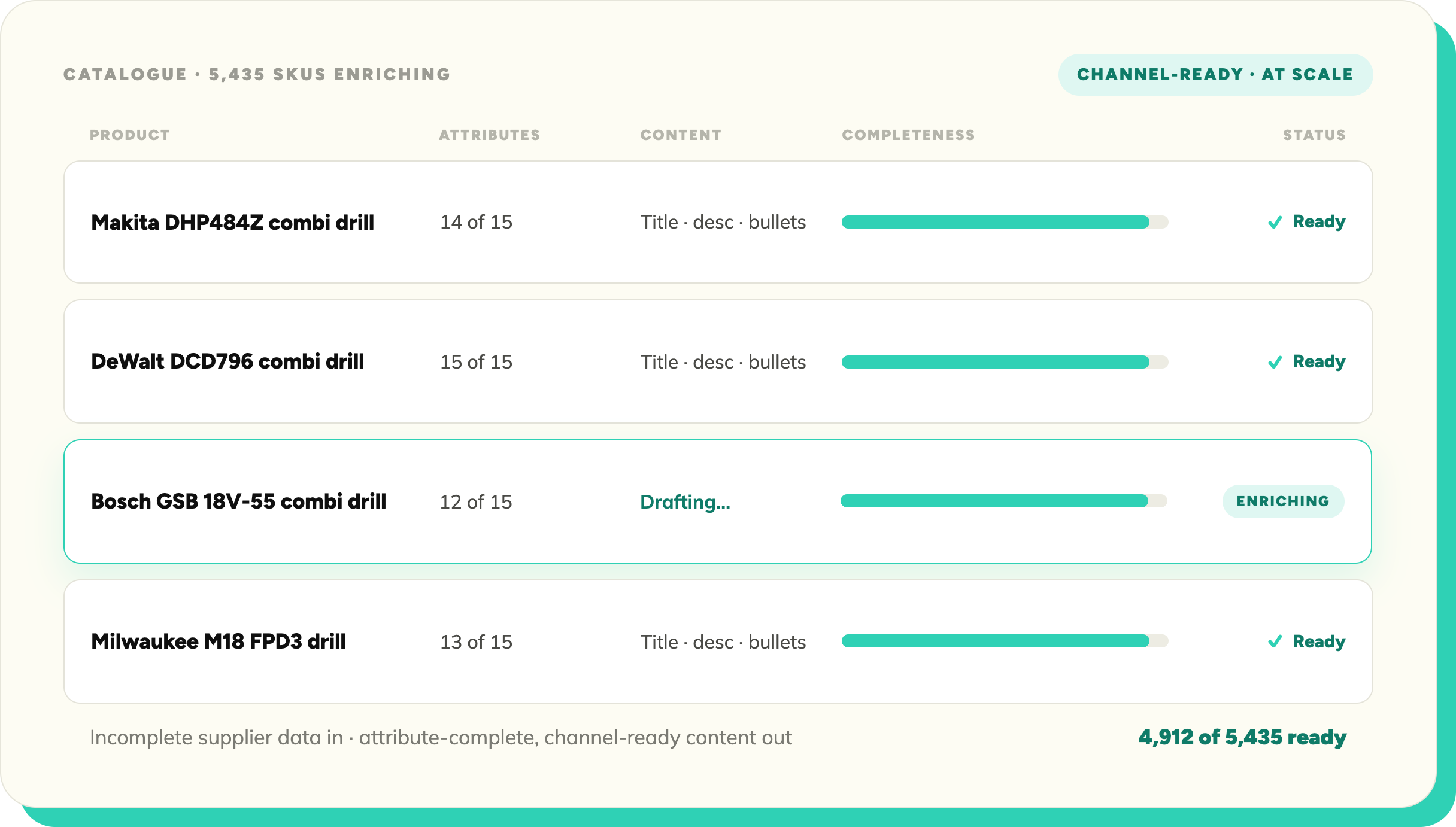
Product data management for distributors is the work of collecting product data from suppliers, structuring and enriching it to a consistent schema, and publishing it to the systems where customers buy: your webshop, your catalogue, your customers' procurement platforms. It is a different job from retail product data management for one structural reason. You do not create the product content. Your suppliers do, in their formats, on their timelines.
That is why distribution product data breaks in a specific way. A mid-market distributor carries 5,000 to 100,000 SKUs from 50 to 500 suppliers, and every supplier sends something different: a spreadsheet in their own layout, a PDF datasheet, a price list, a BMEcat file. The team keying that into an ERP or PIM never catches up, and the catalogue sits half complete while customers filter, search, and find nothing. SKULaunch was built for exactly this workflow: supplier intake, AI enrichment, and clean hand-off to whichever system you run downstream.
A PIM stores and distributes clean product data. Product data management covers the whole job: getting supplier data in, making it complete, and keeping it complete as ranges change. Many distributors run SKULaunch without a PIM at all.
Distributors receive content rather than create it. The management problem starts at intake: hundreds of suppliers, hundreds of formats, and no leverage to force a template. Fix intake and everything downstream gets easier.
Technical catalogues live or die on attributes: voltage, IP rating, thread standard, material grade. Attribute completeness decides whether faceted search works and whether customers' procurement systems accept your data.
Ranges change, suppliers churn, standards move. Product data management is a continuous operation with completeness scoring and exception review, not a cleanup project that ends.
Product data management for distributors breaks into three distinct jobs that most teams run with three disconnected tools and a lot of spreadsheets. SKULaunch runs all three in one pipeline.
Each supplier receives one magic link, with no account or training required. AI pre-fills the submission form from the supplier's own product website, so suppliers confirm rather than type. Any format is accepted at intake, and validation runs at submission, so what reaches your team is already structured against your schema.

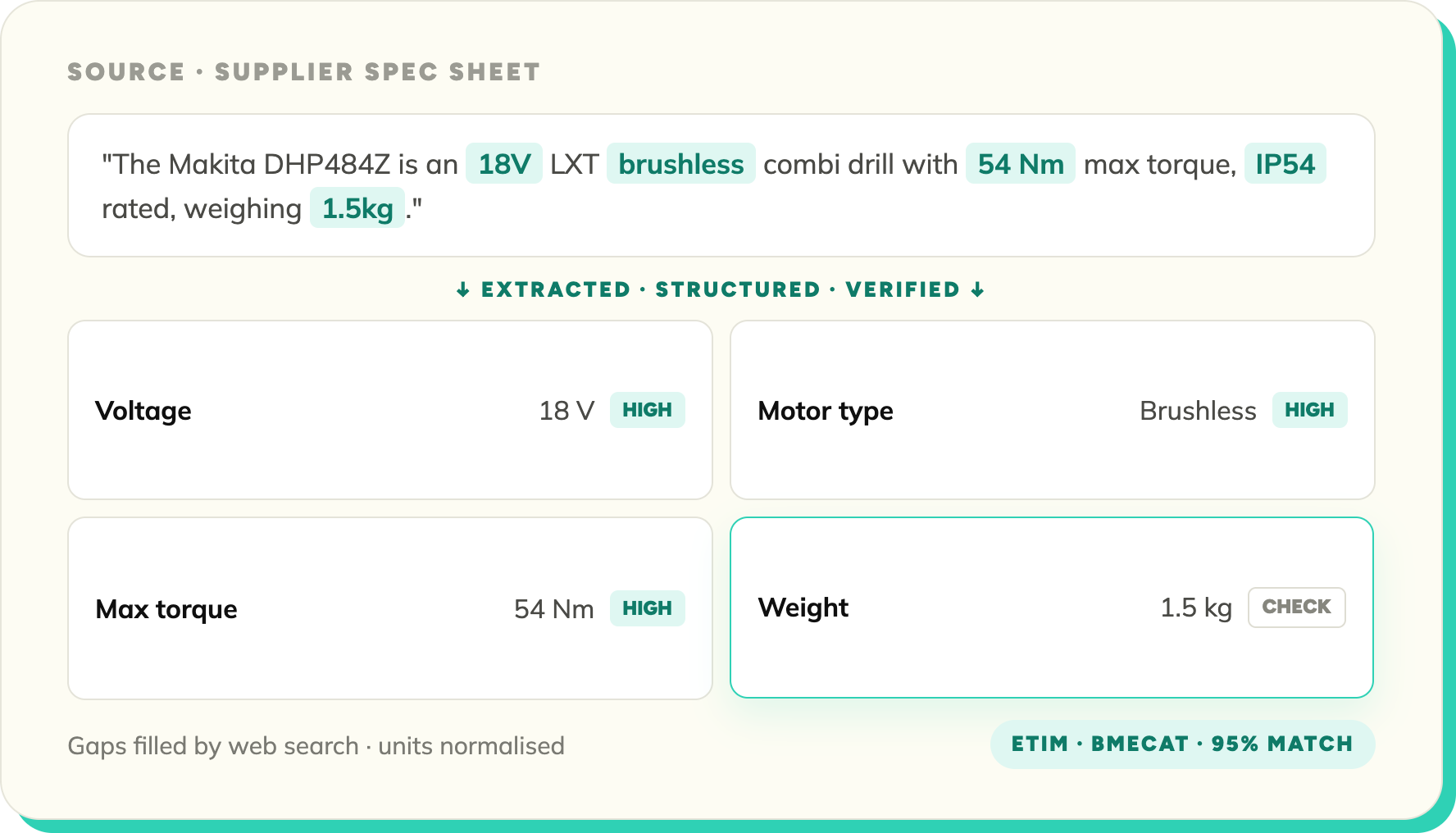
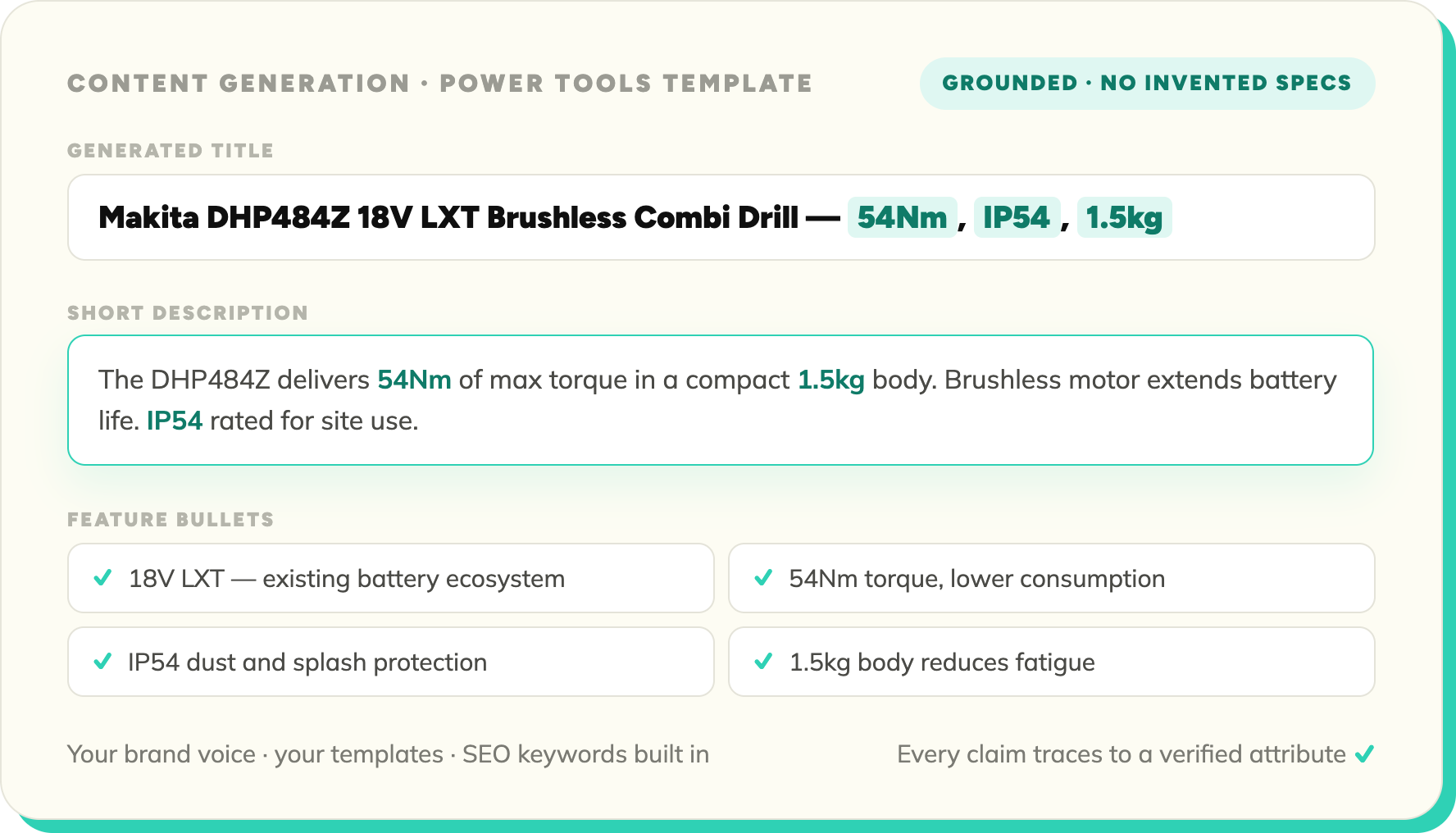
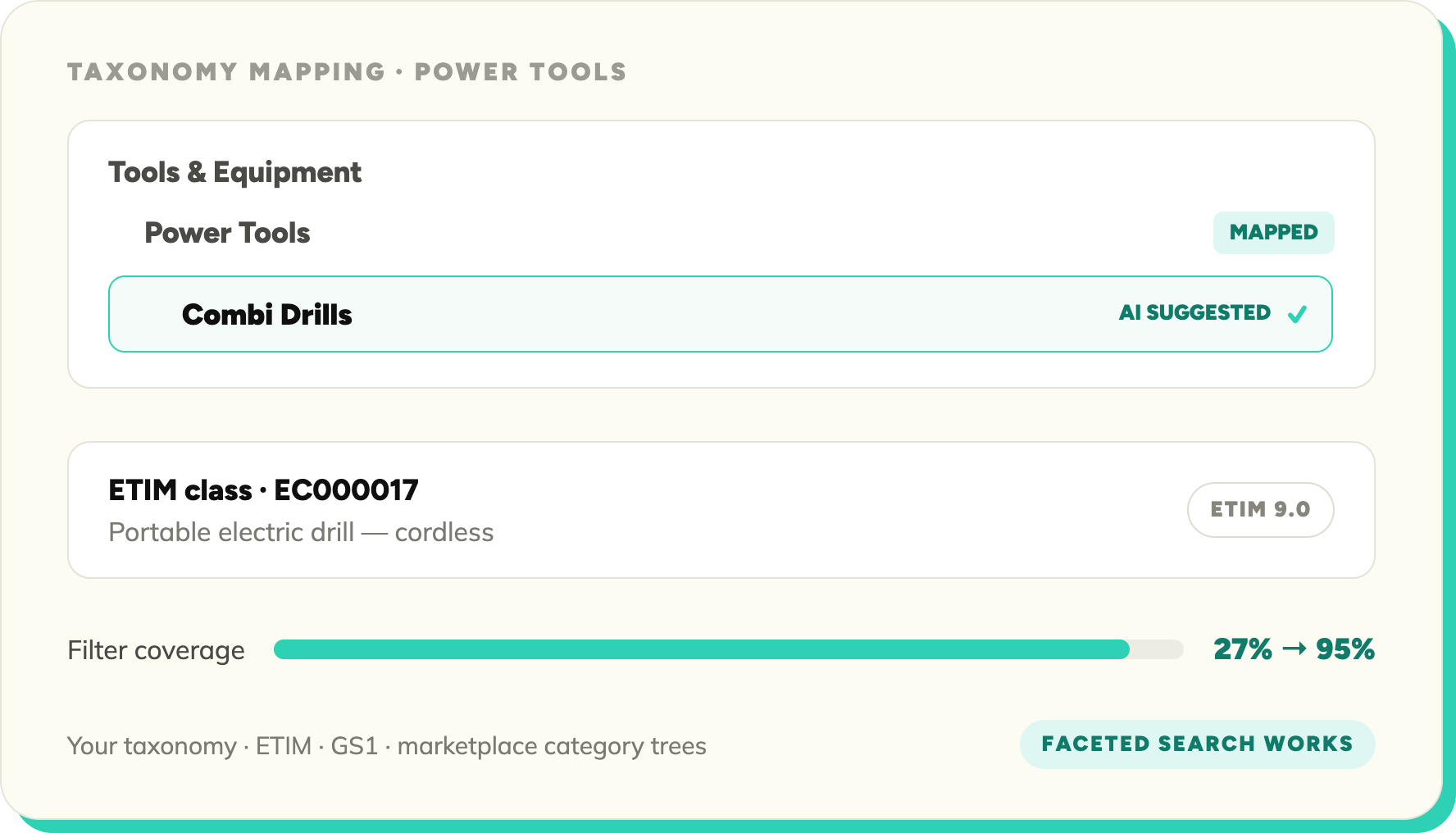
SKULaunch extracts structured attributes from whatever the supplier sent, fills gaps with targeted web research, normalises units and naming, and classifies every product against your taxonomy or against ETIM, BMEcat, and GS1. Descriptions and titles are generated from verified attributes, so nothing in the content is invented.
Every extraction carries a confidence score. High-confidence values approve automatically, while low-confidence values and missing required attributes route to your review queue. Approved records push to your PIM, webshop, or ERP in the format each destination expects, with completeness tracked by supplier, category, and attribute.
No six-month implementation and no SI partner. Most distributors have their first supplier portal live within a day and their first enriched batch back within 48 hours of setup.
Upload existing catalogue data, connect your PIM or ERP, or send suppliers a portal link. SKULaunch ingests any format: CSV, Excel, PDF, product URL, image, or data feed. No reformatting before import.
AI agents read every product record, extract structured attributes, fill gaps using web research, and generate descriptions from verified attribute data. Confidence scores on every extraction. An entire catalogue processes overnight.
High-confidence enrichments are approved automatically. Low-confidence extractions, missing required attributes, and format issues route to your team for review. You work through exceptions, not every record.
Approved, enriched data is pushed directly to your PIM, webshop, marketplace, or ERP. SKULaunch integrates with Akeneo, Shopify, Plytix, Magento, and Mirakl, formatted to each destination's requirements.
Different roles hit the product data problem from different angles. The need underneath is the same: product data management that handles distributor volume and technical complexity without a six-month project.
A major customer complains about your data, a tender is lost on catalogue quality, or a competitor's webshop does what yours cannot. Product data is invisible until it costs an account. The fix is an operating capability, not an IT project.
Revenue targets depend on search, filters, and conversion, and all three run on attribute completeness. You need the catalogue complete this quarter, without hiring a data entry team to do it.
Thousands of supplier SKUs in inconsistent spreadsheets and a launch deadline. You are the one chasing suppliers by email. A portal that collects clean data and a pipeline that enriches it gives you your week back.
New ranges win early orders for whoever lists them first. When enrichment takes six weeks, the window closes. Speed to complete, sellable listings is the difference you are measured on.
Headcount keeps growing around supplier data: chasing it, cleaning it, importing it, fixing it. You want the cost line down and the throughput up without adding another person to the process.
You run the ERP, maybe a PIM, and every data project lands on your desk. SKULaunch connects over API, needs no SI partner, and is configured by the product data team rather than by developers.
The economics changed when AI moved from generating content blindly to extracting and verifying attributes from source data first. For a distributor, three numbers tell the story.
What one UK industrial distributor calculates 14 people touching supplier data costs each year, while enrichment still runs three months behind.
PIM completeness at Bowens Australia, with enrichment running upstream of an existing Akeneo deployment and no extra headcount.
Per-SKU enrichment time at APS Industrial, down from around 45 minutes of manual work per product record.
Operations Director, UK industrial and electrical distributor
SKULaunch customers are distributors and retailers managing large supplier networks across the UK and Australia, from mid-market teams to industrial catalogues over 100,000 SKUs.
Trusted by
APS Industrial
Mole Valley Farmers
RS Group
Bowens Australia
Maxiparts

Extracts structured attributes from PDFs, product URLs, images, spec sheets, and raw text. Any source format, any product category.
Read More →
One link per supplier. AI pre-fills the submission form from the supplier's own website, validation runs at entry, and completion rates move from 12% to 80% plus.
Read More →
Applies category classification to every product, mapping to your internal taxonomy or to ETIM, GS1, and marketplace-specific category trees.
Read More →
Normalises supplier data from any format to your internal schema automatically. 200 supplier formats become one consistent dataset. No cleaning rules to write.
Read More →
Confidence score on every extraction. High-confidence values approved automatically, low-confidence values routed to your team for review. Nothing publishes without sign-off.
Read More →
Processes 1000s of SKUs in a single overnight run. AI works while your team sleeps, with completeness scores and exception reports ready in the morning.
Read More →
Integrates directly with Akeneo, Shopify, Plytix, Magento, and Mirakl. Enriched, approved data is pushed to your destination with no manual export or reformatting.
Read More →
Tracks completeness by supplier, category, and attribute in real time. Flags gaps and controls publishing, so you know where the data holes are before they reach customers.
Read More →
The AI enrichment pipeline in detail: confidence scoring, overnight runs, exception review.
Read More →How SKULaunch handles ETIM and BMEcat natively, from feed ingestion to a 95% attribute match rate.
Read More →How an Australian building supplies retailer filled an Akeneo PIM by putting enrichment upstream.
Read More →
The AI product data platform that turns messy supplier files into sales-ready content. Run it upstream of your PIM, or run it as one.
.avif)