
.avif)
.avif)
Salsify is an excellent product — for enterprise brands syndicating content to retail channels. If you're a B2B distributor managing 50+ suppliers and a technical product catalogue, the fit is a different conversation.
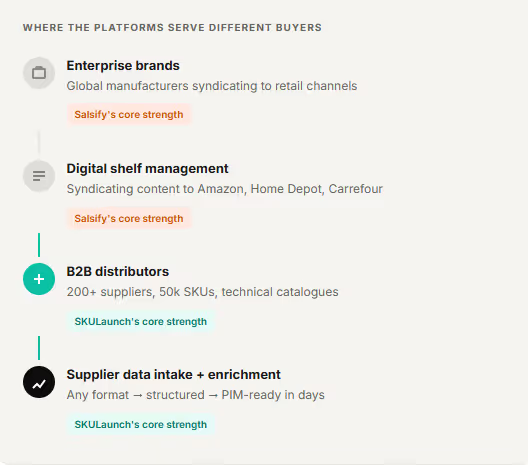
Salsify was built to solve a specific problem: helping global brands manage and syndicate product content to retailers and marketplaces at enterprise scale. For that use case — a manufacturer managing content for Home Depot, Amazon, and Carrefour simultaneously — it's one of the strongest platforms available.
Distributors have a structurally different problem. You don't create product content — you receive it, from 200 suppliers in 200 different formats, and then you need to clean it, structure it, enrich it, and get it live faster than your competitors. The challenge isn't syndication. It's intake.
Operations Director, UK industrial and electrical distributor
Before comparing features, compare buyers. Most misfits happen because the wrong platform was chosen for the wrong use case — not because either product is poor.
Right for you if...

Right for you if...
.avif)
Not a feature checklist — five specific dimensions that determine whether a platform solves your actual problem.
Supplier onboarding is handled through Supplier Data Manager, which was built for brands collecting content from agency and creative partners and fits neatly into Salsify's enterprise content workflows.
Built specifically for distributor intake. AI pre-fills the supplier portal from the supplier's own product website — suppliers confirm rather than type. 200 different supplier formats normalise to one schema automatically. No cleaning rules to write. No SI required.
Implication: the two platforms come at intake from different directions because they serve different buyers. If supplier data intake is your core bottleneck, it is the capability to test first, and it is the problem SKULaunch was designed around.
Enterprise SaaS implementation, typically delivered as a structured programme with an SI partner and dedicated internal project resource. That approach fits the scale and governance needs of the global organisations Salsify serves.
Most distributors have their first supplier portal live within a day. The enrichment pipeline runs its first batch within 48 hours of setup. No SI partner required. Your team is reviewing enriched data by the end of the first week, not the end of the first quarter.
Implication: if you have an urgent data problem, a range launch, a PIM go-live with empty fields, or a backlog of unenriched SKUs, time to value is the number to test first.
Strong for consumer and FMCG product content: titles, descriptions, images, marketing copy, and channel-specific variants, with mature tooling for managing that content across retail channels.
Built with technical distributor catalogues as a primary use case. Ingests ETIM, BMEcat, and GS1 natively with a 95% attribute match rate. Extracts voltage, IP rating, thread standard, cable cross-section, and other technical attributes from supplier PDFs and spec sheets automatically.
Implication: for electrical, industrial, HVAC, or technical categories where attribute precision drives search and filter, native ETIM and BMEcat handling is the capability to look for, and it is core to SKULaunch.
Enterprise pricing by custom quote, shaped around SKU volume, users, modules, and regions. That model suits the global brands Salsify serves, with room to configure the platform to complex multi-region requirements.
Transparent tiered pricing designed for mid-market distributors. No SI costs. No module-based upselling for core supplier onboarding functionality. Pricing is published on the website, so you can evaluate the economics before a sales call.
Implication: match the pricing model to the size of your team. SKULaunch pricing is built around distributors with one to five people managing product data.
Strong governance and workflow tools for managing product content once it is in the system, with mature approval processes and channel-readiness checks built for enterprise content teams.
The enrichment pipeline runs overnight across your entire catalogue, confidence-scoring every extraction and routing exceptions to your team the next morning. 1000s of SKUs enriched in one run. Completeness from 52% to 93%. The AI keeps running as new supplier data arrives.
Implication: If you have a backlog of enrichment work — a catalogue at 50% completeness that needs to reach 90%+ — SKULaunch solves the backlog problem as well as the intake problem.
An honest comparison. Salsify's genuine strengths are included — this table is for helping you make the right decision, not the easiest one.

Salsify ticks in the final two rows are intentional — these are genuine Salsify strengths. If those rows describe your primary use case, Salsify is probably the better fit.
This is the section most comparison pages skip. We're including it because recommending the wrong platform helps no one.
Salsify is genuinely the better choice if your primary challenge is managing and syndicating brand content to retail channels and marketplaces at enterprise scale. If you are a manufacturer selling through hundreds of retail partners and you need channel-specific content governance, digital shelf analytics, and retailer compliance tooling, choose Salsify. That is the problem it was built for, and it does it well.
If you are a distributor who had a Salsify demo and felt it was built for a different kind of organisation, a global brand with a dedicated SI partner and a multi-year roadmap, trust that instinct. The two platforms are built for different buyers, and that is the point of this page.
SKULaunch customers are B2B distributors and retailers managing large supplier networks — not enterprise brands looking for digital shelf tools.
Trusted by
APS Industrial
Mole Valley Farmers
RS Group
Bowens Australia
Maxiparts
GSF Car Parts
Operations Director, UK industrial and electrical distributor
Distributors managing 50 to 500 suppliers use SKULaunch to replace the spreadsheet-based intake process entirely. Suppliers receive a single link and submit data in whatever format they have — their own catalogue, a PDF line card, a product URL. AI maps their format to your schema and flags issues before anything reaches your review queue. Completion rates go from 12% to 80%+.
Distributors with a backlog — a catalogue that's 50% complete and needs to reach 90%+ before a digital channel launch — use the enrichment pipeline to process tens of thousands of SKUs overnight. AI extracts technical attributes from existing content, scores confidence on every extraction, and routes exceptions to your team for morning review.
Electrical and industrial distributors working with ETIM-classified product data use SKULaunch to ingest ETIM feeds and map them to their internal schema automatically. Suppliers who don't provide ETIM-formatted data can still feed an ETIM-aligned catalogue — SKULaunch extracts the relevant technical attributes from whatever the supplier sends.
When a supplier launches a new range, the distributor who gets it live first takes the early orders while competitors are still processing spreadsheets. SKULaunch gives distributors that window — from supplier invite sent to enriched, validated data in your PIM in under 48 hours.
One link per supplier. AI pre-fills from their own website. Supplier confirms. Validated, structured data lands in your review queue. Completion rates go from 12% to 80%+.
Entire catalogue enriched overnight. 1000s of SKUs. Confidence-scored. Your team reviews the exceptions, not every record. Completeness from 52% to 93% in a single run.
ETIM, BMEcat, GS1 — automatically mapped to your schema. 95% attribute match rate. No manual mapping required. Gaps filled by AI from supplier content.
Nothing goes live without your sign-off. Every submission routes through your review queue. Full audit trail — who approved what, when, and what changed.
200 supplier formats normalised to one schema automatically. No cleaning rules to write. Supplier calls it "operating voltage," you call it "voltage" — AI resolves it without configuration.
Real-time completeness scoring by supplier, category, and attribute. Flags gaps. Controls publishing. You see exactly where the data gaps are before they reach your customers.


The AI product data platform that turns messy supplier files into sales-ready content. Run it upstream of your PIM, or run it as one.
.avif)