
.avif)

Akeneo is a strong PIM for managing and syndicating product content. Getting clean data in from hundreds of suppliers in dozens of formats is a different job, and it is the job SKULaunch was built for. The two work well together.
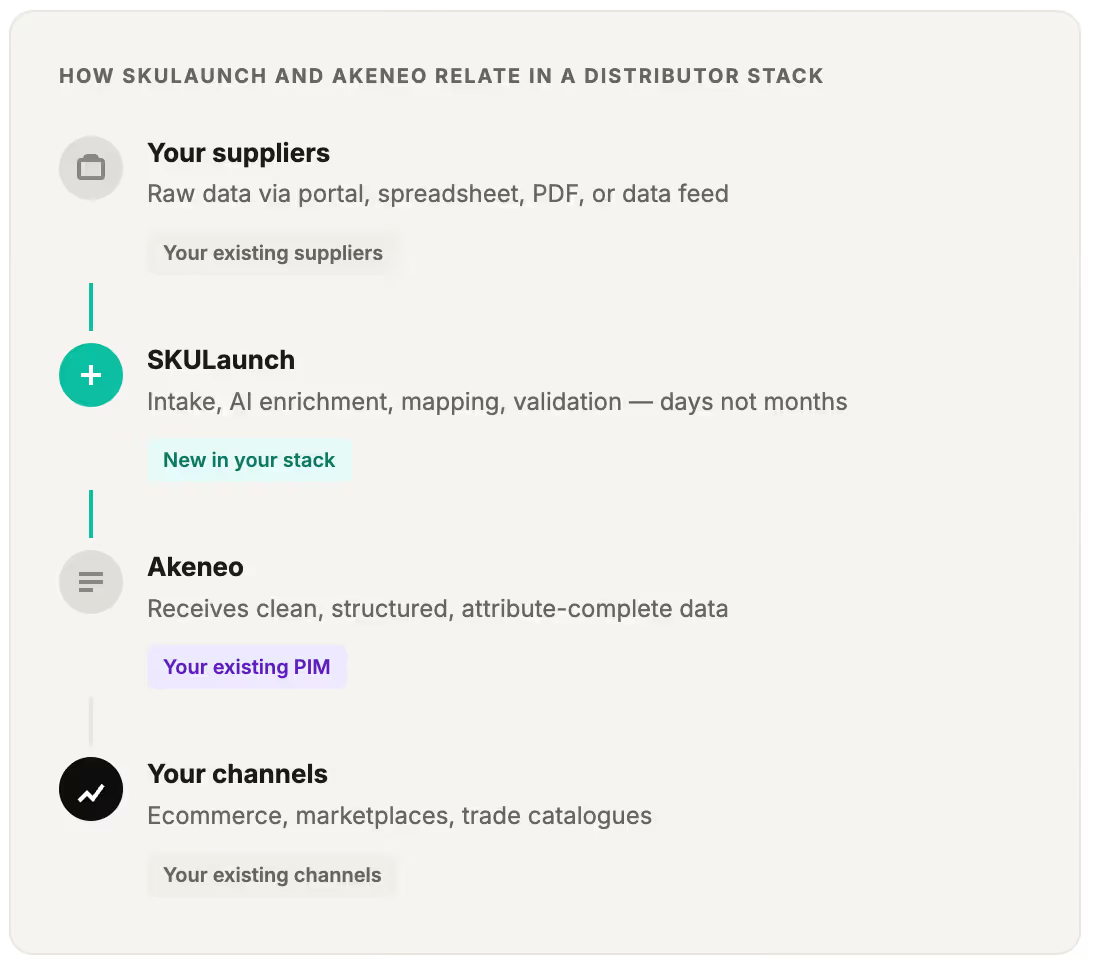
Akeneo is a genuinely strong PIM — flexible data modelling, powerful omnichannel syndication, a large partner ecosystem, and an open-source Community Edition that lets technical teams build exactly what they need. For managing and distributing product content once it's clean, it's one of the best tools available.
The problem distributors hit is upstream. A PIM works best when clean, structured data is coming in. For a distributor with 200 suppliers, each sending data in a different format, at a different quality level, on a different timeline, the data is rarely clean when it arrives. Collecting it, structuring it and enriching it is a job in its own right, and it is the job SKULaunch was built to do.
Operations Director, UK industrial and electrical distributor
The most important question isn't which platform has more features — it's which one was built for your specific situation. For many distributors, the answer is both: SKULaunch upstream handling intake and enrichment, Akeneo downstream managing and syndicating the clean data that results.
Right for you if...

Right for you if...
.avif)
Akeneo and SKULaunch are not direct competitors — they solve different parts of the product data problem. But for distributors choosing between them, or trying to understand whether SKULaunch replaces or complements Akeneo, these five dimensions are where the decision gets made.01
Akeneo collects product data through CSV imports and its Supplier Data Manager module, which brings supplier submissions into the Akeneo workflow and keeps them governed inside the PIM. It works well when suppliers can follow your template and your team owns the mapping.
Built specifically for the distributor intake problem. Suppliers receive one magic link — no account, no training needed. AI pre-fills the submission form from the supplier's own product website. 200 different supplier formats normalise to one schema automatically. Completion rates go from 12% to 80%+. Live within a day.
Implication: the two platforms treat intake differently because they were built for different jobs. Akeneo is built to manage and distribute content. SKULaunch is built to get supplier data in, whatever format it arrives in.
Akeneo has introduced AI-assisted features including attribute suggestions and content generation, which speed up record editing inside the PIM and sit naturally within its governed workflows.
SKULaunch was built for bulk enrichment. Point it at your existing catalogue and it runs extraction, normalisation and content generation across tens of thousands of SKUs in a single run, confidence-scoring every value so your team only reviews the exceptions. Completeness moves in days rather than quarters.
Implication: if you have an urgent data problem, a range launch, a PIM go-live, or a backlog of unenriched SKUs, bulk enrichment speed is the capability to test first.
Akeneo offers real depth for technical teams: an open-source Community Edition, flexible data modelling, and Growth and Enterprise SaaS editions backed by a large partner ecosystem. Teams with developer resource or an SI partner can shape the platform around exactly the workflows they need.
No developer or SI required. Your team configures the attribute schema, validation rules, and supplier templates through a no-code interface. First supplier portal live within a day. First enrichment run within 48 hours. The platform is built for product data managers and ecommerce teams — not for developers who know how to configure a PIM.
Implication: it comes down to the team you have. With developer resource or a partner, Akeneo gives you deep configurability. If you want product data managers to run everything themselves through a no-code interface, that is what SKULaunch is built for.
Akeneo can store ETIM-classified product data, and its marketplace includes community-built ETIM connectors, so teams already working with a partner can bring ETIM data into their Akeneo model.
ETIM, BMEcat, and GS1 ingestion is native — not a connector or add-on. SKULaunch maps supplier data to ETIM classification automatically with a 95% attribute match rate. Suppliers who don't send ETIM-formatted data can still feed an ETIM-aligned catalogue — SKULaunch extracts the relevant technical attributes from whatever they send.
Implication: for electrical, industrial and building supplies distributors where ETIM compliance is a procurement requirement, SKULaunch handles the standard natively and feeds it into whichever platform sits downstream.
This is where Akeneo genuinely leads. Powerful omnichannel syndication, advanced workflow and approval processes, localisation and translation management, DAM integration, 500+ activation channels, and a large ecosystem of syndication connectors. If managing and distributing clean product content across multiple channels is your primary need, Akeneo is one of the best tools for it.
SKULaunch does not replace Akeneo's content management and syndication capabilities. It integrates with Akeneo as an upstream supplier. Enriched, approved data from SKULaunch pushes directly into Akeneo attributes and families — and then Akeneo does what it does best: managing and distributing that content across channels.
Implication: Akeneo is the right tool for content management and syndication. SKULaunch is the right tool for getting clean data into Akeneo in the first place. For many distributors, the best answer is both.
Akeneo's strengths in content management and syndication are real — and included honestly here. For distributors deciding between the two, or evaluating whether to use both, this table shows where each platform leads.

Akeneo's ticks in syndication, workflow, open-source, and localisation are genuine strengths — that's why many distributors use both platforms together rather than choosing one.
This is the section most comparison pages skip. We're including it because recommending the wrong platform helps no one, and because the relationship between SKULaunch and Akeneo is more nuanced than a simple versus.
Choose Akeneo alone if your primary challenge is managing and distributing product content that is already clean and structured: localisation, channel-specific variants, multi-team governance, and enterprise-scale syndication. With a technical team or partner alongside, Akeneo is a powerful platform for what it does.
Choose SKULaunch alone if you don't need a full PIM — you need a fast, no-code way to collect supplier data, enrich it with AI, and push clean records directly to Shopify, Plytix, or another ecommerce platform. Many mid-market distributors find they don't need a PIM at all once SKULaunch is handling the upstream data work.
Use both together if you have Akeneo for content management and syndication but your supplier data intake is still a manual, spreadsheet-driven process. SKULaunch sits upstream of Akeneo — collecting, enriching, and validating supplier data before it enters — and pushes clean, structured records directly into your Akeneo attribute families. Your PIM gets populated; your team stops chasing suppliers.
SKULaunch customers are B2B distributors and retailers managing large supplier networks — some with Akeneo already in place, some without a PIM at all.
Trusted by
APS Industrial
Mole Valley Farmers
RS Group
Bowens Australia
Maxiparts
GSF Car Parts
Operations Director, UK industrial and electrical distributor
The most common distributor scenario: Akeneo is live and the team wants the catalogue fully populated faster. SKULaunch connects to Akeneo via API, enriches the existing catalogue in a single batch run, and routes new supplier submissions directly into the correct attribute families. The PIM gets fully populated without extra headcount.
Distributors who want a dedicated supplier portal alongside Akeneo use SKULaunch as the intake layer: AI pre-fill from supplier websites, any-format acceptance, and validation against your Akeneo schema before anything reaches your review queue. Completion rates typically move from around 12% to 80% or more.
Mid-market distributors with 5,000–30,000 SKUs often don't need a full PIM. SKULaunch handles supplier intake, AI enrichment, validation, and governs a single source of truth — then pushes clean data directly to Shopify, Plytix, or their ecommerce platform. No Akeneo licence, no SI, no implementation project.
Distributors mid-Akeneo implementation use SKULaunch to solve the data problem in parallel — enriching their back-catalogue while the PIM build is underway. By the time Akeneo is configured, the data is ready. The SI doesn't have to wait for content, and the go-live isn't delayed by empty product pages.
One link per supplier. AI pre-fills from their own website. Supplier confirms. Validated, structured data lands in your review queue — mapped to your Akeneo attribute families. Completion rates go from 12% to 80%+.
Entire catalogue enriched in a single run. 1000s of SKUs. Confidence-scored. Your team reviews the exceptions. Completeness from 52% to 93%, ready to push into Akeneo.
ETIM, BMEcat, GS1 — automatically mapped to your Akeneo attribute schema. 95% attribute match rate. No custom connector development. No manual mapping project.
Nothing enters Akeneo without your sign-off. Every submission routes through your review queue. Full audit trail — who approved what, when, and what changed — before it hits the PIM.
200 supplier formats normalised to your Akeneo attribute structure automatically. No cleaning rules to write. SKULaunch resolves naming differences and value variants before data enters your PIM.
Real-time completeness scoring by supplier, category, and Akeneo attribute. Flags gaps before publishing. You see exactly where the data holes are — before they reach Akeneo and your channels.

Most teams shortlist more than one platform. We have written the same side by side for each.
Where the two overlap on AI enrichment, and which part of the workflow each was built for.
Explore →Two AI-first approaches to supplier data, and how the scope of each differs.
Explore →A PIM and the layer that feeds it. Many teams run both, and Plytix is an integration partner.
Explore →
The AI product data platform that turns messy supplier files into sales-ready content. Run it upstream of your PIM, or run it as one.
.avif)