
Black circular shape with three horizontal black bars extending to the right.

vs

SKULaunch vs Pimberly: the supplier data layer and the PIM, compared

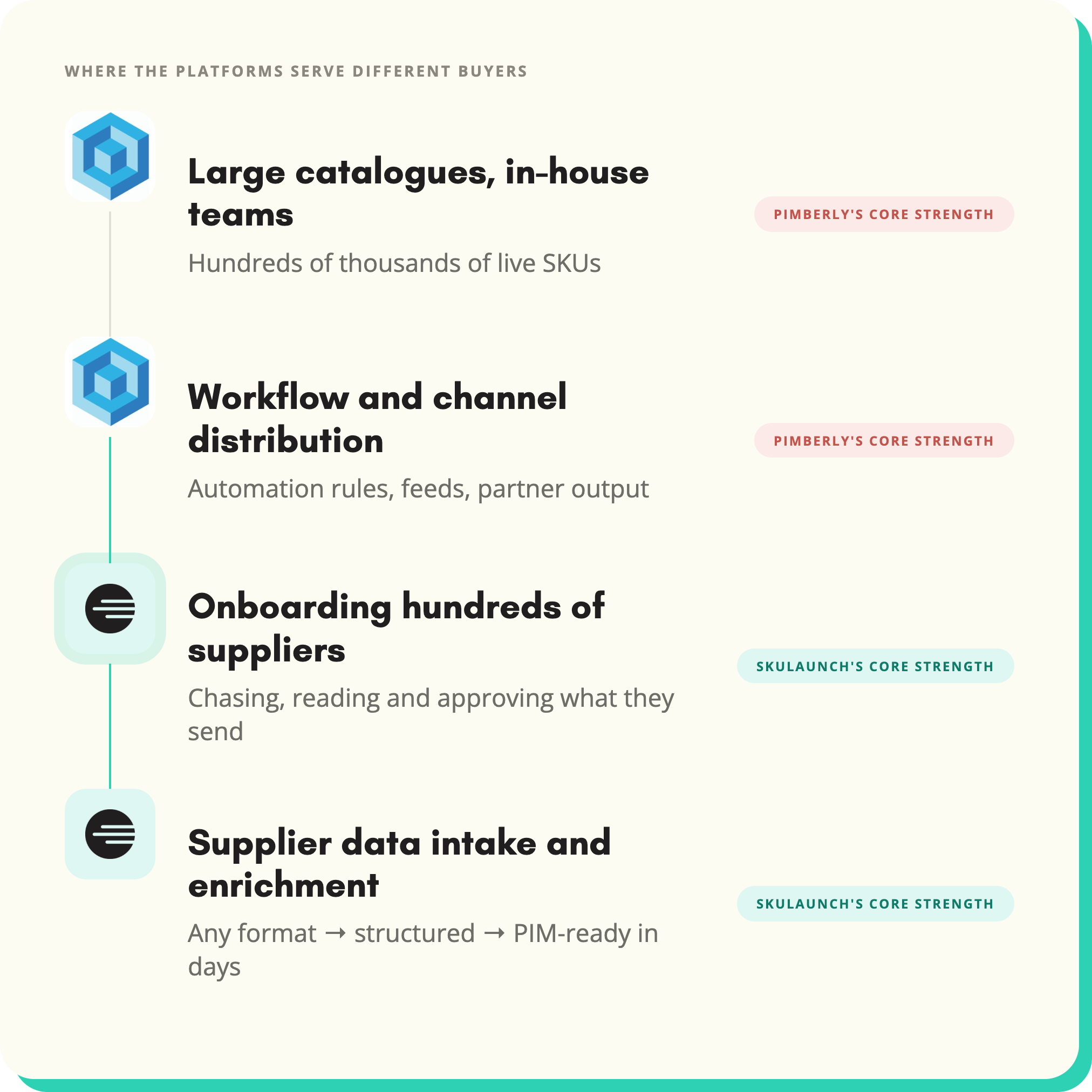
Pimberly is a UK-built PIM used by manufacturers, distributors and retailers to manage large product catalogues. SKULaunch solves a different part of the problem: collecting, structuring and enriching supplier data before it reaches a PIM. This page walks through where each platform leads and when the two work together.
The Notes App for Power Users - Techbeta X Webflow Template
SKULaunch and Salsify Comparison
100%
Tasks completion rate
10M+
Capital raised

80%+

Supplier portal completion rates with SKULaunch, up from around 12% with spreadsheet and email processes

<1 day

SKULaunch first supplier portal live, with no SI partner and no project plan

95%

ETIM and BMEcat attribute match rate when SKULaunch maps supplier data to your schema
THE HONEST CONTEXT

Why distributors search for a Pimberly alternative

Pimberly is a strong PIM with a lot to recommend it: product information and digital asset management in one platform, a powerful workflow and automation engine, an API-first design, and a UK base with UK support. For managing and distributing a large, complex catalogue, it is a serious contender.

What sends distributors looking for alternatives is usually the work upstream of the PIM. A PIM is at its best when clean, structured data flows in. For a distributor with 200 suppliers sending spreadsheets, PDFs and price lists in 200 formats, getting to that clean feed is a project in itself. That intake and enrichment work is the job SKULaunch was built for.

So treat this as two comparisons in one. If you are choosing a PIM, Pimberly belongs on the shortlist, especially for UK teams. If you are trying to fix supplier data intake and enrichment, SKULaunch is the specialist layer, and it pushes clean, approved records into the PIM you choose.
"We have 14 people whose job touches supplier data in some way. Chasing it, cleaning it, importing it, fixing it. When I work out the cost, it's about £400k a year. And we're still 3 months behind on enrichment."

Operations Director, UK industrial and electrical distributor

This page covers both scenarios: teams comparing the two platforms directly, and Pimberly users who want to solve the supplier data intake problem upstream of their PIM.
Buyer fit

Who each platform is actually built for

Before comparing features, compare jobs. SKULaunch and Pimberly solve neighbouring problems, and for some distributors the right answer is both.

Black circular shape with three horizontal black bars extending to the right.

SKULaunch

Right for you if...

Green circular icon with a black check mark in the center indicating confirmation or success.
You're a B2B distributor or retailer managing 50–500+ suppliers
Green circular icon with a black check mark in the center indicating confirmation or success.
Supplier data arrives in inconsistent formats and your team spends headcount cleaning it
Green circular icon with a black check mark in the center indicating confirmation or success.
You manage a technical catalogue where attribute completeness drives search and filter
Green circular icon with a black check mark in the center indicating confirmation or success.
You need new product ranges live in days, not weeks
Green circular icon with a black check mark in the center indicating confirmation or success.
You want something that works without a six-month implementation and SI partner
Green circular icon with a black check mark in the center indicating confirmation or success.
Mid-market: 5,000 to 100,000 SKUs, one to five people managing product data
Green circular icon with a black check mark in the center indicating confirmation or success.
You work with ETIM, BMEcat, or GS1 product data standards
Abstract design of six overlapping light blue circles forming a flower-like pattern.

Pimberly

Right for you if...

Black checkmark inside an orange circle.
You need a PIM to manage a large, complex product catalogue day to day
Black checkmark inside an orange circle.
You want product information and digital asset management in one platform
Black checkmark inside an orange circle.
You value a powerful workflow and automation engine for content processes
Black checkmark inside an orange circle.
You are a UK or US team that wants an established PIM vendor with local support
Black checkmark inside an orange circle.
You manage both B2B and B2C channels from one product data source
Black checkmark inside an orange circle.
You have the team and timeline for a structured PIM implementation
Black checkmark inside an orange circle.
Your supplier data is already reasonably clean and your bottleneck is managing and publishing it
The comparison

Five dimensions that matter to distributors

Five dimensions that show how the platforms differ, and where they meet in the middle.

01

Supplier data intake

Pimberly

Pimberly brings product data in through imports, feeds, and its API, and gives your team workflow tools to process it once it arrives. As a PIM, it assumes your team or your integration owns the mapping step.

SKULaunch

Built specifically for distributor intake. Suppliers receive one magic link. AI pre-fills the portal from the supplier's own product website, so suppliers confirm rather than type. 200 different supplier formats normalise to one schema automatically. No cleaning rules to write.

Implication: the two platforms meet at the import step. Pimberly manages what arrives. SKULaunch makes sure what arrives is complete, structured and validated, then pushes it into your PIM automatically.

02

Implementation and time to value

Pimberly

Pimberly implementations are structured and supported, sized to the scale of catalogue and channel complexity the platform is built to handle.

SKULaunch

Most distributors have their first supplier portal live within a day. The enrichment pipeline runs its first batch within 48 hours of setup. No SI partner required. Your team is reviewing enriched data by the end of the first week, not the end of the first quarter.

Implication: if you have an urgent data problem, a range launch, a PIM go-live with empty fields, or a backlog of unenriched SKUs, time to value is the number to test first.

03

Technical product data and standards

Pimberly

Pimberly models complex product hierarchies and attribute structures well, and pairs them with built-in digital asset management and automation rules.

SKULaunch

Built with technical distributor catalogues as a primary use case. Ingests ETIM, BMEcat, and GS1 natively with a 95% attribute match rate. Extracts voltage, IP rating, thread standard, cable cross-section, and other technical attributes from supplier PDFs and spec sheets automatically.

Implication: for electrical, industrial, HVAC, or technical categories where attribute precision drives search and filter, native ETIM and BMEcat handling is the capability to look for, and it is core to SKULaunch.

04

Pricing and total cost

Pimberly

Pimberly pricing is tailored to each customer based on catalogue size and requirements, which suits the larger and more complex deployments it serves.

SKULaunch

Transparent tiered pricing designed for mid-market distributors. No SI costs. No module-based upselling for core supplier onboarding functionality. Pricing is published on the website, so you can evaluate the economics before a sales call.

Implication: match the pricing model to the size of your team and catalogue. SKULaunch publishes its pricing and is built around distributors with one to five people managing product data.

05

Bulk enrichment at catalogue scale

Pimberly

Pimberly gives teams strong in-PIM tools for improving records at scale: workflow automation, completeness tracking, and rules that keep a large catalogue consistent.

SKULaunch

The enrichment pipeline runs overnight across your entire catalogue, confidence-scoring every extraction and routing exceptions to your team the next morning. 80,000 SKUs enriched in one run. Completeness from 52% to 93%. The AI keeps running as new supplier data arrives.

Implication: if you have a backlog of enrichment work, a catalogue at 50% completeness that needs to reach 90% or more, SKULaunch clears the backlog and your PIM keeps the results organised.

Want to see how SKULaunch gets clean supplier data into your PIM?
Book a 30-minute demo →
Side by side

SKULaunch vs Pimberly at a glance

An honest comparison. The ticks reflect two platforms built for different layers of the product data stack.

FEATURE

SKULaunch

PIMBERLY

Built primarily
for B2B distributors

Green circular icon with a black check mark in the center indicating confirmation or success.
Gray circular button with a bold gray X symbol in the center.

AI-powered supplier data intake (any format)

Green circular icon with a black check mark in the center indicating confirmation or success.
Gray circular button with a bold gray X symbol in the center.

ETIM and BMEcat
native
support

Green circular icon with a black check mark in the center indicating confirmation or success.
Gray circular button with a bold gray X symbol in the center.

Implementation time

DAYS

Structured programme

Built-in digital asset management

Gray circular button with a bold gray X symbol in the center.
Black checkmark inside an orange circle.

Overnight bulk
enrichment
(80k+ SKUs)

Green circular icon with a black check mark in the center indicating confirmation or success.
Gray circular button with a bold gray X symbol in the center.

Published monthly pricing

Green circular icon with a black check mark in the center indicating confirmation or success.
Gray circular button with a bold gray X symbol in the center.

Confidence-scored AI extraction

Green circular icon with a black check mark in the center indicating confirmation or success.
Gray circular button with a bold gray X symbol in the center.

Digital shelf
syndication
to retail channels

Gray circular button with a bold gray X symbol in the center.
Black checkmark inside an orange circle.

Enterprise brand
and manufacturer
use
case

Gray circular button with a bold gray X symbol in the center.
Black checkmark inside an orange circle.

Pimberly ticks reflect genuine strengths: it is an established PIM with DAM and automation built in. SKULaunch is built to feed the PIM layer, not replace it.

Who it's for

When to choose Pimberly, and when to use both

This is the section most comparison pages skip. We're including it because recommending the wrong platform helps no one.

Choose Pimberly as your PIM if you need an established platform to manage a large, complex catalogue, you want PIM and DAM in one place, and a workflow engine matters to your team. Its UK base is a real advantage for UK distributors who want local support. If your supplier data arrives clean, a strong PIM may be all you need.

Use both together if the PIM layer is right but the data feeding it is not. SKULaunch sits upstream, collects supplier submissions through the portal, enriches and validates them, and pushes approved records into your PIM. The PIM stays the system of record. Your team stops cleaning spreadsheets.

Trusted by product data teams

Used by product data teams at distributor scale

SKULaunch customers are B2B distributors and retailers managing large supplier networks, some with an established PIM in place, some without one at all.

Trusted by

APS Industrial

Mole Valley Farmers

RS Group

Bowens Australia

Maxiparts

GSF Car Parts

"Distribution is structurally different from retail. You don't control the product, your suppliers do. You can't make 200 people use the same spreadsheet template the same way. So you've hired people to manage the chaos instead. And the chaos still wins, because it grows faster than the team does."

Operations Director, UK industrial and electrical distributor

Use cases

What distributors use SKULaunch for, with and without a PIM

Feeding an under-populated PIM

The PIM is live, the team is trained, but the catalogue is incomplete because supplier data still arrives by email and spreadsheet. SKULaunch enriches the existing catalogue in a batch run and routes new supplier submissions straight into the right fields. The PIM fills up without extra headcount.

Overnight enrichment of existing catalogues

Distributors with a backlog, a catalogue that is 50% complete and needs to reach 90% or more before a digital channel launch, use the enrichment pipeline to process tens of thousands of SKUs overnight. AI extracts technical attributes, scores confidence on every extraction, and routes exceptions to your team for morning review.

ETIM and technical standards mapping

Electrical and industrial distributors working with ETIM-classified product data use SKULaunch to ingest ETIM feeds and map them to their internal schema automatically. Suppliers who do not provide ETIM-formatted data can still feed an ETIM-aligned catalogue: SKULaunch extracts the relevant technical attributes from whatever the supplier sends.

New product range launches in days

When a supplier launches a new range, the distributor who gets it live first takes the early orders. SKULaunch gives distributors that window: from supplier invite sent to enriched, validated data in your PIM in under 48 hours.

How it works

From messy supplier files to PIM-ready data in days

1

Connect your systems

SKULaunch connects to your PIM, ecommerce platform, or ERP via API. It reads your existing attribute structure and uses it as the blueprint supplier submissions are mapped against. Setup takes under an hour. No SI involvement required.

2

Define your attribute schema

Set up your product types, required attributes, validation rules, and accepted value lists. SKULaunch AI can suggest schemas for any product category in minutes, including ETIM-aligned attributes for technical products. This becomes the blueprint every supplier submission is mapped against.

3

Send suppliers one link

Each supplier receives a single magic link. They click it, submit data in any format: URL, spreadsheet, PDF, or raw text. AI extracts attributes automatically, pre-fills the submission form, and validates against your schema before anything reaches your team. No supplier account required. No template to fill in.

4

Review, approve and publish

Your team reviews the exceptions AI has flagged, not the entire dataset. Approve what is clean, push back on what needs attention, then publish enriched data directly to your PIM, ecommerce platform, or ERP. Nothing goes live without your approval. Every decision is logged in a full audit trail.
Key capabilities

Everything you need to replace the spreadsheet chaos

Built for distribution volumes. Whether you're managing 5,000 or 100,000 SKUs across 50 or 500 suppliers, SKULaunch handles the supplier count, SKU count, and data complexity that distribution businesses deal with daily.
AI attribute extraction

One link per supplier. AI pre-fills from their own website. Supplier confirms. Validated, structured data lands in your review queue. Completion rates go from 12% to 80%+.

AI enrichment studio

Entire catalogue enriched overnight. 80,000 SKUs. Confidence-scored. Your team reviews the exceptions, not every record. Completeness from 52% to 93% in a single run.

Standards and data feeds

ETIM, BMEcat, GS1, automatically mapped to your schema. 95% attribute match rate. No manual mapping required. Gaps filled by AI from supplier content.

Approval workflows

Nothing goes live without your sign-off. Every submission routes through your review queue. Full audit trail of who approved what, when, and what changed.

Mapping and normalisation

200 supplier formats normalised to one schema automatically. No cleaning rules to write. The supplier calls it operating voltage, you call it voltage, and AI resolves it without configuration.

Product data quality

Real-time completeness scoring by supplier, category, and attribute. Flags gaps. Controls publishing. You see exactly where the data gaps are before they reach your customers.

Frequently asked

Questions about SKULaunch and Pimberly

Is SKULaunch an alternative to Pimberly?
Black upward-pointing arrow composed of black squares with missing parts creating a pixelated effect on a white background.
It depends which problem you are solving. Pimberly is a PIM: it manages, organises and distributes product content, with digital asset management and workflow built in. SKULaunch is the layer upstream: it collects supplier data, enriches it with AI, and pushes clean records into a PIM or ecommerce platform. If your challenge is managing content, Pimberly is the right kind of tool. If your challenge is getting clean data in, that is SKULaunch.
Does SKULaunch replace our PIM?
Black upward-pointing arrow composed of black squares with missing parts creating a pixelated effect on a white background.
No. SKULaunch is not a PIM, it is the layer that feeds your PIM with clean, structured data. It sits upstream of whatever system you use for content management, and pushes enriched records in on approval. Some smaller distributors run SKULaunch straight into Shopify or Magento without a separate PIM.
How long does SKULaunch take to implement
alongside a PIM like Pimberly?
Black upward-pointing arrow composed of black squares with missing parts creating a pixelated effect on a white background.
Most SKULaunch customers have their first supplier portal live within a day and their first enrichment run complete within 48 hours of setup, with no SI partner required. SKULaunch reads your existing attribute structure and maps supplier submissions against it, so enriched records arrive in the shape your PIM expects.
Does SKULaunch handle ETIM and technical product data standards?
Black upward-pointing arrow composed of black squares with missing parts creating a pixelated effect on a white background.
Yes. SKULaunch ingests ETIM, BMEcat, and GS1 data feeds natively and maps them to your internal schema automatically, with a 95% attribute match rate. It also extracts ETIM-relevant technical attributes from non-standard supplier files, so even suppliers who do not provide ETIM-formatted data can still feed your ETIM-aligned catalogue. For electrical, industrial, and building supplies distributors, this is a core capability, not a custom add-on.
How does SKULaunch pricing compare to Pimberly?
Black upward-pointing arrow composed of black squares with missing parts creating a pixelated effect on a white background.
SKULaunch publishes monthly pricing on the website: Starter from £499 per month for up to 10,000 SKUs and Scale from £1,299 per month for up to 100,000 SKUs, with custom Enterprise plans above that. Pimberly pricing is tailored to each customer based on catalogue size and requirements, which suits the larger deployments it serves. The two are priced as different layers of the stack, and some teams budget for both.

Ready to get clean supplier data into your PIM, or replace the spreadsheet chaos entirely?

Book a 30-minute demo. Bring a sample of your messiest supplier file and we will show you what the enrichment pipeline does with it in real
time.
© 2026 SKU Launch Ltd. All rights reserved.
Built for e-commerce teams who are done doing it by hand.