
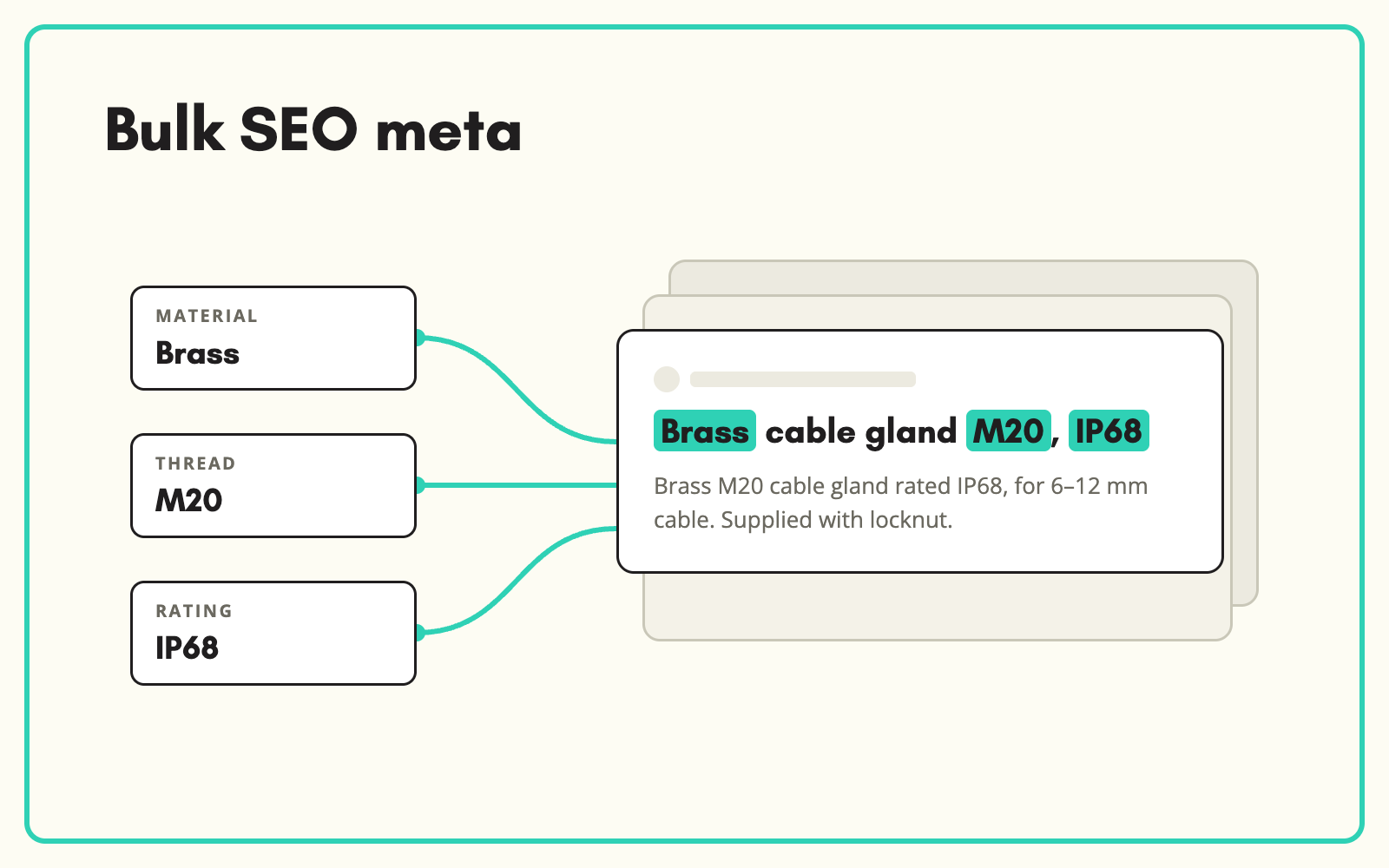
Writing SEO meta titles and descriptions for every product page is the kind of job that never gets done by hand. SKULaunch generates them in bulk from each product's verified attributes, to the length limits and patterns you set, so thousands of product pages get unique, accurate meta instead of blanks or duplicates.
The problem
On most catalogues, product meta is either empty, so search engines improvise from page text, or templated as "Product name | Brand", so thousands of pages share the same pattern and say nothing about the product. Free meta description generators work one page at a time and know nothing about your product data, so they produce generic copy that can contradict the specification. Doing it properly by hand for 20,000 SKUs is not realistic.
Before and after
An illustrative example for a stainless steel sink.
Before: the current meta
Title: "Sink | ACME Home". Description: blank, so the search snippet shows cookie banner text.
After: generated in SKULaunch
- Meta title: Single Bowl Stainless Steel Kitchen Sink, 1.0 Bowl Reversible | ACME Home
- Meta description: Inset single bowl sink in brushed stainless steel with reversible drainer. 860 x 500 mm, 180 mm bowl depth, waste and overflow included.
- Every figure taken from the product's approved attributes
- Within your title and description length limits
How it works in SKULaunch
- Set the rules per category. Decide which attributes lead the title, what the description should cover, the tone and the length limits. A sink and a cable need different patterns.
- Generate from verified data. Content generation uses the approved attributes on each product, so meta never claims a spec the product does not have.
- Review in bulk. Check the results in the grid alongside the attributes they came from, edit where needed, and approve.
- Publish to your platform. Meta fields go out with the rest of the record to Shopify, Magento, WooCommerce or your PIM.
What good product meta looks like
A strong product meta title leads with what the shopper searches for, the product type, then adds the one or two attributes that separate it from similar products, then the brand. Keep it to roughly 50 to 60 characters so it is not cut off. A strong meta description gives the specifics a shopper uses to choose, such as size, material, capacity or compatibility, in about 150 to 160 characters, with no filler. Search engines may rewrite snippets, but they rewrite thin and duplicated ones far more often than specific, accurate ones.
What changes
Every product page gets meta that describes that product, in your format, without a copywriter touching each one. Updates follow the data: change an attribute and the meta can be regenerated to match.
Common questions
Can we keep meta we have already written?
Yes. Generate only for products with blank or templated meta and leave hand-written meta untouched.
Does it work for category pages too?
This use case covers product pages. Category meta is usually written by hand because there are far fewer of them.
Will it stuff keywords?
No. Meta is written for the shopper, from the product's own attributes, within the limits you set.
See content generation, catalogue enrichment, and how to write product descriptions at scale.

.avif)