
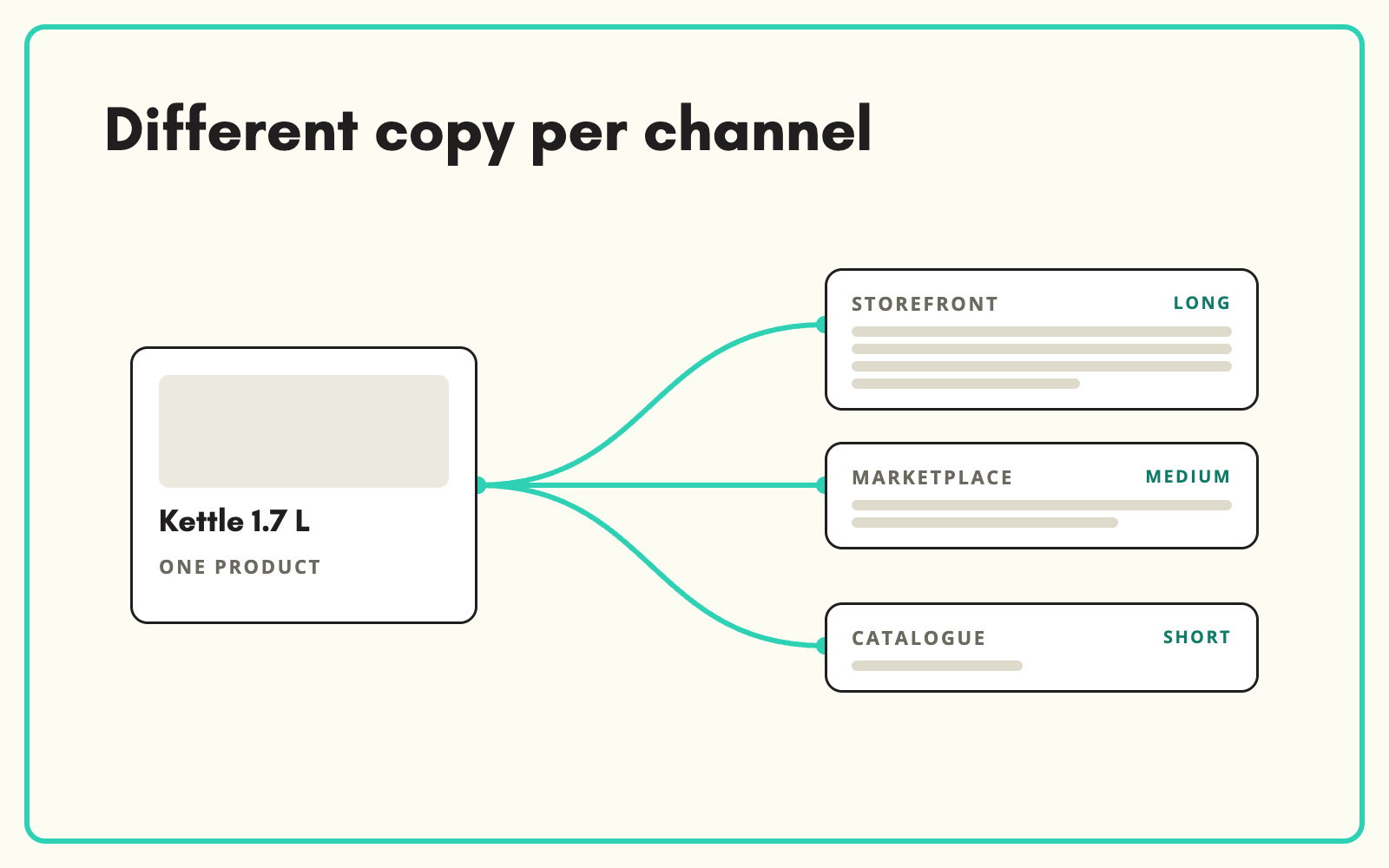
Your website, Amazon and a trade catalogue each want different copy for the same product. SKULaunch writes channel specific product content, titles, descriptions and bullets, from one set of verified attributes, so every channel gets copy in its format without anyone maintaining separate versions.
The problem
Channels have different rules: title formulas, character limits, bullet counts, banned words. Teams either push the same copy everywhere, which breaks rules and wastes space, or hand-edit a version per channel, which drifts out of date the moment a spec changes.
Before and after
An illustrative example for one power tool sold through a retailer's three channels.
Before: one description everywhere
A 900-character website description pasted into Amazon, truncated in the trade catalogue, and missing the bullets the marketplace expects.
After: from SKULaunch
- Website: full description with use cases and specifications
- Amazon: title to the category formula, five bullets, a shorter description
- Trade catalogue: 200-character technical summary
- All generated from the same approved attributes
How it works in SKULaunch
- Create channel content fields. Hold a title, description and bullets per channel as separate attributes.
- Set the rules per channel. Lengths, formulas and style for each.
- Generate from one source. All channel copy comes from the same verified attributes.
- Publish to each channel. Each channel receives its own fields.
Regenerate channel specific product content, do not maintain it
The trap with per-channel copy is maintenance. If each version is hand-edited, a spec change means editing it four times. If each version is generated from the same attributes, a spec change means updating one value and regenerating. That is the difference between multichannel copy that stays accurate and copy that slowly diverges.
Writing a rule set for each channel
Before you generate anything, write down what each channel needs. A one-page rule set per channel usually covers:
- Title formula. For example brand, product type, key spec, size, for a marketplace; something shorter and plainer for your own site.
- Length limits. Characters for titles, bullets and descriptions, with a margin below the hard limit.
- Structure. How many bullets, whether specs sit in the description, whether HTML is allowed.
- Words to avoid. Promotional terms some marketplaces reject, and competitor or trademark terms.
- Audience. Trade buyers want ratings and codes first; consumers want the use and the result.
Those rules become the settings for each channel's content fields, so the next range follows them without a fresh brief.
What changes
Every channel gets copy that fits its rules, and one change to the data updates them all.
Common questions
Which channels can we write for?
Any channel you define, with its own fields and rules.
Can channels share some copy?
Yes. Reuse a field where the rules allow.
What happens when a spec changes?
Update the attribute and regenerate the affected channel copy.
Should our website copy differ from marketplace copy?
Usually, yes. Your own site can carry fuller descriptions and specs, while marketplaces reward short copy that follows their rules. Both draw on the same attributes.
More on channels: different attributes for different channels, feature bullets, suppressed Amazon listings and marketplace syndication.

