
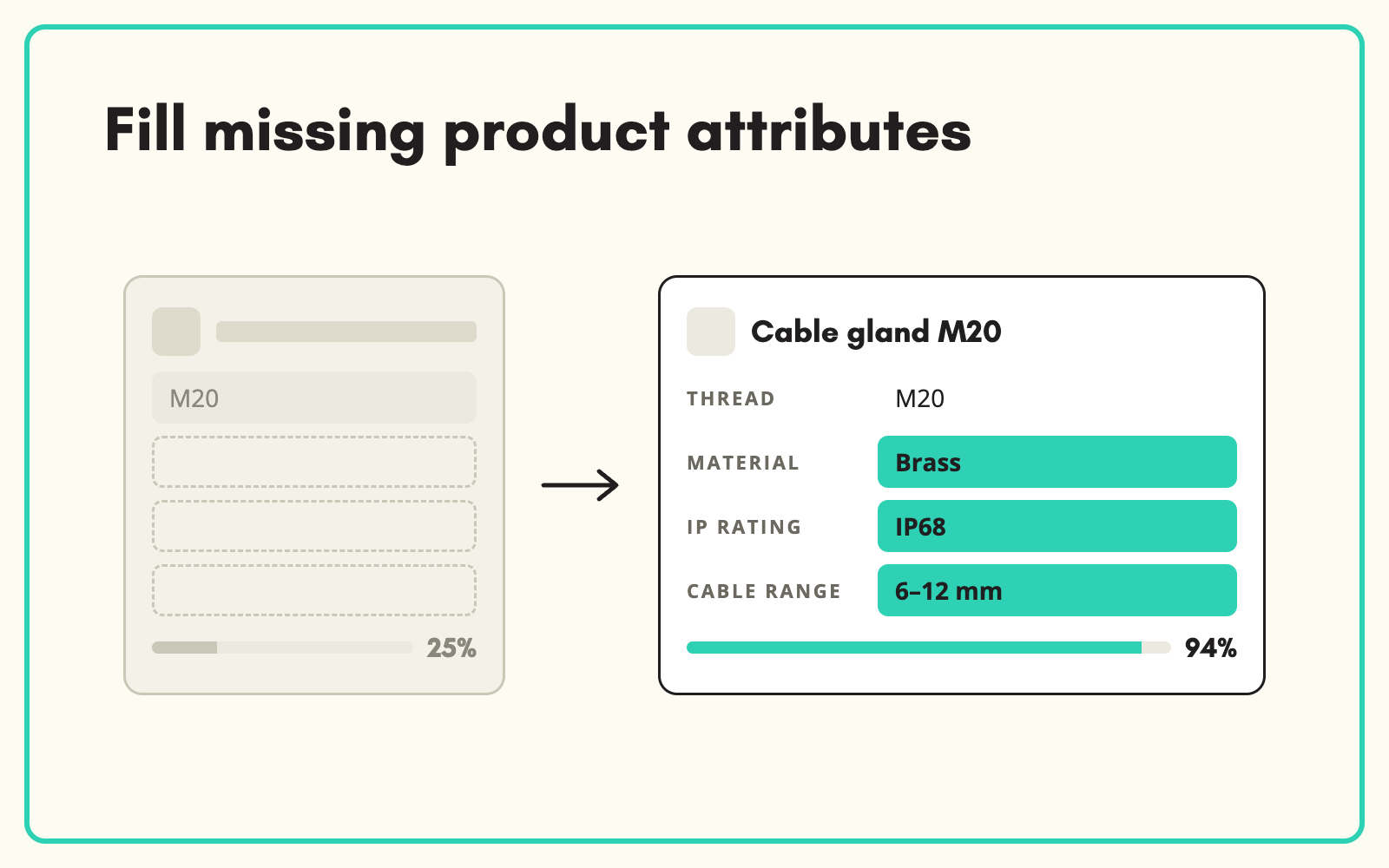
Filling missing product attributes is the core of enrichment. SKULaunch finds every empty attribute your categories require, sources the values from supplier datasheets, manufacturer sites, product images and the web, and writes them to each product for review, across thousands of SKUs at once.
The problem
Most catalogues are far less complete than their owners think. The title and price are there, but the attributes that drive filters, comparisons and search are empty: dimensions, materials, ratings, compatibility. Customers cannot filter to the product, so they do not find it. Filling the gaps by hand means research per product, per attribute, and a team that can do a few hundred SKUs a week against a catalogue of tens of thousands.
Before and after
An illustrative example for a door handle.
Before: the record in your PIM
Lever on rose door handle, satin chrome. Supplier code DH-4471. Everything else blank.
After: enriched in SKULaunch
- Finish: Satin chrome. Material: Zinc alloy
- Handle type: Lever on rose. Rose diameter: 52 mm
- Suitable door thickness: 35 to 54 mm
- Fire rated: Yes, with certification noted
- Each value sourced from the datasheet or manufacturer page and reviewed before approval
How it works in SKULaunch
- See what is missing. Completeness is measured per category against the attributes that category needs, so you know exactly which values are empty and where.
- Choose the sources. AI enrichment agents use the sources available for each product: the supplier datasheet, the manufacturer's page, product images, text descriptions and web search.
- Fill against your model. Values are extracted for your attributes, in your units and from your allowed value lists, not as free text.
- Review and approve. Filled values are reviewed in the grid before approval, so nothing reaches your website unchecked.
Fill what matters first
Not every empty attribute is equal. Start with the attributes that power your filters and the comparisons customers make, then the ones marketplaces require, then the nice-to-haves. A catalogue that is 95% complete on the ten attributes that drive filtering will outsell one that is 70% complete across fifty. Completeness by category, rather than one number for the whole catalogue, is what shows you where to start.
What changes
Bowens, an Australian building materials distributor, lifted PIM completeness from 30% to 94% with SKULaunch enriching upstream of the PIM. Filters started working, products started appearing where customers looked, and the team moved from researching values to approving them.
Common questions
Where do the values come from?
From the sources you allow: supplier files and datasheets first, then manufacturer pages, product images and web search. Source priority decides which wins when they disagree.
Will it invent values it cannot find?
No. Attributes without a reliable source stay empty and visible, rather than being guessed.
Does it work with our existing PIM?
Yes. Pull products from Akeneo, Plytix, Magento or a file, enrich them in SKULaunch, and publish back.
Read the product data enrichment guide, the Bowens case study, and how to enrich a whole category in one run.

.avif)