
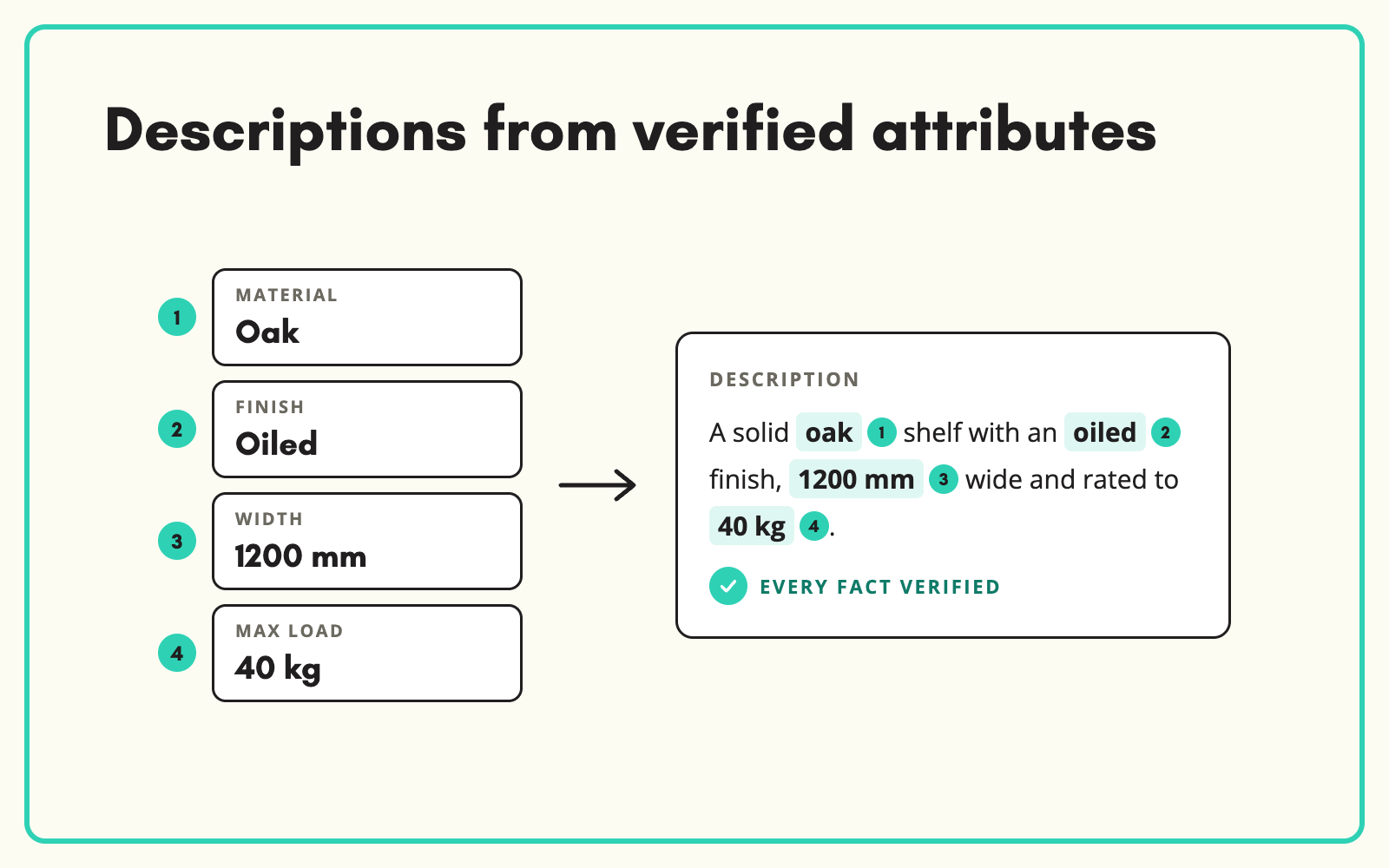
Bulk product descriptions are only as good as the facts they are written from. SKULaunch generates descriptions across whole categories from each product's verified attributes, so every claim in the copy matches the data, across thousands of products and in the structure you set per category.
The problem
Free description generators work one product at a time and write from a title. They produce fluent copy with specifications the product may not have, and they cannot follow your category structure or tone across a catalogue. Hand-writing is accurate but slow, so most ranges end up with supplier copy, duplicated across every stockist, or nothing.
Before and after
An illustrative example for a garden hose reel from a home and garden retailer.
Before: a title-only generator
"This premium hose reel is perfect for every garden, offering unbeatable durability and convenience for all your watering needs."
After: written by SKULaunch from attributes
- Wall-mounted hose reel holding up to 30 m of 12.5 mm hose, with 20 m supplied
- Powder-coated steel frame and a rewind handle with a lock
- Includes a four-pattern spray gun and connectors
- Each figure taken from the product's approved attributes
How it works in SKULaunch
- Enrich first. Fill and approve the attributes, so the writer has facts to work with.
- Set the pattern per category. Decide what each description covers, its length and tone.
- Generate in bulk. Content generation writes descriptions across a category from each product's attributes.
- Review and approve. Check copy alongside the attributes it came from, then approve.
Grounded copy reads better and ranks better
Descriptions built from attributes are specific by default: they mention the capacity, the material, what is included. That specificity is what shoppers look for and what search engines and AI assistants reward. It also makes every description unique, because no two products share exactly the same attributes, which solves the duplicate copy problem at the same time.
Planning bulk product descriptions by category
The pattern you set per category does most of the work. For each one, decide:
- What the first sentence says. Usually product type, the defining spec and who it is for.
- Which attributes must appear. Pick the five or six that drive the buying decision, not all forty.
- Length. Short for commodity lines such as fixings; longer where buyers compare features.
- Tone and banned words. Set once, applied to every product in the category.
Run one category first, review a sample of twenty, adjust the pattern, then run the rest.
What changes
Every product gets accurate, specific copy in your structure, without a copywriter on each one.
Common questions
What if attributes are missing?
The description only covers what the data supports. Enrich first for richer copy.
Can we control length and tone?
Yes, per category.
Can we keep hand-written descriptions?
Yes. Generate only where descriptions are missing or supplier-supplied.
Do generated descriptions hurt SEO?
Not when each one is built from that product's own attributes. Thin, templated copy that only swaps the product name is the real risk.
More on descriptions: our AI product description generator guide, the content generation platform page, B2B product descriptions and replacing duplicate supplier copy.

