
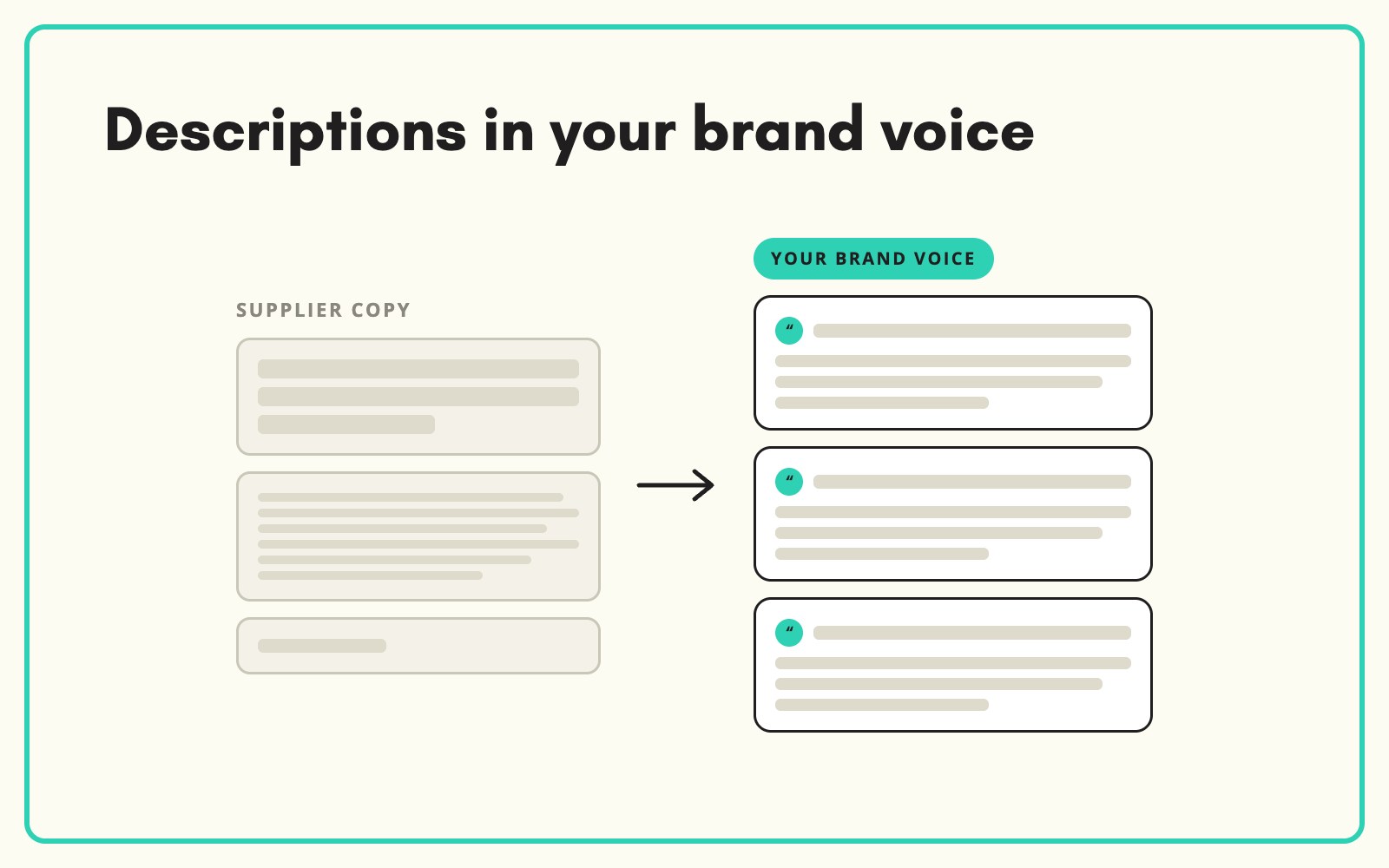
Brand voice product descriptions make a whole catalogue read as if one team wrote it, even when two hundred suppliers supplied the original copy. SKULaunch rewrites descriptions in your tone of voice, from your written rules and each product's verified attributes, so the voice on the homepage carries through to every product page.
The problem
A retailer with 200 suppliers has 200 writing styles on its website: shouty capitals from one, technical shorthand from another, marketing fluff from a third. The brand voice the marketing team worked hard on appears on the homepage, the emails and the social channels, then disappears the moment a customer opens a product page.
Rewriting by hand is impossible at catalogue scale. Even a fast copywriter writes careful descriptions one at a time, and new supplier ranges land faster than any team can rewrite them. So most teams rewrite the top sellers, leave the long tail in supplier copy, and the website ends up with two voices: theirs and everyone else's.
Before and after
An illustrative example from a homeware catalogue, for a scented candle.
Before: the supplier's copy
"LUXURY SOY CANDLE!!! AMAZING FRAGRANCE. BURN TIME 40HRS. PERFECT GIFT FOR HER."
After: in your voice from SKULaunch
- A short, calm opening line in your house style
- Soy wax, fig and cedar fragrance, around 40 hours of burn time, from the attributes
- Your preferred terms used, banned phrases avoided
- Same structure as every other candle in the category
How it works in SKULaunch
- Write down the voice. Capture tone, sentence style, words to use and words to avoid in your content settings.
- Set category patterns. Decide what each description covers for each product type, and in what order.
- Generate from attributes. Copy is written from verified data in your voice, so the facts come from the product record, not from the supplier's adjectives.
- Review samples, then scale. Approve a sample per category in the grid, adjust the rules if needed, then run the rest.
A voice needs rules, not adjectives
"Warm and premium" is not a brief a writer, or an AI, can follow consistently. Ask five copywriters to write "warm and premium" and you get five different voices. Useful voice guidance is concrete enough that two people reading it would make the same choices. The more specific the rules, the more consistent the output across thousands of products.
How to write a voice brief for product copy
Most brand guidelines are written for campaigns, not product pages. Turn them into a one-page brief that covers these points:
- Tone in three plain statements. For example: calm, not breathless. Expert, not technical. Friendly, not familiar.
- Sentence length. A target, such as most sentences under 20 words.
- Who you are talking to. Whether to address the customer as "you", and whether the brand says "we".
- Spelling and style conventions. British or Australian spelling, how to write units, whether to use sentence case.
- Preferred terms. "Sofa" not "couch", "jug" not "pitcher", your own name for a product line.
- Banned words. "Amazing", "must-have", "luxury" unless earned, "perfect gift", exclamation marks.
- Structure. What the opening line does, how long the body is, and whether facts go in prose or bullets.
- What never to claim. No health, safety or environmental claims unless the attribute data supports them.
- Two or three before and after examples. The fastest way to show what the rules mean in practice.
An illustrative brief for a homeware retailer might read: "Calm, plain and warm. Most sentences under 20 words. Speak to the customer as you. British spelling. Open with what the product is for, then the facts. Never use amazing, must-have or perfect gift. No exclamation marks."
Keeping brand voice product descriptions consistent at scale
Consistency comes from separating two things that supplier copy mixes together: the facts and the voice. The facts come from the attributes, such as wax type, fragrance notes and burn time. The voice comes from your rules. When the two are kept apart, you can change the voice without touching the data, and fix the data without rewriting the voice.
In practice that means three habits. Review a sample from every category before running the whole category, because what reads well for candles may not suit cookware. When something is wrong, fix the rule, not the individual description, then regenerate. And keep the brief in one place, so the copy written next year follows the same rules as the copy written today.
Common mistakes
- Pasting the campaign brand book into the settings and expecting product copy to follow it.
- Letting the voice invent facts. Voice can make a description warmer, not longer on specs it does not have.
- Using one voice for every channel when a marketplace listing needs plainer copy than your own site.
- Editing hundreds of outputs by hand instead of fixing the rule that caused the problem.
What changes
The whole catalogue sounds like your brand, not like your suppliers, and new ranges arrive in the same voice as the old ones.
Common questions
How do I keep product descriptions in a consistent brand voice?
Write concrete rules and examples, generate from attributes rather than from supplier copy, and review a sample per category before scaling.
Can we use our existing brand guidelines?
Yes. Turn them into concrete rules and examples in the content settings.
What is the difference between brand voice and tone of voice?
Brand voice is the consistent personality across everything you write. Tone is how that voice adjusts to the context, such as plainer on technical products and lighter on gifts.
Can different categories have different tones?
Yes. Patterns and tone can vary by category.
Does it keep British spelling?
Yes, if that is in your rules.
Will the AI make up product details to sound better?
Descriptions are written from the product's verified attributes, and every result is reviewed in the grid before it goes live.
More on descriptions at scale, replacing duplicate supplier copy, copy for each channel, content generation, and how AI product description generators work.

