
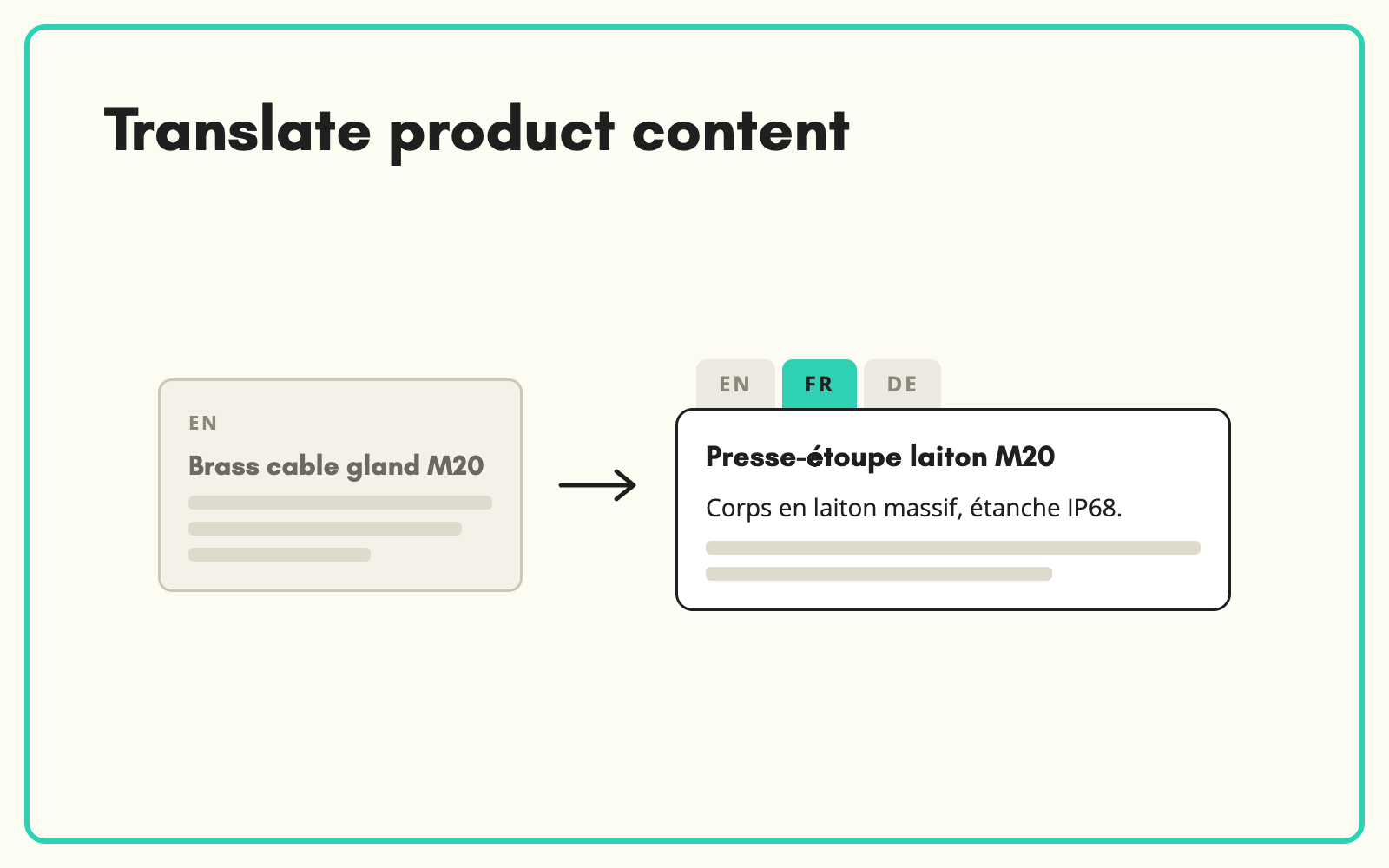
Launching in a new market means every product field in a new language. SKULaunch generates translated and localised product content from the same verified attributes as your source language, so titles, descriptions and bullets are consistent across markets rather than translated one page at a time.
The problem
Translation agencies charge per word and work from finished copy, so every source change triggers another round. Machine translation of whole pages mangles technical terms and units. And local conventions, such as decimal separators, measurement units and spelling, are easy to miss. The result is foreign-language catalogues that lag the source and read awkwardly.
Before and after
An illustrative example for a product launching in France.
Before: the plan
3,000 English descriptions exported to an agency. Six-week turnaround. Specs updated twice in the meantime.
After: in SKULaunch
- French titles, descriptions and bullets generated from the verified attributes
- Units and decimal formats localised
- Technical terms kept consistent with a glossary
- Native-speaker review on a sample per category before approval
How it works in SKULaunch
- Add language fields. Hold localised content in fields per language.
- Set terminology. Provide preferred terms for each market so technical vocabulary stays consistent.
- Generate from attributes. Copy is written for each language from the same verified data.
- Review with a native speaker. Approve samples per category, then the rest.
Translate data, not just text
Attribute values such as materials and colours are best translated once, as controlled values, rather than inside every sentence. Do that first and generated copy in each language stays consistent with the filters and specifications customers see. It also means a spec change flows through every language automatically.
What changes
New markets get complete catalogues in weeks, consistent with the source and with each other.
Common questions
Which languages are supported?
Confirm your target languages with us. Review by a native speaker is always recommended.
Do we still need translators?
For review and terminology, yes. The volume work is generated.
Can units change per market?
Yes. Localised fields can present units the local market expects.
See different copy per channel, controlled value lists, and content generation.

.avif)