
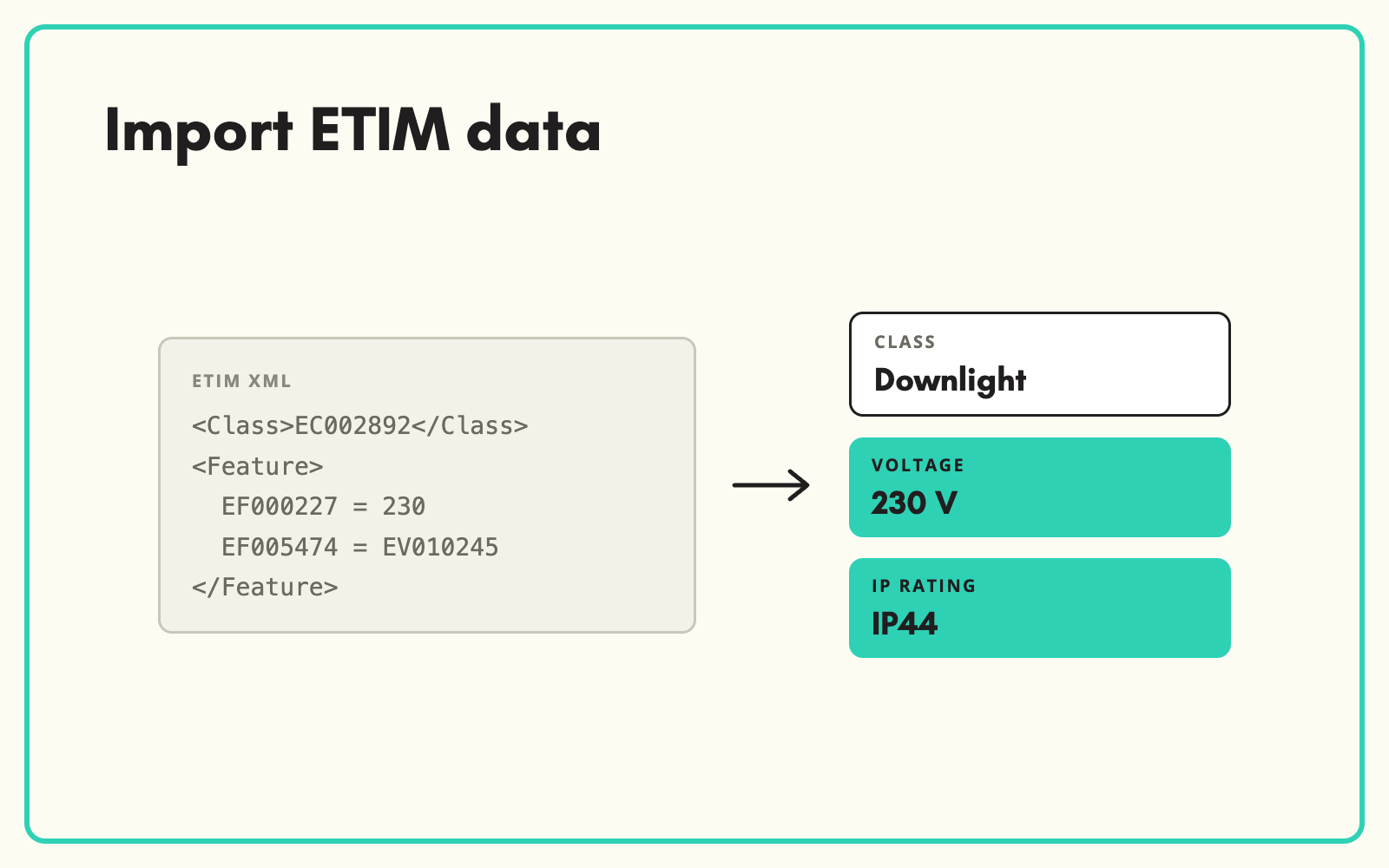
Electrical and installation suppliers increasingly send product data as ETIM, often inside a BMEcat XML file. SKULaunch imports that data directly, decodes the ETIM classes, features, values and units into readable attributes, and maps them to your own model so the data is usable on your website and in your PIM.
The problem
ETIM is excellent structured data, but it arrives in a form most teams cannot use. A BMEcat file is XML, features are codes rather than names, values are codes too, and units are referenced rather than stated. Without a developer or a specialist tool, the file sits unopened while someone retypes specs from the supplier's PDF. The irony is that the most structured data you receive ends up being keyed by hand.
Before and after
An illustrative example from a luminaire supplier.
Before: what is in the ETIM file
An EC class code for the product type, then a list of EF feature codes, each paired with a number, a true or false value, or an EV value code, with units referenced by EU code. No attribute names and no units in plain text.
After: what SKULaunch imports
- Category: Downlights, mapped from the ETIM class
- Rated voltage: 230 V
- Lamp type: LED
- IP rating: IP44
- Units resolved and normalised to your standard
- ETIM class retained on the record for customers who need it
How it works in SKULaunch
- Upload the ETIM or BMEcat file. No XML parsing, scripting or developer time.
- Classes, features and values are decoded. Codes become readable attribute names and values in the version the supplier used.
- Map to your model. ETIM features are matched to your own attributes, and ETIM classes to your taxonomy, with mappings saved for the next file.
- Fill what ETIM does not cover. Descriptions, titles and any attributes outside the ETIM class are enriched from the datasheet and manufacturer site, then sent for approval.
ETIM in one paragraph
ETIM is an open classification model for technical products, maintained by ETIM International and its national organisations. Each product type is a class, each class has a defined set of features, and each feature has either a numeric value with a unit, a logical value, or a value chosen from a controlled list. Versions are released periodically, so the same product may be described against ETIM 8, 9 or 10 depending on the supplier. The value of ETIM is consistency across suppliers. The cost is that the raw format is built for machines, which is why decoding and mapping matter.
What changes
A 95% attribute match rate between supplier ETIM features and your model, with the remainder raised for a one-off mapping decision. ETIM files become the fastest data to load rather than the slowest.
Common questions
Do we have to use ETIM as our own taxonomy?
No. SKULaunch maps ETIM to whatever taxonomy and attribute model you use, and keeps the ETIM class on the record for customers who ask for it.
What if suppliers are on different ETIM versions?
Each file is decoded in the version it was written in and mapped to your model, so mixed versions end up consistent.
Can we export ETIM back out?
Yes. Products classified to ETIM can be exported with their ETIM class and features for trade customers and buying groups.
See ETIM data mapping, our explainer on what ETIM is, and how to classify your own products to ETIM.

.avif)