
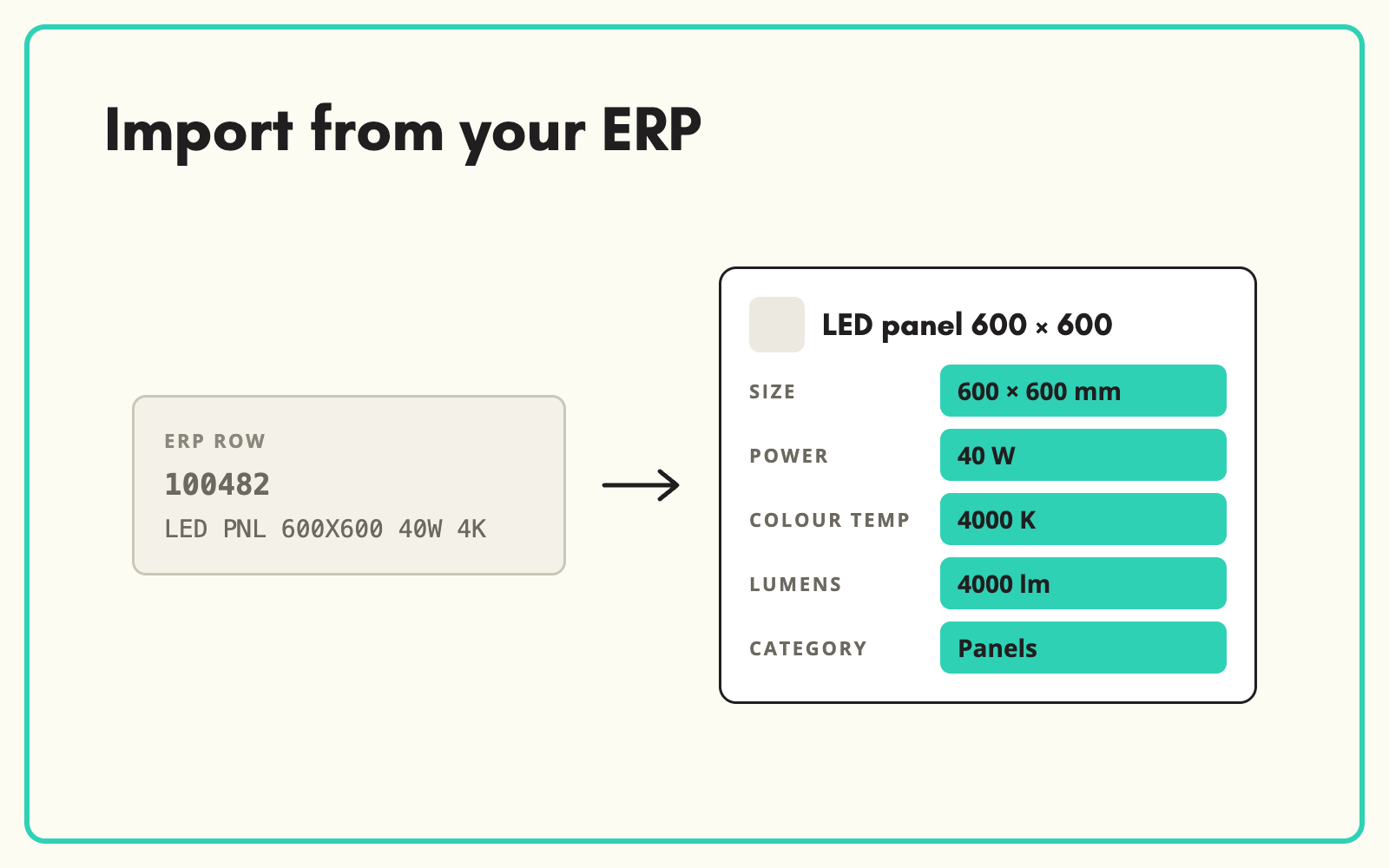
An ERP item master is built for ordering and stock, not for selling. It holds a code, a 30-character description and a unit of measure. SKULaunch imports that item master and turns each line into a complete product record, with attributes, content and images, ready for your website and customers.
The problem
In most distributors the ERP is the only system with every product in it, and the least useful for ecommerce. Descriptions are abbreviated to fit a field, attributes are absent, and categories reflect purchasing rather than how customers shop. Enrichment starts from almost nothing for tens of thousands of lines.
Before and after
An illustrative example from an electrical wholesaler's ERP.
Before: the ERP line
Item 77812, "SKT 13A 2G DP SW WHT", UOM EA, product group 14.
After: the record in SKULaunch
- Title: 13A two-gang double pole switched socket, white
- Category: Wiring accessories > Sockets
- Rating: 13 A. Gangs: 2. Switching: double pole. Finish: white
- Description and datasheet sourced from the manufacturer
- ERP item number kept as the link back to the item master
How it works in SKULaunch
- Import the item master. Load the ERP extract, keeping the ERP code as the identifier.
- Classify. Auto-classify each line into your ecommerce taxonomy, independent of ERP product groups.
- Expand and enrich. Decode abbreviations into attributes, then fill the rest from manufacturer pages, datasheets and web search.
- Export back if needed. Send enriched fields back to the ERP or on to your PIM and website.
Decode the abbreviations first
ERP descriptions are compressed, not empty. "SKT 13A 2G DP SW WHT" already contains five attributes. Expanding those into structured values first gives enrichment a far better starting point and fewer gaps to source externally. It also catches inconsistencies, such as two abbreviations for the same finish, before they spread to every channel.
What changes
The ERP stays the operational master, while every item gets a full, sellable record without anyone typing it from scratch.
Common questions
Do we have to change the ERP?
No. SKULaunch reads an extract and can send enriched fields back if you want them there.
Which identifier do we use?
Usually the ERP item number, so every record links back to the item master.
Can we keep ERP product groups?
Yes, as an attribute. Your ecommerce taxonomy can differ from them.
See enriching from a part number, consolidating ERP, PIM and supplier data, and product data management for distributors.

.avif)