
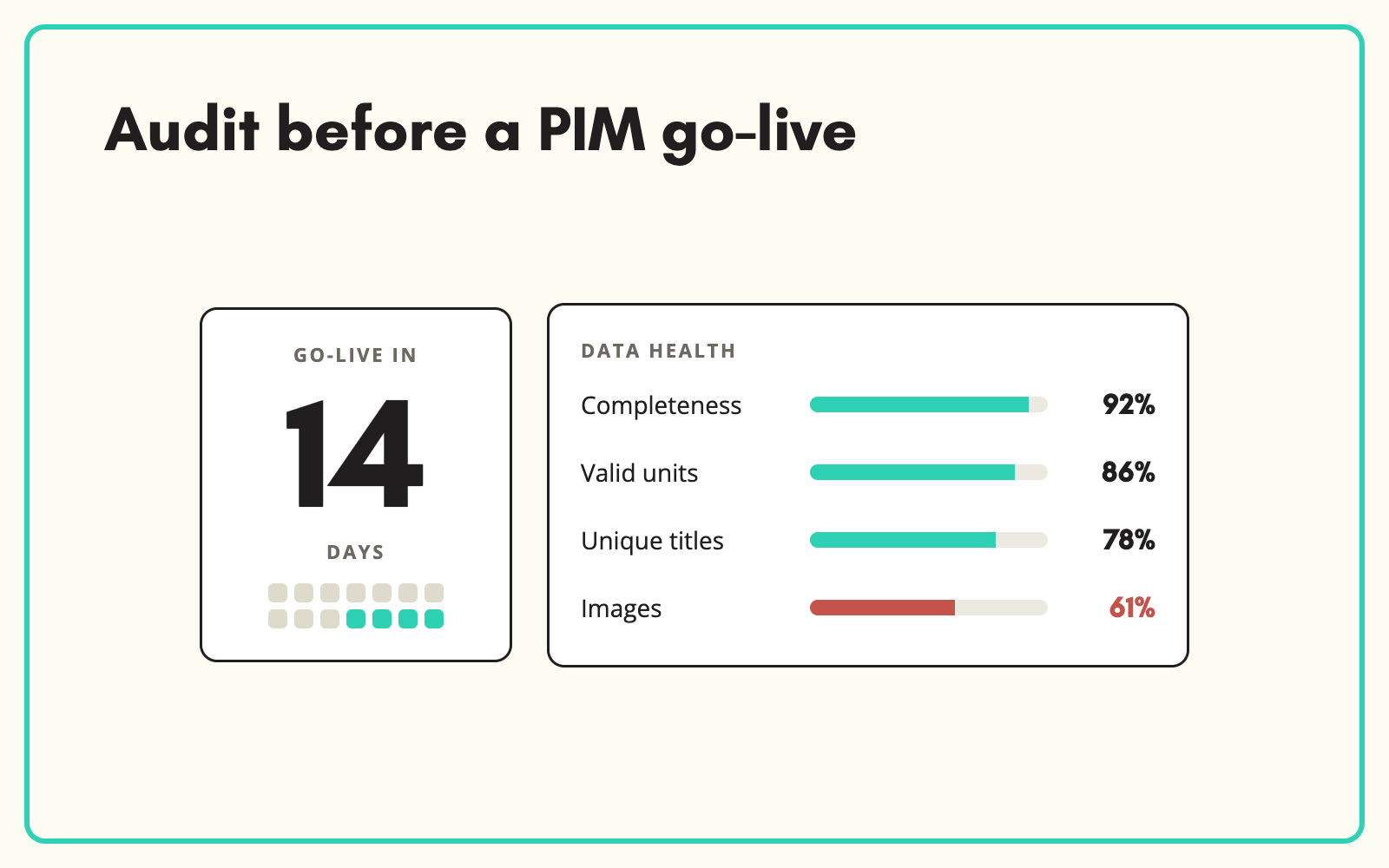
A product data audit measures how ready your catalogue is for a new PIM, website or channel: what is complete, what is inconsistent, what is duplicated and what is in the wrong place. Run one six weeks before go-live and you find problems you cannot fix in time. SKULaunch audits catalogue quality against the new data model early, so you know the size of the problem while there is still time to fix it.
The problem
Go-live plans assume the data will be fine. Then test loads fail, filters are empty and stakeholders see half-complete products on the staging site. The project slips, or launches with known problems. A proper audit up front would have shown it, but nobody had the tools or the time.
The usual substitute is a spreadsheet export and a few pivot tables. That tells you how many cells are blank. It does not tell you whether the values that are filled are usable, whether products sit in the right category, or how far the data is from the new model you are about to load it into. Those are the questions that decide go-live.
Before and after
An illustrative example from a building products distributor six weeks before a new PIM and website launch.
Before: the assumption
"The data is mostly there, we'll tidy it up after launch." 18,000 SKUs. Go-live in six weeks. No measure of completeness against the new model.
After: the audit in SKULaunch
- Completeness against the new model by category, lowest first: fixings at 41%, adhesives at 63%, power tools at 82%
- 2,300 products in catch-all categories such as "Miscellaneous" and "New lines"
- Colour held in 140 distinct values where the new model allows 18
- Around 600 likely duplicates sharing a manufacturer part number
- A realistic plan: three categories fixed before launch, the rest scheduled after
How it works in SKULaunch
- Load the data and the target model. Import current products and the new taxonomy and attributes.
- Measure. Completeness, value consistency and classification are measured against the new model.
- Prioritise. Rank gaps by category and channel importance.
- Fix in the same place. Move straight from audit to enrichment and clean-up.
A product data audit checklist
These are the six areas I check on every pre-launch audit. Each one should end with a number, not an opinion.
- Completeness. For each category, what percentage of the required attributes in the new model is filled? Measure against the target model, not the old system, because a field that never existed cannot be blank.
- Consistency. How many distinct values does each filterable attribute hold, and how many should it? Units, spellings and abbreviations all count.
- Duplicates. How many products share a manufacturer part number, GTIN or near-identical title? Decide which record survives before migration, not after.
- Identifiers. Are GTINs present, the right length and passing the check digit? Are manufacturer part numbers and brands filled?
- Classification. Is every product in a real end category of the new taxonomy? Count what sits in catch-all or legacy categories.
- Assets. Does every product have a main image, and do the documents customers need, such as datasheets and safety sheets, link to the right product?
Common audit mistakes
The first is auditing the old data against the old model. It tells you the legacy system is fine, which you already knew. The second is reporting one completeness figure for the whole catalogue. An average of 70% can hide your best-selling category at 30%. The third is sampling. A hundred products checked by hand will miss the 2,000 in the wrong category. The fourth is auditing too late. An audit is most useful when it can still change the launch scope.
What a go-live audit should answer
Four questions decide whether you are ready. Is every product in a real category? Are the attributes behind filters complete for the top categories? Are values consistent enough for filters to work? Are there duplicates that will confuse search? If you can answer those with numbers, you can plan the launch honestly, and decide which categories go live complete and which follow.
A measured gap is a gap you can close. Bowens moved PIM completeness from 30% to 94%.
What changes
No surprises at go-live, and a plan based on data rather than hope.
Common questions
What is a product data audit?
A structured check of catalogue quality covering completeness, consistency, duplicates, identifiers, classification and assets, measured against the data model you are moving to.
How do I audit product data quality before a PIM migration?
Load current products and the target taxonomy and attributes into one place, measure each category against the new model, then rank gaps by commercial importance. SKULaunch does the loading and measuring.
Can we audit before buying anything else?
Yes. A trial is enough to load data and measure it.
How long does an audit take?
Loading and measuring takes days, not weeks. Interpreting the results takes product knowledge.
Do you offer an audit service?
Start with Data, SKULaunch's sister consultancy, runs audits if you want it done for you.
What should we fix before launch and what can wait?
Fix classification and the filter attributes in your top categories first. Long-tail categories and copy improvements can follow, as long as the plan says so.
More on cleaning data before a PIM migration, measuring completeness, fixing inconsistent values, validating GTINs, product data quality and what to do before a PIM or replatform.

