
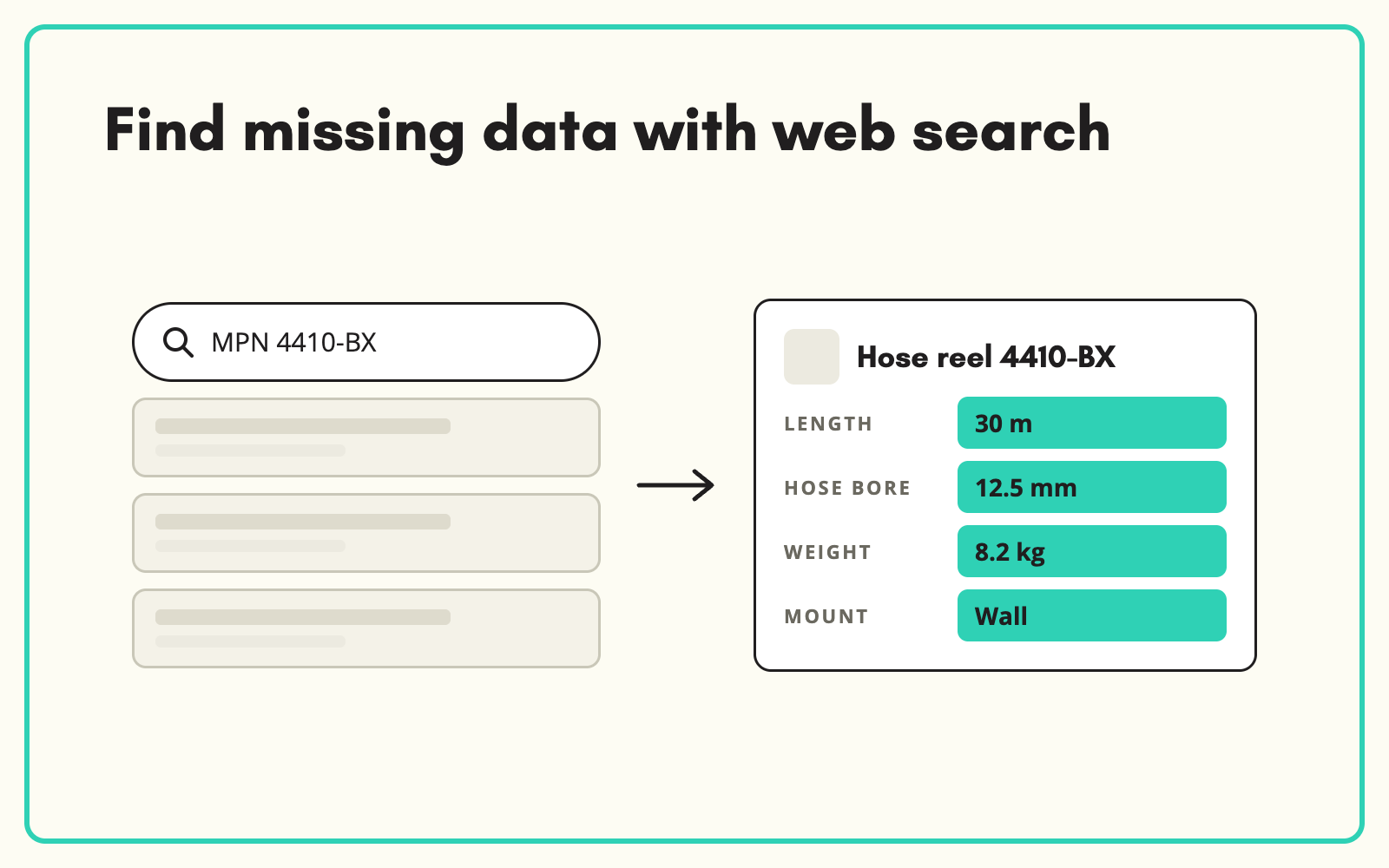
When all you have is a part number, the answer is usually somewhere online. SKULaunch's AI web search finds the right product page, datasheet or listing for each product, extracts the values your attributes need and writes them back for review.
The problem
Researching products one by one is the slowest part of enrichment. Someone searches the part number, opens five tabs, works out which result is the actual product, reads the specs and types them in. Multiply by thousands of SKUs and the backlog never shrinks, especially for long-tail products where the supplier has nothing more to give.
Before and after
An illustrative example for a replacement part.
Before: what you hold
"FLT-2290, filter cartridge", brand known, nothing else.
After: after AI web search in SKULaunch
- Correct manufacturer page identified from the brand and part number
- Dimensions, micron rating and compatible models extracted
- Datasheet link stored on the product
- Values written to your attributes for review, with the source recorded
How it works in SKULaunch
- Choose the identifiers. Tell SKULaunch which fields to search with, such as part number, EAN, brand and model.
- Search and select. The Web Search tool finds candidate pages and selects the one that matches the product.
- Extract against your model. Values are pulled for your category's attributes, normalised to your units and value lists.
- Review. Results go to the grid for approval, ranked below supplier and datasheet sources by default.
Search with more than one identifier
Part numbers are not unique across brands, and EANs are sometimes reused or wrong. Searching with a combination, brand plus part number, or EAN plus a key spec, cuts false matches dramatically. Where a product cannot be matched confidently, leaving it empty for review is better than filling it with data from a similar-looking product.
What changes
Long-tail products that would never get researched by hand get complete records, and the team spends time checking rather than searching.
Common questions
Which sources does it use?
Public web pages, prioritising manufacturer sites and datasheets over general listings.
Will it overwrite supplier data?
No. Source priority keeps supplier and datasheet values above web data unless you choose otherwise.
What if it cannot find the product?
The attributes stay empty and visible, rather than being guessed.
See AI product data extraction, extracting from manufacturer websites, and enriching from a part number.

.avif)