

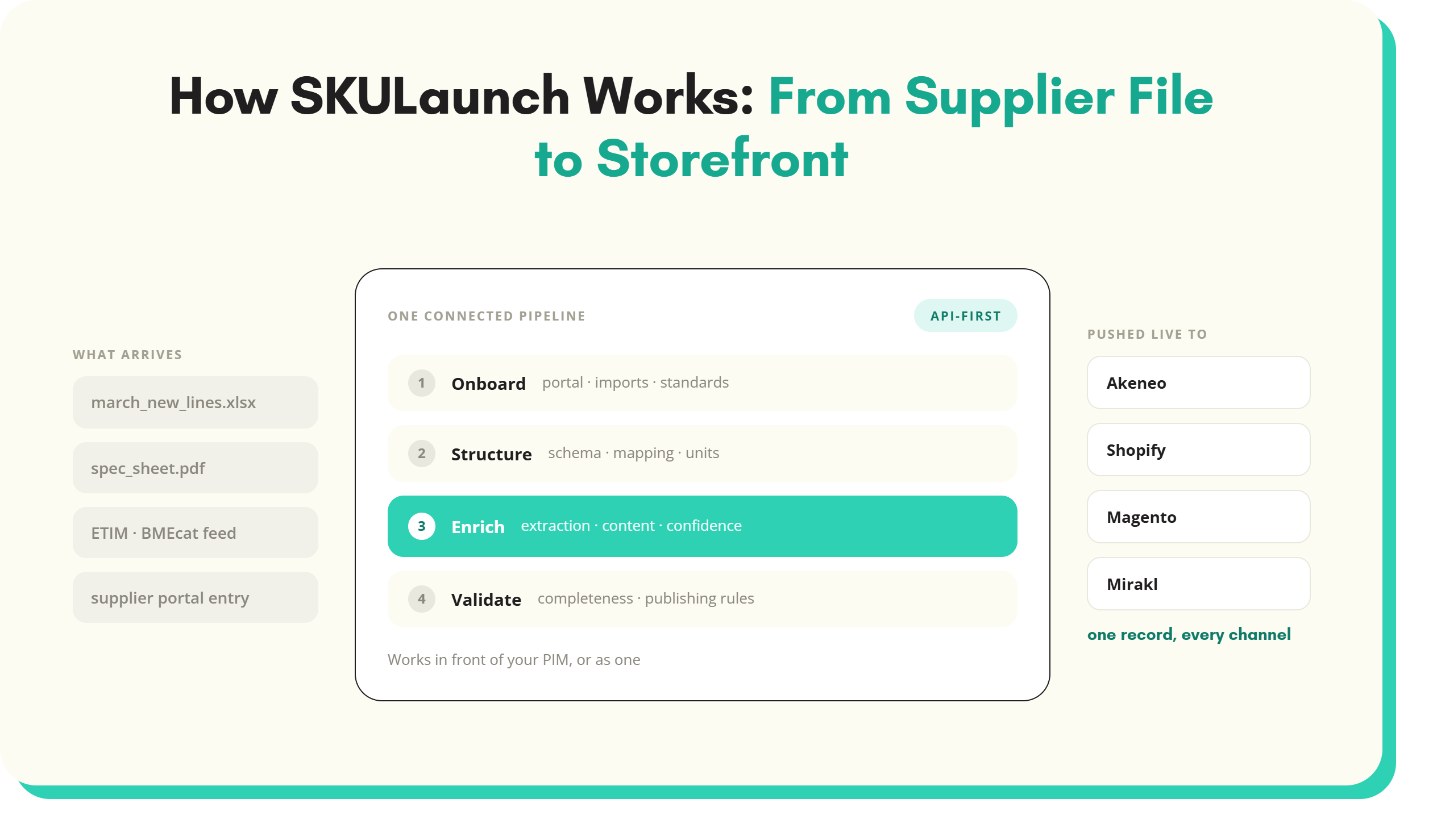
SKULaunch takes supplier product data in whatever format it arrives and turns it into structured, enriched, publish-ready records.
SKULaunch takes supplier product data in whatever format it arrives and turns it into structured, enriched, publish-ready records. Nobody reformats each file by hand. Understanding how SKULaunch works means looking at a set of connected capabilities inside a single supplier onboarding platform. Together they cover the full path from raw supplier file to live listing. That connection matters, because separate point tools each solve one step and leave the gaps between steps to a spreadsheet.
How SKULaunch works: supplier data onboarding first
Supplier files arrive in whatever format a given supplier happens to use. Excel spreadsheets, PDFs, Word documents, image folders, and half-complete listings sent by email are all normal. The first job is getting that data in without anyone retyping it.
A supplier portal gives each supplier a single link to submit data directly. The portal shows the supplier exactly which fields the business needs, in the business’s own structure. That removes the email attachments and manual chasing that unstructured onboarding usually runs on. It also gives the catalogue team one place to see what each supplier has submitted and what is still missing.
Import tools handle CSVs, spreadsheets, and pasted data for suppliers who prefer to keep working from a file. Columns map automatically into the business’s own schema. A supplier can keep sending the same spreadsheet they have always used, and the mapping absorbs the difference.
Where a supplier’s file follows an industry standard such as ETIM, BMEcat, or GS1, standards and data feeds map that format directly. No custom handling per supplier is needed. This matters most in technical categories, such as electrical or building products, where a recognised classification standard already exists. Reinventing that structure supplier by supplier would be wasted effort.
Structured attributes and enrichment
Raw supplier data usually needs structuring and enriching before it is usable. Both happen inside the platform rather than in a side spreadsheet.
Schema and attribute tools build a category-specific attribute schema first. Every product in a category then carries the same defined fields. A cordless drill always has voltage, chuck size, and battery type, not whatever attributes one supplier thought to include.
Product data extraction pulls structured detail directly from PDFs, images, URLs, and other unstructured sources, including scanned documents. A supplier does not need to provide clean, labelled data for the platform to read it. A 40-page manufacturer spec sheet becomes a set of populated attribute fields, not a document someone reads and retypes.
An enrichment studio fills the remaining gaps with confidence-scored suggestions. High-confidence values pass through. Low-confidence values queue for human review. The team works by exception, so attention goes to the records that genuinely need a decision rather than every record equally.
Content generation then produces titles, descriptions, and bullet points grounded in the attributes actually extracted. The copy describes what the data says the product is. It does not invent claims to fill a gap that would otherwise sit empty.
How SKULaunch works: mapping, normalisation and quality control
Two hundred supplier formats need to resolve to one internal schema before a catalogue is genuinely usable. Mapping and normalisation handles that translation automatically. One supplier writes Colour, another writes Finish, and a third buries the value inside the product name. One sends dimensions in millimetres and another in centimetres. The platform aligns naming conventions and units without anyone writing custom cleaning rules per supplier. That is exactly the kind of task that scales badly by hand and cleanly when automated.
Product data quality tracking then measures completeness in real time, by supplier, category, and attribute. Gaps get flagged as they appear. Publishing rules control what is allowed to go live, so an incomplete record cannot quietly reach the storefront. That replaces spot-checking a sample after the fact and hoping the sample caught the real problem.
Managed support for suppliers who cannot provide clean data
Not every supplier can provide structured data on their own, particularly smaller or less organised ones. For teams that would rather not chase them, a managed service can source, standardise, and format supplier data directly. That covers the sourcing, transposition, and system population that would otherwise land on an internal team already stretched thin. It matters most for larger businesses onboarding many suppliers at once, where genuinely unstructured data exceeds what automation alone resolves.
The line between self-service automation and managed support comes down to where a supplier’s data starts. A supplier who already produces reasonably structured files benefits most from automation applied to what they send. A supplier who has never held structured data at all usually needs a person coordinating with them directly. That stays true at least until a workable process is established.
How SKULaunch works: connecting your systems
An API-first architecture connects to PIM systems, ERP platforms, marketplaces, and ecommerce platforms. Destinations include Akeneo, Shopify, Magento, Plytix, and Mirakl. There is no separate manual export per system. Enriched records push to every connected destination from one central copy. Each system then works from the current record rather than its own ageing export. Adding a new marketplace or ERP later becomes a configuration step, not a fresh integration project built from scratch.
Where SKULaunch fits: with a PIM, or as one
SKULaunch works with a PIM, or as one. Teams that already run a PIM keep it as the system of record for finished product data, with SKULaunch in front, doing the work that makes a PIM worth having: getting supplier data in, structured, complete, and validated. The empty PIM 6 months after go-live is usually an onboarding failure, not a PIM failure. Feeding it enriched, quality-checked records from day one is how that outcome gets avoided. Teams without a PIM run SKULaunch as one: its built-in PIM layer holds one governed record per product, models variants, and pushes straight to an ecommerce platform or marketplace. Teams redesigning this end to end can work through a full supplier onboarding workflow stage by stage.
Why the pieces work better connected
None of these capabilities does much on its own. Onboarding without enrichment produces clean but incomplete records. Enrichment without quality control produces enriched records with no way to catch what went wrong. Integration without the earlier steps just moves badly structured data between systems faster. Run as one connected platform, this is how SKULaunch works end to end. A business moves from a spreadsheet-driven onboarding process to one that scales with the catalogue rather than against it. For the wider category context, this guide to supplier onboarding software covers how to evaluate the options.
To see how SKULaunch handles a real supplier catalogue, request a demo.
See SKULaunch in action
Watch how we handle AI enrichment, supplier onboarding, and catalogue scale in a live 30-minute demo.


.avif)