

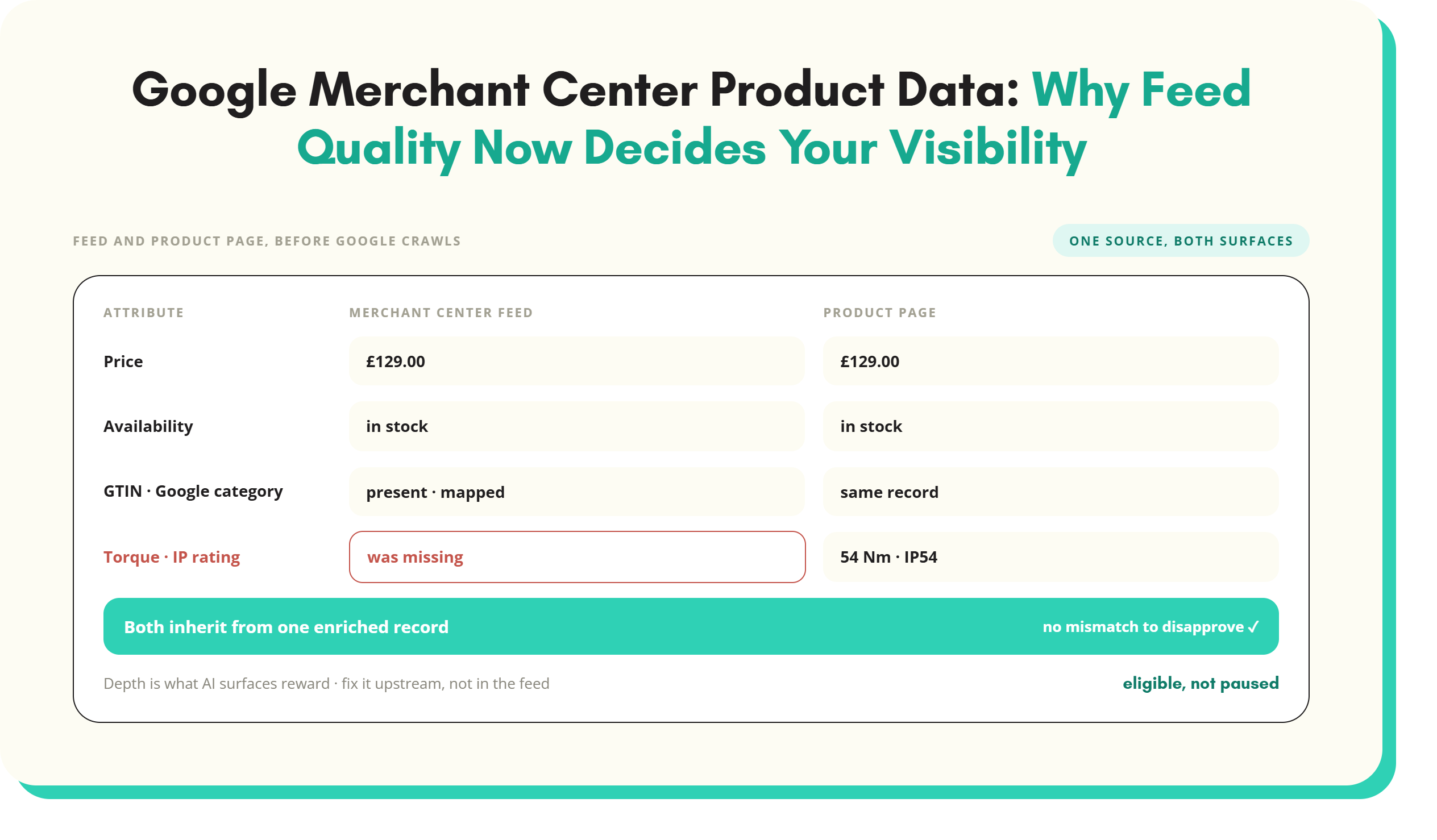
Google decides which products appear in Shopping results, AI Overviews and AI Mode based on the product data you send it.
Google decides which products appear in Shopping results, AI Overviews and AI Mode based on the product data you send it. If your Google Merchant Center product data is incomplete, or disagrees with the product page it links to, your products lose eligibility before a shopper ever sees them. The uncomfortable part is that most feed problems are not feed problems at all. They are catalogue problems that started upstream, weeks before anyone opened Merchant Center.
Why Google Merchant Center now depends on structured product data
Google’s shopping surfaces no longer run on keyword matching alone. AI Overviews and AI Mode assemble product recommendations from the Shopping Graph, which is built largely from Merchant Center feeds. When a shopper asks a conversational question, Google answers it by reading structured attributes: material, dimensions, compatibility, certifications, price, availability.
That changes what wins. A product with a complete GTIN, a mapped Google product category, populated attributes and a description that matches its landing page is eligible for placements that a thin listing simply is not. Two retailers can sell the identical SKU at the identical price, and the one with cleaner Google Merchant Center product data takes the visibility. This is the same completeness problem covered in our guide to product data enrichment, applied to one very unforgiving channel.
What happens when the feed and the product page disagree
Google checks that what you declare in the feed matches what the shopper finds on the PDP. When they diverge, the consequences arrive quickly.
- Disapprovals and paused listings: a supplier price change that reaches the feed but not the PDP, or the other way round, triggers a mismatch disapproval. The product disappears from Shopping until someone finds and fixes it, and every day paused is a day of lost sales.
- Lost rich results: inconsistent structured data costs you review stars, price annotations and availability badges in classic search, which costs click-through rate.
- Weaker AI eligibility: Google’s AI surfaces favour listings it can trust. Feeds with gaps or contradictions are quietly deprioritised, and there is no error message telling you it happened.
- Manual rework: teams end up rebuilding feeds market by market, chasing rejection emails and re-uploading spreadsheets. The work never ends because the root cause, the catalogue, never changed.
- Higher returns: when the spec on the listing does not match the product that arrives, the shopper sends it back. Returns driven by bad content are one of the quieter items in the cost of bad product data.
A typical example: a distributor lists 8,000 SKUs on Shopping. A supplier issues a mid-season price file, the ERP takes the update, the feed regenerates overnight, but the PDPs cache the old price for another day. Google crawls, sees the mismatch, and disapproves a few hundred products. Nobody notices until the weekly performance report, by which point the campaign spend behind those products has been wasted. Nothing in that chain was anyone’s mistake. It was two systems holding two copies of the truth, drifting apart on their own schedules.
What a policy-safe Google Merchant Center feed needs
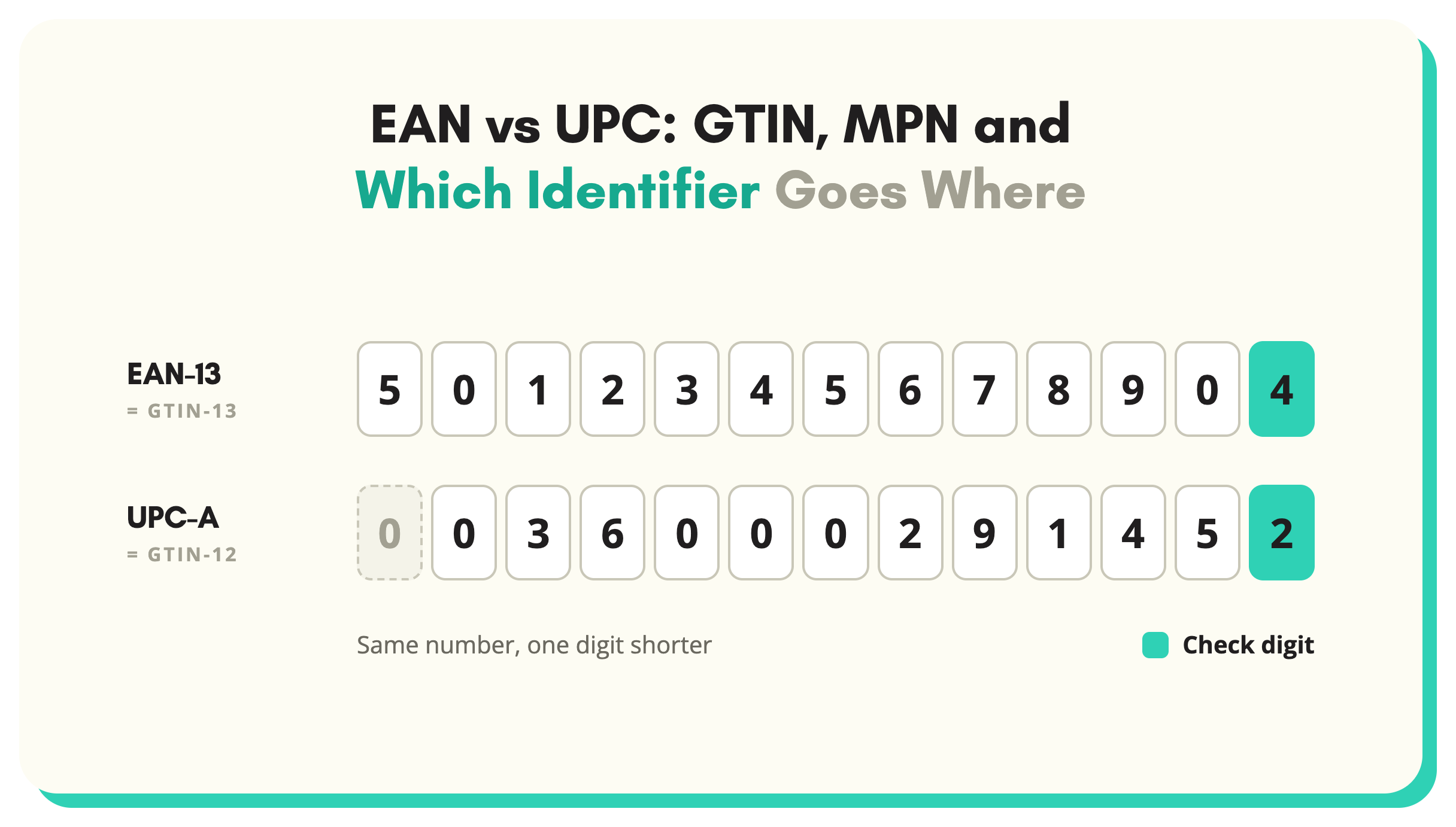
Strip away the tooling and the requirements are stable. Every product needs the required attributes populated: a unique id, an accurate title, a description, price, availability, an image link, and a GTIN or MPN where one exists. Beyond the minimum, the feeds that perform share five traits. The Google Shopping feed template lays the 27 attributes out in specification order with the conditionally required ones flagged, which saves discovering them one rejection at a time, and the difference between a GTIN and an MPN decides which of the two you are allowed to omit.
- Attribute values that match the landing page exactly, including price, availability and variant details. One source of truth feeding both is the only reliable way to guarantee this.
- A correct mapping to Google’s product taxonomy, not a best guess made once and never revisited.
- Images that meet Google’s size, background and quality requirements, and that actually resolve when Google crawls them.
- For AI-generated images, the IPTC DigitalSourceType metadata tag left intact. Google requires this tag on AI-generated imagery and prohibits stripping it, so an export pipeline that removes metadata can get compliant images rejected.
- Localised values for every target market: language, currency, sizing conventions and any market-specific compliance wording, not a machine-translated copy of the domestic feed.
None of this is exotic. It is the same discipline as any other channel, held to a stricter standard because a machine, not a merchandiser, is doing the checking.
Merchant Center’s diagnostics tab tells you which products failed and why, and it is worth checking weekly. But it is a symptom report, not a cure. Fixing an item there means editing a value in the feed, which drifts out of sync again the next time the source data changes. Teams that live in diagnostics are playing whack-a-mole with a catalogue problem.
Fix the product data upstream, not in the feed
Feed management tools patch symptoms. They rewrite titles, fill gaps with rules and suppress products that would fail. That keeps the account alive, but the catalogue underneath is still wrong, so the same errors come back with every supplier update.
The durable fix is to repair the data before it reaches any channel. This is where SKULaunch sits. It reads the supplier files you actually receive, PDFs, spreadsheets, URLs and images, and extracts structured attributes from them. It classifies products against your taxonomy, generates descriptions grounded in those attributes, and runs completeness and validation checks so gaps are caught before publication, not after a disapproval email.
In practice that looks like this. A 50,000 SKU distributor receives supplier content as PDFs with mixed layouts, half-populated spreadsheets and links to supplier websites. Manually, turning one of those into a complete, feed-ready record takes 30 to 45 minutes of copying, checking and rewriting. Extraction turns the same inputs into structured attributes in minutes, and validation flags the records still missing a GTIN, an image or a required attribute before they go anywhere near a channel.
Enriched data then pushes to the platforms you already run, Shopify, Magento, Akeneo and others. Because the PDP and the Merchant Center feed both inherit from the same enriched source, the feed-versus-page mismatch that drives most disapprovals stops being possible. You are not synchronising two copies of the truth. There is one.
Enrichment that improves how products surface in AI results
Once the required attributes are solid, the marginal gains come from depth. Complete technical specifications let a product answer the long-tail, high-intent queries that AI Mode increasingly handles: torque ratings, ingredient lists, fitment, compatibility. Structured attributes also make spec tables and side-by-side comparisons cheap to build on the PDP, which signals to Google that the content is complete and authoritative.
Doing this by hand across a 50,000 SKU catalogue is not realistic, which is why most catalogues never get past the required minimum. AI content generation grounded in extracted attributes changes the economics: descriptions, bullet features and localised copy produced from the structured data rather than invented, so what the feed declares and what the page says stay in agreement. For a fuller picture of the workflow, see the overview of product data enrichment.
Localisation deserves the same treatment. Expanding a feed into a new market usually means weeks of translation, resizing conventions and compliance wording, done market by market. When the source attributes are structured, localised titles and descriptions can be generated per market from the same underlying record, so the German feed, the French feed and the UK feed all stay consistent with their own landing pages rather than with each other’s mistakes.
Key takeaways
- Google Merchant Center product data now determines eligibility for AI Overviews, AI Mode and Shopping placements, not just classic search rankings.
- Feed and PDP consistency is a hard requirement. Mismatches cause disapprovals, and disapprovals cost sales days.
- AI-generated images must keep the IPTC DigitalSourceType tag, or Google can reject otherwise compliant listings.
- Feed tools fix symptoms. Enriching the catalogue upstream fixes the cause and keeps every channel consistent.
- Depth wins the long tail: complete specs and attribute-grounded content are what AI-driven discovery rewards.
Where to go next
If your Merchant Center account is generating more rejection emails than revenue, the feed is not where to start. Audit the catalogue behind it. Our guide to product data enrichment covers how to measure completeness, prioritise the attributes that matter per category, and build a repeatable enrichment workflow that every channel, including Google, inherits from.
See SKULaunch in action
Watch how we handle AI enrichment, supplier onboarding, and catalogue scale in a live 30-minute demo.

.avif)