

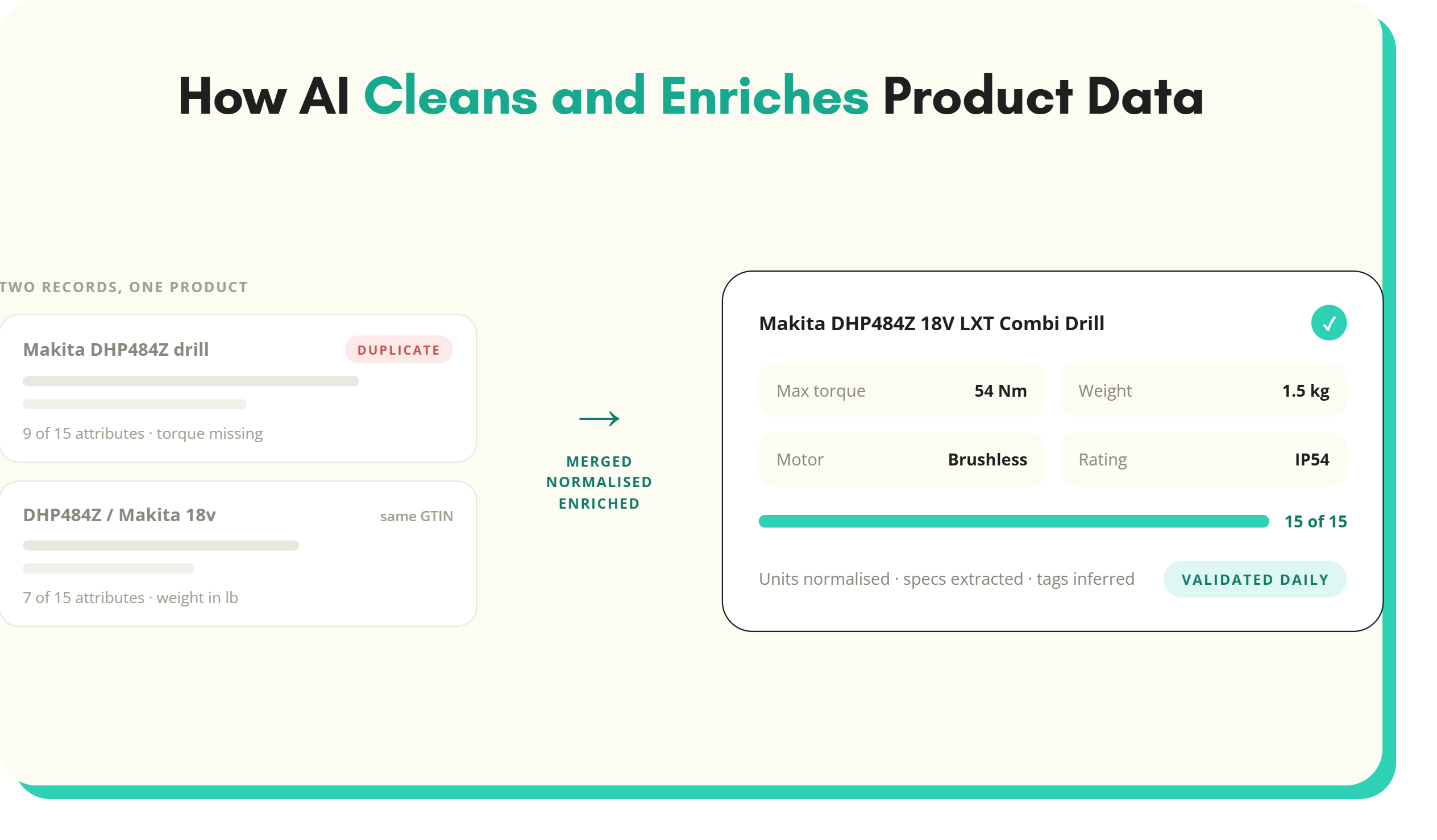
Messy product data has a way of compounding rather than staying contained.
Messy product data has a way of compounding rather than staying contained. A duplicate listing splits a single product's search visibility across two records. A mismatched attribute costs a return. Multiplied across a catalogue of thousands, small inconsistencies stop being individually minor and start being a genuine drag on conversion, search visibility, and returns. The businesses that avoid this are the ones with a structured way to clean and enrich product data continuously, not just at onboarding.
What dirty product data actually costs
Customers bounce when they cannot find the specs they need to decide. Products fail to surface in AI answers, marketplaces or internal search when attributes are missing or misclassified. Duplicate SKUs create conflicting records for what should be a single product, splitting its sales history and search ranking across two or three weaker listings instead of one strong one. Teams spend real time chasing suppliers for information that should have arrived complete the first time, time that does not show up anywhere as a cost until someone actually tracks how many hours a week it consumes.
Returns compound the cost further. A listing describing a "white gloss finish" that turns out to be matte white generates one return and one customer unlikely to order again. Multiplied across thousands of SKUs with the same category of error, the effect on margin is not hypothetical. This kind of mistake often goes unresolved simply because nobody had time to catch it manually. Each individual mismatch looks minor in isolation; the pattern across a full catalogue does not.
AI-powered product data cleansing
Cleansing covers three related problems: inconsistent formatting, genuine errors, and duplicate records. Standardisation converts units to a consistent system, corrects typos, and unifies formats across suppliers. A value recorded three different ways by three different suppliers resolves to one consistent value as a result. Error correction identifies entries that do not make sense in context, a kettle listed with a 300-litre capacity, for instance, flagging them before they reach a live listing rather than after a customer notices.
Deduplication merges multiple listings of the same underlying product using identifiers such as GTINs, UPCs, or model numbers, rather than leaving near-identical records to split a product's visibility across several weaker entries. This matters more than it might first appear: two listings for the same product do not double a merchant's chances of a sale. They halve the search ranking and review count each individual listing would otherwise have, since neither one accumulates the full signal the product actually has. A product with genuinely strong reviews and search performance, split across two listings by accident, looks weaker on paper than a single merged listing with the combined signal would.
How to clean and enrich product data once cleansing is done
Once data is clean, enrichment fills what is still missing. Product data extraction pulls detail from spec sheets, images, or manufacturer sources rather than leaving a gap for a person to research individually. Automated tagging adds contextual detail, such as "dishwasher-safe" or "fire-rated," inferred from existing specifications rather than requiring someone to manually annotate every record. Generated or improved descriptions support both on-site search and the kind of detail a buyer actually needs to decide, rather than a placeholder paragraph that says little about the specific product. The mechanics of this process are covered in more depth in the product data enrichment guide, which also covers the enrichment side in isolation from cleansing.
Why you need to clean and enrich product data continuously
A single cleanup does not stay clean. Automated audits catch spec mismatches or outdated attributes before they go live, rather than after a customer or a channel has already flagged them. Real-time supplier syncs pull in updated specifications or certifications as soon as a supplier makes them available, rather than waiting for the next scheduled review. Custom validation rules enforce compliance or channel-specific requirements automatically, which matters more in regulated categories such as healthcare, construction, or electronics, where an outdated certification is a compliance risk rather than just an inconvenience.
Where generative AI goes beyond cleanup
Cleansing and enrichment fix what is wrong or missing. A further layer of generative AI can go further still: inferring a likely missing attribute based on similar products in the same category, rewriting a description for tone or clarity rather than just filling a gap, suggesting related products based on genuine similarity in specifications, and proposing new taxonomy structures where an existing one no longer fits a growing catalogue well.
This shifts the work from correcting known problems to improving a catalogue that is already technically correct but could still be more useful, more discoverable, or better organised. Deduplication and validation catch what is broken. This layer works on what is functional but not yet as good as it could be, which is a genuinely different kind of task requiring a different kind of judgement from the system doing it.
Inferring a missing attribute from similar products, for instance, is not the same operation as extracting one directly from a supplier's own spec sheet. Extraction reads a value that already exists somewhere in the source material. Inference estimates a plausible value based on patterns across comparable products, which carries more uncertainty and needs a correspondingly higher bar for confidence before it is trusted without review. A category with hundreds of near-identical products supports confident inference; a category with few close comparisons does not, and the system needs to reflect that difference in how much scrutiny each suggestion gets before publication.
How to clean and enrich product data for good
Cleansing, enrichment, and continuous validation are not one-off projects; each has to run continuously as a catalogue grows and changes, since dirty data does not stay fixed once and never recur. A supplier onboarding platform built around all three, backed by the product data quality discipline that keeps catching drift after the fact and the same product data enrichment process covered above, is what actually keeps a catalogue clean rather than periodically re-cleaning the same accumulated mess.
To see how SKULaunch cleans and enriches a real product catalogue, request a demo.
See SKULaunch in action
Watch how we handle AI enrichment, supplier onboarding, and catalogue scale in a live 30-minute demo.


.avif)