

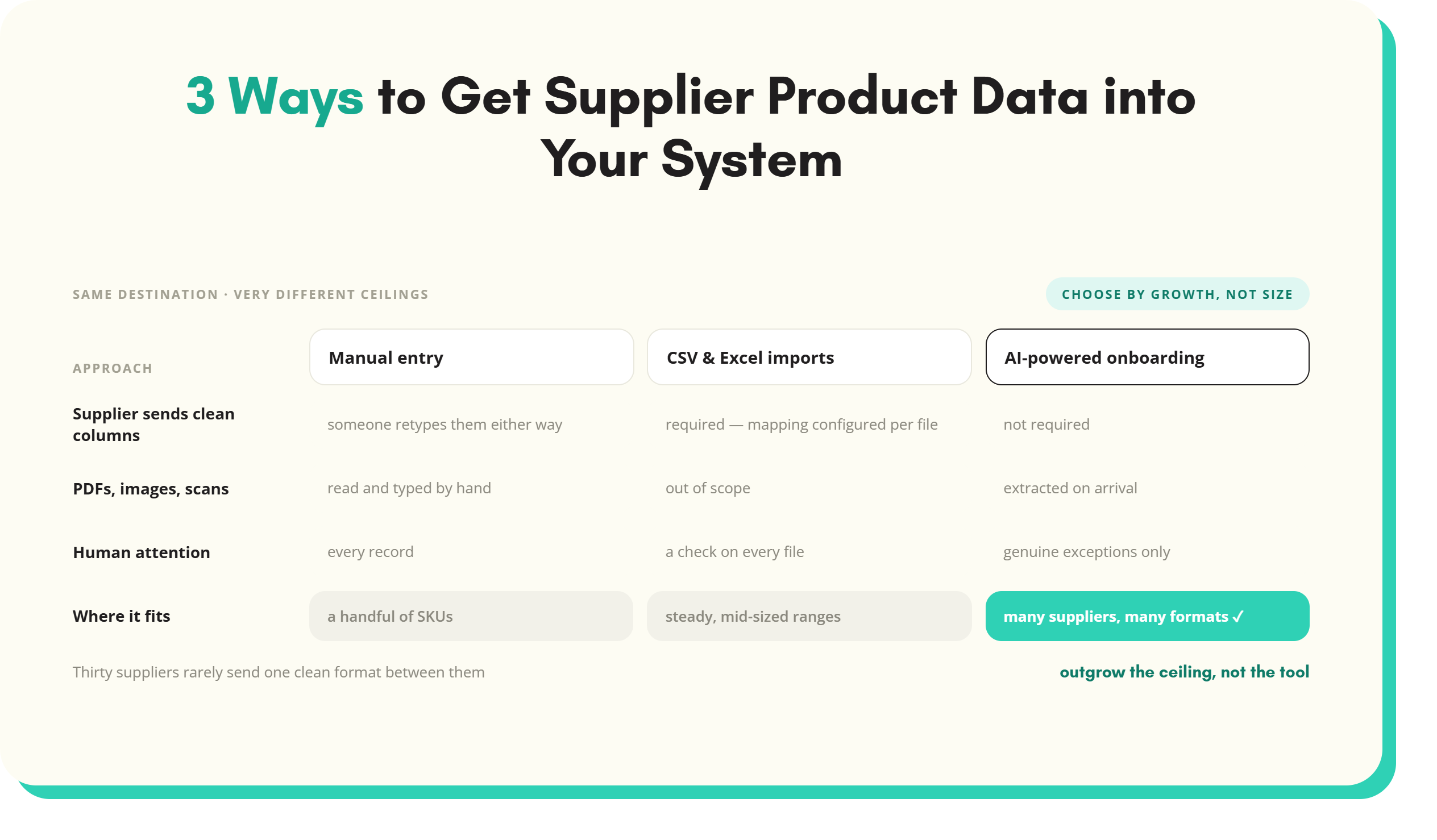
Getting supplier product data into your system comes down to one of three approaches: manual entry, structured file imports, or AI-powered onboarding.
Getting supplier product data into your system comes down to one of three approaches: manual entry, structured file imports, or AI-powered onboarding. Each works, in the sense that each eventually gets data from a supplier into a live system. What differs sharply is how well each holds up as a catalogue grows.
Manual entry: getting supplier product data in by hand
Manual entry is where most businesses start, and for a genuinely small catalogue it can work well enough. A person reads a supplier's file and types the relevant fields into the target system directly. It requires no new tooling and no process to set up beyond someone willing to do the work. That is exactly why it feels like a reasonable starting point for a business with a handful of SKUs and one or two suppliers.
The drawbacks surface as volume grows. The work is labour-intensive and does not get any faster with practice. Each new SKU still requires the same manual steps as the last, no matter how experienced the person doing it becomes. Human error creeps in under time pressure, mislabelled images and incorrect attributes among the most common mistakes. Those mistakes tend to cluster right when accuracy matters most, during a high-volume launch under a deadline. Onboarding speed caps out at whatever a person can physically process in a day. That becomes a real constraint the moment a launch needs to happen faster than that ceiling allows.
Consider a hypothetical retailer planning to launch 2000 new SKUs from multiple suppliers ahead of a major seasonal event. Relying entirely on manual processing, the team struggles with the range of formats landing on their desks, spec sheets, images, and descriptions each arriving differently from each supplier. Under that kind of time pressure, errors happen, and the result is incorrect listings and missed sales right at the point in the calendar when accuracy matters most.
CSV and Excel imports: faster supplier product data handling
For a business with a steadily growing product line, automating uploads through structured file imports improves onboarding speed meaningfully over manual entry. Suppliers commonly provide data in exactly this format, and a CSV or Excel file with structured columns maps far more directly to a PIM, ERP, or ecommerce platform than free text ever could.
This approach speeds up onboarding substantially compared to manual input, reduces the volume of manual labour and the error rate that comes with it, and suits bulk uploads or periodic supplier updates well. It still comes with real requirements, though. Supplier files generally need standardising and validating, sometimes cleaning outright, before they are usable. Data mapping has to be configured precisely to avoid values landing in the wrong field. Regular auditing is still necessary, since an automated import does not automatically mean an accurate one.
Consider a hypothetical distributor integrating automated CSV imports from several suppliers, cutting onboarding time from weeks to days as a result. Even with that improvement, inconsistent data still surfaces occasionally and needs a manual check before it goes live. The gain over manual entry is real, but the need for validation does not disappear; it just becomes a smaller, more manageable part of the process.
AI-powered onboarding: the most scalable way to handle supplier product data
An AI-powered product data onboarding platform extends automation further than a structured file import can reach on its own. Rather than requiring a supplier to already provide clean, structured columns, it can extract data directly from PDFs, images, and other unstructured sources, then validate, standardise, and enrich it regardless of the format it originally arrived in.
This matters because supplier files are not always structured to begin with. A CSV import handles a supplier who already sends clean spreadsheets well. It does nothing for a supplier who only sends a PDF spec sheet or a folder of untagged images, which is where AI-powered extraction and enrichment actually earn their place: automated extraction from whatever format arrives, real-time validation before anything goes live, enrichment that fills genuine gaps with structured, accurate detail, and integration into existing systems without a separate manual mapping step for every supplier. A business receiving data from thirty suppliers is unlikely to have thirty suppliers all sending the same clean format, which is precisely the scenario a CSV-only approach struggles with and AI-powered extraction handles without treating each new format as a special case.
Consider a hypothetical online retailer that previously faced real delays onboarding new collections because supplier images and specs had to be processed by hand. Moving to AI-powered onboarding compresses that timeline substantially, since the bulk of the work that used to require someone reading a PDF and typing values into a spreadsheet now runs automatically the moment a file arrives, with a person's attention reserved for genuine exceptions rather than every single record.
Choosing the right approach for your business
Manual entry can suit a genuinely small catalogue with a handful of SKUs and no near-term growth plans, where the overhead of any new tooling outweighs the benefit. CSV and Excel imports work well for a medium-sized business that needs real speed but can still absorb occasional manual review without it becoming a bottleneck. A supplier onboarding platform built around AI-powered onboarding fits larger or rapidly growing catalogues, or any business where accuracy and consistency across many suppliers and formats genuinely matters to the customer experience, since it is the only one of the three that does not require supplier data to already be structured before it can help.
The right choice generally tracks catalogue size and growth trajectory more than anything else. A business that has outgrown manual entry but has not yet outgrown CSV imports does not need to jump straight to full automation. One that is already struggling to keep pace with supplier formats, regardless of catalogue size, usually has, and the sooner that gap is addressed, the less time gets lost to launches that arrive later than they should.
To see how SKULaunch handles supplier data onboarding for a catalogue like yours, get a demo with your own data.
See SKULaunch in action
Watch how we handle AI enrichment, supplier onboarding, and catalogue scale in a live 30-minute demo.


.avif)