
Product data enrichment compared:
every approach, side by side
There are six common ways to enrich product data: your PIM's built-in AI, a content or syndication platform, an AI-native enrichment tool, a general AI model like ChatGPT, an offshore or in-house team, or a managed service. Each suits a different catalogue. This page compares them on the same criteria, including where SKULaunch is not the right fit.
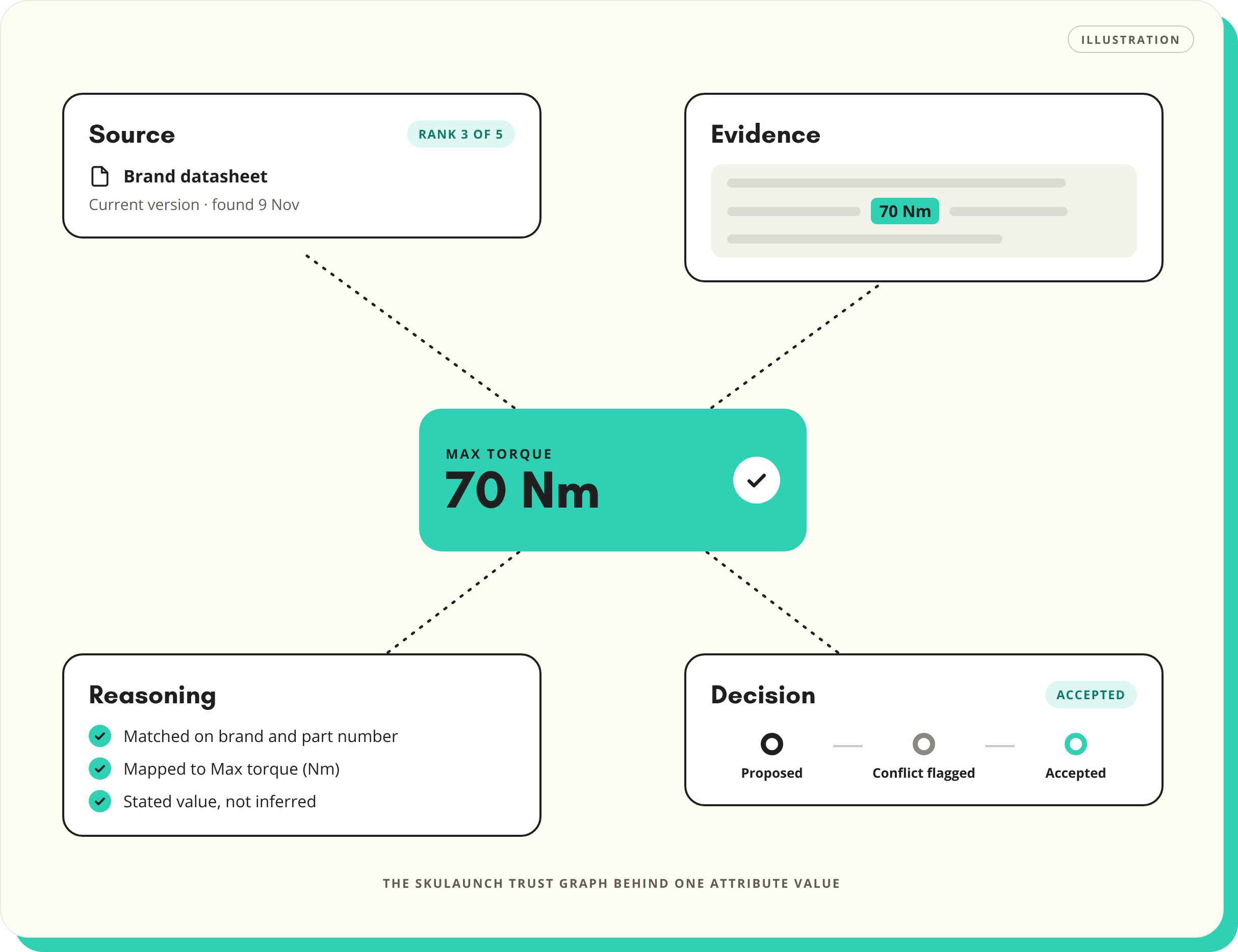
How we compared them
Every approach is judged on the questions that decide whether enriched data can be trusted and used: where each value comes from, whether the right product was matched, what happens when sources disagree, whether values fit your taxonomy, how it scales and what it costs. The ratings describe the typical setup in each category. Individual products vary, so test any shortlist on your own hardest SKUs.
The approaches, one by one
What each approach is, when it works well and what to watch for.
Your PIM's built-in AI
AI features inside your PIM that write descriptions, translate and suggest values from data already in the record.
Best when: your records already hold good source data and you mainly need copy, translation or tidying in one system.
Watch out for: it can only work with what the record contains, so empty technical attributes stay hard to fill, and few show where a suggested value came from.
Content and syndication platforms
Platforms that prepare and publish product content to retailers and marketplaces, often with AI help for channel copy.
Best when: your main problem is meeting each channel's content rules and getting listings accepted.
Watch out for: they are built around channel requirements, not researching missing technical facts from supplier and manufacturer sources.
AI-native enrichment tools
Specialist software that researches and fills missing attributes with AI.
Best when: you have large volumes of thin supplier data and need attributes filled quickly.
Watch out for: tools differ widely on whether they show sources, keep conflicting values and work to your taxonomy. Ask to see the evidence for any single value before you buy.
General AI models
Assistants such as ChatGPT, Gemini and Claude, used through a chat window or simple scripts.
Best when: drafting copy from facts you supply, or small batches where someone checks every value.
Watch out for: no traceable source per value, best-guess product matching, inconsistent units and no review trail, so every value still needs checking.
Offshore or in-house team
People researching and keying attributes by hand, often from supplier files and websites.
Best when: a small range needs careful judgement, or data has to be gathered by phone or from printed catalogues.
Watch out for: slow and costly to scale, quality varies between people, and the reasoning behind each value is rarely recorded.
Managed enrichment service
A provider runs enrichment for you, usually combining software and people.
Best when: you want the outcome without running the work yourselves.
Watch out for: ask how sources are recorded, who owns the evidence, and whether the result stays maintainable after the project ends.
SKULaunch Trusted Enrichment
AI enrichment that records the source, evidence, reasoning and decision for every value in the SKULaunch Trust Graph, works to your taxonomy and pushes to your PIM and channels.
Best when: technical catalogues with many suppliers, where a wrong specification costs a return, a failed compliance check or a broken filter.
Not the right fit when: a small catalogue with simple attributes and good supplier data may be well served by your PIM's built-in AI, and if channel acceptance is your main problem, start with a syndication platform. SKULaunch can sit alongside either.
Which approach fits your catalogue
- A few hundred products with simple attributes: your PIM's built-in AI, or a general AI model with someone checking every value.
- Listings rejected by retailers or marketplaces: a content and syndication platform.
- Thousands of SKUs, thin supplier data and technical attributes: specialist enrichment software that shows the evidence for every value.
- No team to run the work: a managed service, provided the evidence stays with you.
Most teams combine approaches. A common setup is enrichment software for the facts, the PIM as the system of record and a syndication platform for channels.
The approaches at a glance
Frequently asked questions
What is the best way to enrich product data?
It depends on your catalogue. Small catalogues with good source data can often use a PIM's built-in AI. Large technical catalogues with thin supplier data usually need specialist enrichment software that shows the source for every value. Many teams combine approaches.
Can my PIM enrich product data with AI?
Most PIMs now include AI features for copy, translation and suggested values. They work best when the record already holds good data, and they rarely show where a suggested value came from.
Is ChatGPT good enough for product data enrichment?
It is useful for drafting copy from facts you supply and for small checked batches. For technical attributes across thousands of SKUs it lacks source citations, reliable product matching and a review trail.
What should I ask an enrichment vendor?
Ask where each value comes from, whether you can see the evidence, how conflicting sources are handled, whether values fit your taxonomy and who approves changes. The free buyer's checklist lists ten questions.
Can I use more than one approach?
Yes. A common setup is enrichment software for the facts, a PIM as the system of record and a syndication platform for channels.
Test any approach on your hardest 1,000 SKUs
Whatever you shortlist, run it on your own difficult products and check the evidence behind each value. SKULaunch is free for one month on up to 1,000 products, with no card needed.

The AI product data platform that turns messy supplier files into sales-ready content. Run it upstream of your PIM, or run it as one.
