

SKULaunch is one of the twelve platforms covered here, and this article was compiled by SKULaunch’s team.
Firstly, full disclosure. SKULaunch is one of the twelve platforms covered here, and this article was compiled by SKULaunch’s team. The point is not to pretend that it does not bias the framing. The point is to be honest about what each tool is good at, where it is weak, and which buyer should pick which platform. If a tool is recommended for distributor use cases, that should be defensible. If a tool is recommended for small DTC brands, that should also be defensible, even when the right answer is not SKULaunch.
Product data enrichment is the upstream work of turning messy supplier inputs into clean structured records. It sits ahead of the PIM. Some tools cover both layers. Some are PIM-first with enrichment bolted on. Some are pure enrichment. The differences matter when you are choosing what to buy. The boundary between the two layers is set out in product data enrichment vs PIM.
What to look for in a product data enrichment tool
Eight criteria worth weighing against your own catalogue and team.
1. Ingestion breadth
Can the platform read what your suppliers actually send? PDFs with table layouts, spreadsheets with merged cells, scraped product URLs, images of spec labels. If sixty percent of your suppliers send PDFs and the tool needs you to convert everything to a structured CSV first, the tool is not solving your problem.
2. Attribute extraction quality
The bar to clear is accuracy on the long tail of attributes a category actually demands, such as: Voltage, IP rating, thread pitch, dimensions in three units, regulatory marks. Generic tools handle the easy thirty percent and dump the rest on a human.
3. Classification accuracy
Does it place SKUs into your taxonomy reliably? ETIM, UNSPSC, eClass, GS1 GPC, or your own internal hierarchy. Mis-classification at scale produces broken navigation, broken filters, and broken supplier feeds.
4. Content generation
Description, title, bullet points, SEO copy, channel variants. Done well, this reads consistently and is tuned per channel. Done badly, every product reads like the same Google Shopping placeholder.
5. Normalisation and unit handling
“10mm”, “10 mm”, “0.01m”, and “0.39in” should all become one canonical value. “Black”, “BLK”, and “Jet Black” should map to one colour. Without this, filters and search are noise.
6. Integrations
Where does it push to? Akeneo, Salsify, Plytix, Shopify, Magento, BigCommerce, Mirakl, in-house ERPs. The number of native connectors matters less than whether the ones you actually need are robust.
7. Continuous capability
Enrichment is not a one-off project. New suppliers send new data formats every month. The tool needs to handle ongoing ingestion, not only the initial bulk load.
8. Standards support
GS1, GDSN, ETIM International, eClass, UNSPSC, retailer-specific schemas. Industries with regulated catalogues need this. Industries without it can ignore it.
The 12 tools
Each tool gets a short overview, what it is good at, what it is not good at, who it fits, and an indicative pricing band.
1. SKULaunch
An AI-first enrichment platform with a built-in PIM layer. SKULaunch ingests supplier PDFs, spreadsheets with merged cells, product URLs, and images, extracts structured attributes, classifies into ETIM, UNSPSC, or custom taxonomies, and generates descriptions. It pushes directly into Akeneo, Plytix, Shopify, Magento, and Mirakl through native integrations. Customers include RS Group, Mole Valley Farmers, Bowens, APS Industrial, Fantastic Furniture, and Maxiparts.
Strengths: It’s an AI-first design rather than AI features bolted onto an older PIM. Strong on technical catalogues. Built for B2B distribution. Sits upstream of whichever PIM is already in place, or runs standalone with its own PIM layer as the system of record. The Enrichment Studio is the working environment where data managers review and approve extracted records.
Limitations: the built-in PIM layer is deliberately lighter than an enterprise system of record, so teams with deep approval workflows or print-channel governance pair SKULaunch with a dedicated PIM. If the data is already clean and the problem is pure multi-channel feed orchestration, SKULaunch is the wrong layer in the stack.
Best fit: distributors and retailers with messy supplier-led catalogues, especially in technical categories. Strong from 10,000 SKUs upward.
Indicative pricing: mid band. Not published.
skulaunch.com
2. Akeneo
The dominant open-source PIM. Mature attribute management, a workflow engine that scales, large partner ecosystem, recently expanded AI features under the Akeneo PIM AI banner for description generation and classification.
Strengths: flexibility, governance, ecosystem, strong fit for technical B2B catalogues, ETIM-friendly, good for teams with developer capacity to extend it. The Community Edition is genuinely usable for smaller deployments.
Limitations: AI enrichment is an add-on, not the core. The platform still expects clean, structured data going in. Implementation can be heavy. The boundary between Akeneo and a dedicated enrichment layer is covered in how SKULaunch pairs with Akeneo.
Best fit: mid-market to enterprise with developer capacity, distributors and brands wanting a PIM they can shape.
Indicative pricing: Community free. Growth and Enterprise editions sit in the mid to high commercial bands. Six-figure ARR is common at enterprise scale.
3. Plytix
A lightweight cloud PIM and DAM aimed at SMB and mid-market brands. Transparent pricing, self-serve onboarding, low implementation overhead.
Strengths: easy to start, friendly UI, good DAM features for the price point, transparent published pricing. Strong fit for DTC brands and smaller catalogues that want to be running this quarter rather than next year.
Limitations: lighter on enterprise governance, AI enrichment less mature than dedicated tools, not built for 100,000-SKU technical catalogues with deep classification needs. How the two pair together is covered in the Plytix integration.
Best fit: DTC brands, small ecommerce teams, organisations under 10,000 SKUs.
Indicative pricing: transparent SaaS, plans published from low monthly fees up through mid-market tiers.
plytix.com
4. Salsify
An enterprise Product Experience Management (PXM) platform. Strong on retail syndication, GDSN connectivity, content quality scoring, and brand-to-retailer commerce.
Strengths: mature retailer network, content scorecards mapped to Walmart, Target, Amazon, and Kroger schemas, strong workflow, large enterprise references.
Limitations: premium pricing, heavier implementation, less suited to extracting attributes from messy supplier PDFs. Optimised for the brand-to-retailer flow, not the supplier-to-distributor flow.
Best fit: enterprise consumer brands publishing to large retail networks.
Indicative pricing: high band, enterprise commercial. Not published.
salsify.com
5. inRiver
A mid-market to enterprise PIM with a strong workflow engine and a marketing-led enrichment philosophy.
Strengths: workflow flexibility, marketing-driven content management, well suited to storytelling-heavy categories, good for manufacturers and distributors with rich product narratives that require approval steps before publication.
Limitations: less AI-native than newer entrants, classification and extraction from unstructured sources are not the strong suit. Implementation effort is real.
Best fit: manufacturers and distributors with marketing-heavy product stories and the team to manage workflow.
Indicative pricing: mid to high band, enterprise commercial. Not published.
inriver.com
6. Syndigo
An enterprise content syndication and Master Data Experience platform. Roots in GDSN data pools and retail content distribution.
Strengths: largest retailer network in CPG syndication, strong on regulated categories (food, healthcare, beauty), content quality scoring against retailer standards, deep GS1 and GDSN coverage.
Limitations: optimised for syndication, not extraction. CPG-shaped, which means it is less natural for B2B industrial distribution.
Best fit: CPG brands publishing to retail networks. Regulated categories where content compliance is the daily job.
Indicative pricing: high band, enterprise commercial. Not published.
syndigo.com
7. Pimberly
A UK-headquartered mid-market PIM with built-in DAM, channel management, and growing AI capabilities.
Strengths: configurable workflows, marketplace and channel support, strong UK and EMEA presence, mid-market price point that fits buyers between Plytix and Akeneo.
Limitations: AI enrichment is improving but it is not the core competence. The platform is suited to data that is already largely clean, with enrichment as a content polish rather than an extraction job.
Best fit: UK and EMEA mid-market retailers and brands, multi-channel ecommerce with a moderate catalogue size.
Indicative pricing: mid band. Not published.
pimberly.com
8. Productsup
A feed management platform with PIM capability. Channel-led, optimised for marketplaces, retail media, and shopping feeds.
Strengths: channel and feed transformation, broad marketplace coverage, strong for orchestrating outbound channel data when the catalogue already exists somewhere upstream.
Limitations: feed-first, not catalogue-first. Less of a system of record. AI extraction from supplier inputs is not the strong suit.
Best fit: brands and retailers with heavy marketplace and channel-feed orchestration needs.
Indicative pricing: mid band. Not published.
productsup.com
9. Catsy
A mid-market PIM and DAM, North America focused, with a leaning toward B2B manufacturers and distributors.
Strengths: solid import and export handling, attribute management, accessible for B2B distributors with technical catalogues that need a PIM without enterprise pricing.
Limitations: smaller ecosystem than the bigger players, AI enrichment less mature, North America centric.
Best fit: B2B manufacturers and distributors in North America with mid-sized catalogues.
Indicative pricing: lower mid band. Not published.
catsy.com
10. Catalyst (Bridgeline Digital)
A bundled PIM, ecommerce, and search platform from Bridgeline Digital. Sold as an integrated stack to B2B distributors moving off legacy systems.
Strengths: all-in-one suite appeal, distributor-aware features, integrated site search and merchandising via Bridgeline’s HawkSearch product. One vendor relationship across PIM, commerce, and search.
Limitations: AI enrichment is limited compared to specialists, installed base concentrated in North America, suite play means less freedom to mix and match best-of-breed components.
Best fit: B2B distributors looking for an integrated PIM and commerce stack from one vendor.
Indicative pricing: mid band, varies by bundle. Not published.
bridgeline.com
11. Informatica Product 360
An enterprise MDM-class PIM, part of Informatica’s Intelligent Data Management Cloud. Strong on multi-domain master data: product, customer, supplier.
Strengths: deep governance, enterprise integration, multi-domain MDM, suitable for organisations that need a single platform across customer and product master data, often inside a wider Informatica footprint.
Limitations: heavy implementation, premium pricing, AI enrichment is delivered through Informatica’s broader AI stack rather than being purpose-built for product data extraction. Overkill for a pure PIM use case.
Best fit: large enterprises with multi-domain MDM strategies and regulated industries.
Indicative pricing: high band, enterprise commercial. Six-figure ARR is the floor.
informatica.com
12. Bluestone PIM
A cloud-native composable PIM built on MACH principles: microservices, API-first, cloud-native, headless.[1]
Strengths: API-first architecture, marketplace-friendly, plugs into composable commerce stacks, modern integration model.
Limitations: AI enrichment is not native, the composable model assumes the buyer wants to integrate other best-of-breed pieces, requires development capacity to assemble the full picture.
Best fit: mid-market and enterprise teams running composable commerce, marketplaces, and headless storefronts.
Indicative pricing: mid band. Not published.
bluestonepim.com
Matrix comparison table
Which tool to pick by scenario
Technical distributor, 50,000+ SKUs, complex supplier data
This is the SKULaunch sweet spot, paired with a PIM. Akeneo is the most common PIM in this scenario, with SKULaunch handling the upstream extraction. Bluestone is the second most common pairing. Catsy or Catalyst suit smaller distributors that want a one-stack purchase. The Salsify, Syndigo, and Productsup cluster is the wrong shape: built for brand-to-retail and marketplace feeds, not supplier-to-distribution.
DTC brand, under 5,000 SKUs, simple data
Plytix is the obvious answer. Transparent pricing, low implementation overhead, suits a small team. SKULaunch is overkill: the data extraction problem barely exists at this scale. Akeneo Community Edition is a credible alternative if the team has developer capacity. Salsify and Syndigo are too heavy. Pimberly is worth a look if the brand sits in the UK and the catalogue is closer to 5,000 than 500.
Marketplace operator with compliance pressure
Mirakl-led marketplaces and operators with regulated category compliance (food, electrical, healthcare) need both extraction and standards support. SKULaunch handles seller data ingestion and ETIM or GS1 classification at the front. Salsify or Syndigo handle outbound retail syndication if the operator distributes to large grocers. Productsup fills the channel-side feed orchestration gap. Informatica Product 360 is the answer when product data has to merge with customer and supplier master data inside a wider data fabric.
Enterprise retailer with multi-channel needs
Multiple categories, dozens of channels, high SKU volume, and regulated areas. The honest answer is more than one tool. SKULaunch upstream for extraction, Akeneo or Salsify as the system of record, Productsup or Syndigo for outbound channels. Bluestone PIM fits when the wider commerce stack is composable and the buyer wants to assemble a best-of-breed picture. Informatica P360 is correct when product master data has to merge with customer and supplier master data, and overkill the rest of the time.
Key takeaways
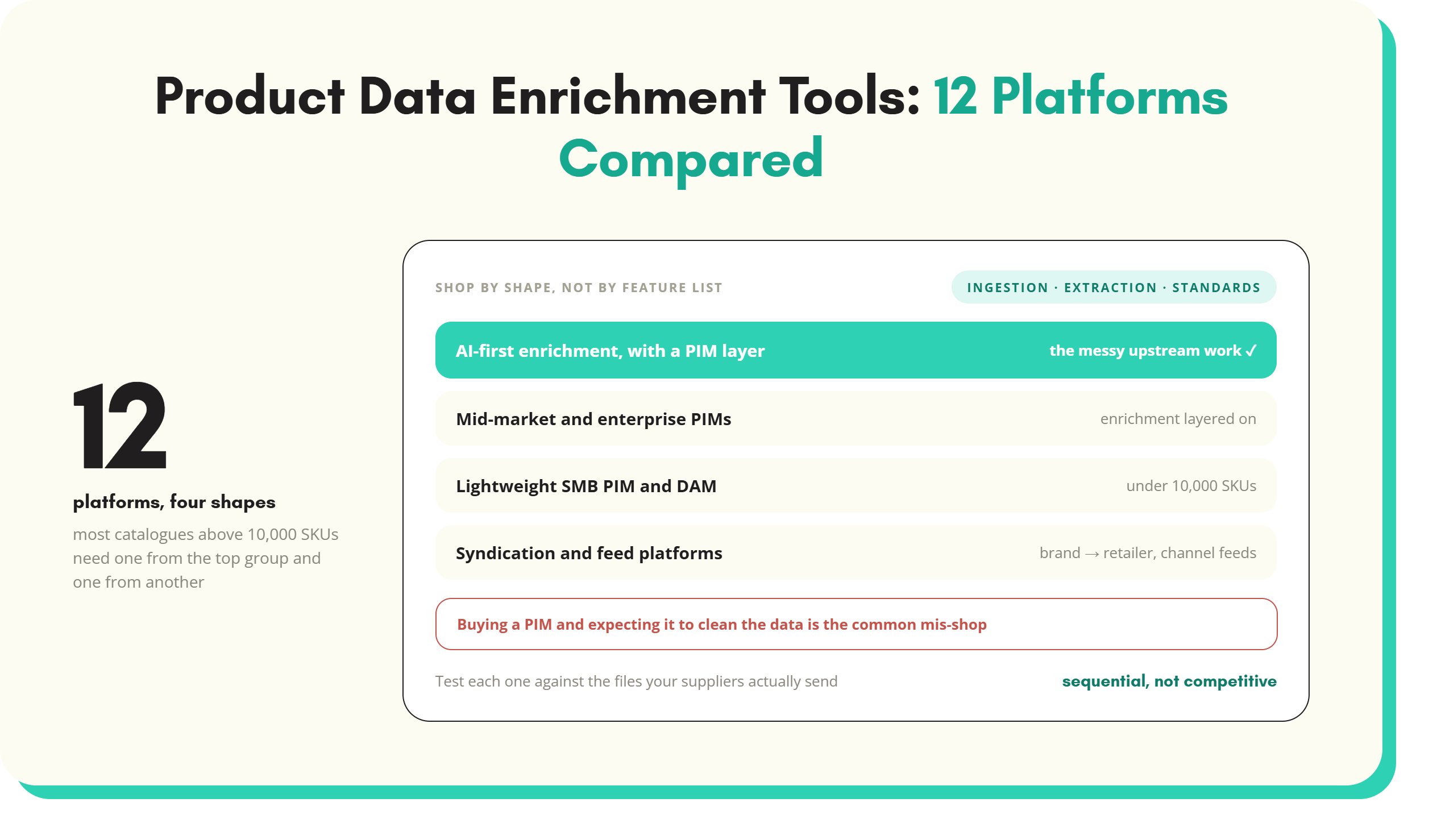
1. The 12 tools split into four shapes.
- AI-first enrichment platforms with a built-in PIM layer (SKULaunch).
- Mid-market and enterprise PIMs with enrichment features layered on (Akeneo, inRiver, Pimberly, Catsy, Catalyst, Bluestone PIM).
- Lightweight PIMs aimed at SMB (Plytix).
- Enterprise syndication and feed platforms (Salsify, Syndigo, Productsup, Informatica Product 360).
2. Buyers tend to mis-shop in two predictable ways:
- They buy a PIM and assume it will do the enrichment, then spend a year trying to clean data inside a tool that was not designed for it.
- Or they buy an enrichment tool without a PIM and find themselves needing governance and syndication six months later.
3. The honest pattern:
- Most distributors and retailers above 10,000 SKUs need both an enrichment platform and a lightweight PIM.
- The two layers are sequential, not competitive.
- Choose the enrichment tool for the messy upstream work.
- Choose the PIM for storage, governance, and channel syndication.
The full picture sits in the product data enrichment pillar.
Next steps
Evaluating enrichment platforms? Book a 30-minute demo and we will show SKULaunch against the criteria in this article: ingestion, extraction, classification, integrations. Using your own supplier data.
See it in practice: bulk product data enrichment, find missing product data with AI web search and extract product data from manufacturer websites.
See SKULaunch in action
Watch how we handle AI enrichment, supplier onboarding, and catalogue scale in a live 30-minute demo.


.avif)