

Incomplete product data is one of the most common reasons a product launch stalls.
Incomplete product data is one of the most common reasons a product launch stalls. It is also one of the easiest gaps to miss until a listing is already live. A supplier file can look complete at a glance and still be missing one field. That single gap, a dimension, a certification, an allergen note, can determine whether the product can be listed at all.
Why incomplete product data slips through
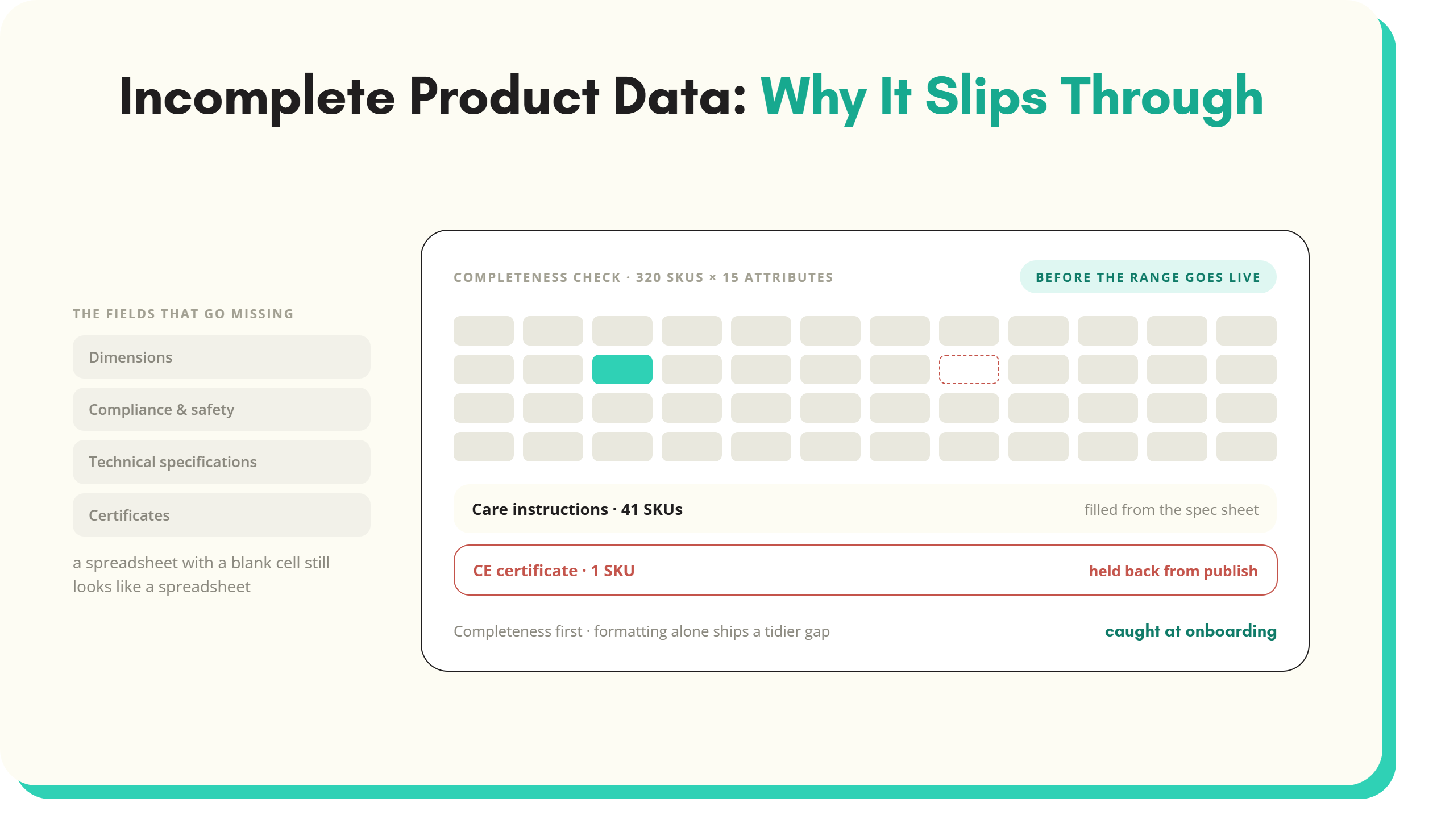
Supplier files rarely fail all at once. More often, they arrive mostly complete, with a handful of fields left blank or simply never asked for in the first place. The most frequently missing fields tend to be the ones that take real effort to source. Product dimensions, compliance and safety information, technical specifications, and certifications or regulatory details top the list. None of these are optional extras. Each one is something a customer, a retailer, or a regulator will eventually need. That holds true whether or not it was filled in at the point of onboarding.
The gap is easy to miss during onboarding because a spreadsheet with a blank cell still looks like a spreadsheet. Nothing about the file itself signals that a listing built from it will fail a compliance check three weeks later. Nothing signals that a customer will receive a product that does not match its description, because a key spec was never filled in. The problem only becomes visible once it has already caused a return, a complaint, or worse.
What incomplete product data costs a launch
The consequences scale with how critical the missing field is. A food product listed without allergen information is not a minor gap. It is a compliance risk that can trigger a recall or a legal issue well after the product has already reached customers. By that point, the cost of the original gap has multiplied many times over. Missing technical specifications for an industrial part cause a quieter but still costly problem. Customers order the wrong item, and the resulting return or exchange eats into margin that a complete listing would have preserved from the outset.
Filling gaps manually, one missing field at a time, is slow, expensive, and easy to get wrong under deadline pressure. It also pulls people away from work that actually grows the business. Chasing a missing spec from a supplier by email is not time spent on customer service or sales. A team of two or three people can absorb this cost quietly for a while. That holds right up until catalogue size or launch frequency makes the manual approach untenable.
Two failure modes that compound incomplete product data
Incomplete attributes rarely show up in isolation. Two related problems tend to make the gap harder to catch. Both are worth understanding, even though neither is the root cause on its own.
Inconsistent formatting hides missing data inside data that looks fine at first glance. One supplier might categorise clothing by style, another by use case, and a third might use a completely different taxonomy again. One might record dimensions in centimetres, another in inches. A third might round to the nearest whole number in a way that loses precision nobody notices until a customer complains. None of that is wrong exactly. It just makes it harder to see at a glance which records are actually complete once everything is forced into a single schema.
Weak validation allows both problems to reach a live listing. Without a system checking for missing fields and formatting inconsistencies before import, other problems slip through too. Incorrect descriptions, outdated stock levels, and inaccurate pricing all reach live listings alongside the genuinely missing attributes. The result is not one clean failure, but a scattering of small errors across the catalogue. Each one is individually minor and collectively expensive, since a team chasing one visible error rarely has time to go looking for the quieter ones sitting next to it.
Closing the gaps in supplier product data
An AI-powered product data onboarding platform such as SKULaunch is built to catch these gaps before they reach a live system, rather than after a customer or a regulator finds them. Automated data enrichment scans incoming records, identifies missing attributes, and fills them using AI product data extraction, reference data, and pattern recognition, rather than leaving a person to track down each gap individually.
Agreeing clear data standards with suppliers upfront, as part of a wider supplier onboarding process, reduces how often gaps occur in the first place. That said, it rarely removes the need for a validation step, since even a well-briefed supplier will occasionally miss a field, particularly on a new product range where the required attributes have not yet become routine.
None of this replaces the supplier relationship. It changes what that relationship has to cover. Instead of chasing a missing spec after a launch has already stalled, a team can flag the same gap during onboarding, before it has cost anything beyond a quick correction.
What this looks like in practice
Take a fashion retailer sourcing from a dozen international suppliers. Formats vary supplier to supplier, and several listings arrive missing size charts, material details, or care instructions entirely. Standardising the formatting alone would not fix the gaps. Enrichment is what fills the missing fields, and validation is what confirms nothing critical is still absent before the range goes live, since the retailer's launch calendar does not leave room to discover a gap after the fact.
Consider also an industrial distributor receiving data from suppliers worldwide, where missing compliance certificates or incomplete technical specifications have previously caused order errors and supply chain friction. In that kind of business, a missing certificate is not a cosmetic gap; it can block a shipment at customs or trigger a compliance review well after the sale has closed. Automated validation catches gaps like this before a product reaches a customer, rather than after an incorrect part has already been shipped and needs to be returned, re-specified, and re-shipped at real cost.
Key takeaways
Missing and incomplete product attributes are usually the root problem, with inconsistent formatting and weak validation making the gaps harder to spot rather than causing them outright. A business that fixes formatting but not completeness will still ship listings missing critical fields, just in a tidier spreadsheet. A business that adds validation but never addresses the underlying gaps will simply get faster, more consistent notifications about the same missing data.
Treating attribute completeness as the starting point, backed by automated enrichment and validation, closes more of the gap than fixing formatting or validation in isolation. For a broader look at the other two failure modes, the product data integration guide and the bulk SKU imports guide cover related ground in more depth.
To see how SKULaunch fills the gaps in a real supplier data set, request a demo.
See it in practice: fill missing product attributes across thousands of SKUs, measure product data completeness by category and channel and find missing product data with AI web search.
See SKULaunch in action
Watch how we handle AI enrichment, supplier onboarding, and catalogue scale in a live 30-minute demo.


.avif)