

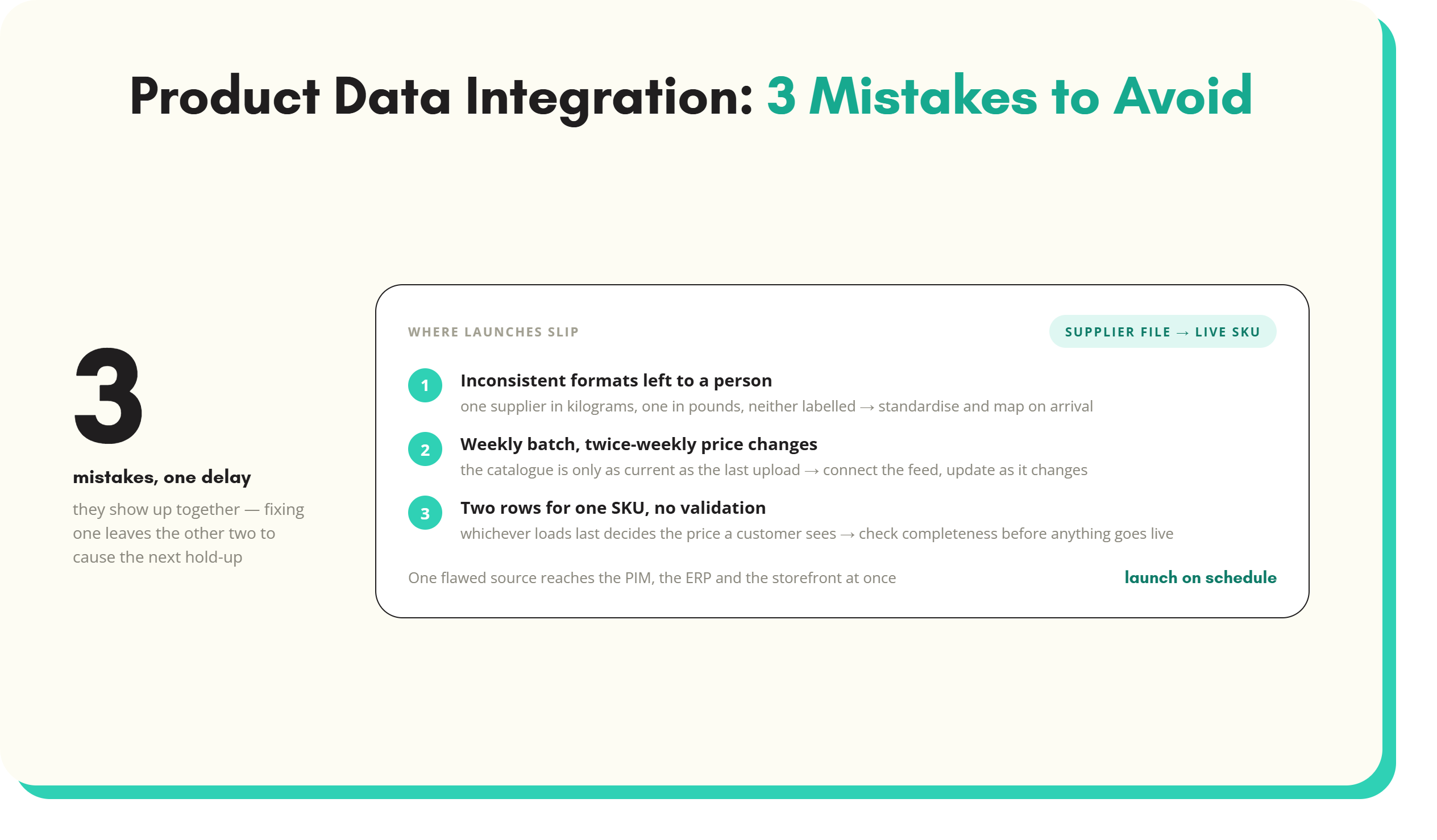
Product data integration is what determines whether a new SKU actually goes live on schedule.
Product data integration is what determines whether a new SKU actually goes live on schedule. A fast, well-connected process between supplier files and internal systems is a genuine advantage. A slow, disjointed one creates delays, misalignments, and errors that show up long after the launch date has passed.
Why product data integration determines launch speed
A product launch is only as strong as the data it is built on. That data needs to be structured and consistent to be usable. A retailer might be adding thousands of SKUs to an ecommerce platform. A distributor might be updating technical attributes for a B2B catalogue. Either way, integrating supplier data efficiently sits at the centre of the process.
A well-integrated onboarding process does several things at once. It reduces manual work by automating validation and formatting. It catches errors before they become missing or incorrect product information. It speeds up SKU onboarding, so products go live sooner. It also keeps PIM, ERP, and ecommerce platforms in step with each other, rather than each holding a slightly different version of the same product.
Even so, plenty of businesses still run into the same integration pitfalls, over and over, with every new supplier range. Three mistakes account for most of the delay, and they tend to show up together rather than in isolation.
Mistake one: letting inconsistent formats break product data integration
Supplier product data rarely arrives in one consistent format. One supplier might send an Excel file with incomplete attributes. Another might provide data through an API that follows entirely different conventions, using its own field names and units. Without a system robust enough to standardise and validate both, the result is the same either way. Errors, missing information, and manual rework fall on whoever notices first.
The impact shows up on both sides of the launch. SKU onboarding slows down while someone chases missing or incorrect attributes, often by email, one field at a time. Teams spend hours cleaning and reformatting data that should have arrived usable. Customers see the result too, in listings that are incomplete or simply wrong. That might be a missing size chart, or a spec that does not match the product photographed.
Take a hypothetical distributor bringing on two new suppliers for the same product category at once. One sends weights in kilograms, the other in pounds, and neither field is labelled clearly enough to catch the mismatch automatically. Without a standardisation step, that discrepancy reaches the live catalogue and stays there until a customer complaint flags it.
An AI-powered product data onboarding platform such as SKULaunch can automate the structuring and enrichment that would otherwise fall to a person. Automated validation checks for missing or incorrect fields before data reaches internal systems, rather than after. Agreeing clear formatting requirements with suppliers upfront helps too. It rarely eliminates the problem entirely across a large supplier base, but it cuts down how often it happens.
Mistake two: neglecting real-time data in product data integration
Plenty of businesses still rely on batch uploads and static spreadsheets, both of which carry a built-in risk. The data is only ever as current as the last upload. Incorrect pricing, discontinued products still listed as available, or stock levels that have not been refreshed can each derail a launch on their own. All three tend to happen at once once a catalogue reaches any real size.
Customers who see incorrect or incomplete details either abandon the purchase, or receive something that does not match what was advertised. Either outcome drives returns as much as it drives complaints. Pricing and inventory mismatches create operational headaches that someone then has to untangle, usually under time pressure. Launch delays follow as teams stop what they are doing to fix the data manually instead of shipping on schedule.
Consider a retailer running a batch upload once a week while a key supplier changes pricing twice in that window. Every listing sits wrong for days at a time, and the discrepancy only surfaces when a customer orders at the outdated price. A weekly batch process cannot catch that kind of change, no matter how carefully it is run.
Moving to an API-first approach applies updates to SKUs in real time rather than on a batch schedule. Connecting directly to supplier feeds keeps product information synchronised as it changes, rather than waiting for the next manual export. Automating data enrichment alongside this, covering descriptions, specifications, and categorisation, keeps the whole record current, not just the price.
Mistake three: skipping validation before product data integration completes
Many businesses assume the supplier data they onboard is accurate and complete. It rarely is. Without rigorous validation checks in place, incorrect or duplicate SKUs make their way into the catalogue. That complicates inventory management and produces listings that are simply wrong from the moment they go live.
Product listings go live with missing or incorrect information. That shows up downstream as cart abandonment, returns, and a dent in brand trust that is harder to fix than the original data error. The same mistakes tend to appear across PIM, ERP, and ecommerce platforms at once, since they all draw from the same flawed source. That turns a single fix into a cleanup job across several systems rather than one. For regulated categories, such as products with safety or compliance attributes, unvalidated data carries a compliance risk on top of the operational one.
A hypothetical example: a supplier sends a spreadsheet with two rows for the same SKU, one with an old price and one with the current price, and no clear indication of which is authoritative. Without a validation step, both could end up in the system. Whichever loads last determines what the customer sees, by accident rather than design.
Automated data quality checks validate completeness, accuracy, and compliance before anything reaches a live system. Supplier data validation tools flag discrepancies while they are still cheap to fix, rather than after a listing has already gone live. A managed service such as SKU Concierge can take on the sourcing and verification work directly. That suits teams that would rather not build that capability in-house from scratch.
Getting product data integration right
The three mistakes, inconsistent formats, stale updates, and skipped validation, tend to compound each other rather than occur in isolation. A supplier file with inconsistent formatting is also more likely to go unvalidated. A business running on batch updates is usually the same one without real-time checks in place. Fixing one in isolation rarely solves the underlying problem, since the other two are still there to cause the next delay.
Addressing all three moves SKU onboarding from a recurring bottleneck to something closer to a routine step. A structured product data enrichment process replaces ad hoc reformatting with a repeatable check before data ever reaches a live platform, backed by AI product data extraction to close the gaps in supplier files. For distributors managing the same problem across a wider catalogue, the product data management for distributors approach covers similar ground in more depth. The result is faster launches, fewer downstream errors, and less manual work overall.
See it in practice: turn ERP item master data into sellable product records, product attribute mapping across every supplier and reuse column mappings for repeat supplier files.
See SKULaunch in action
Watch how we handle AI enrichment, supplier onboarding, and catalogue scale in a live 30-minute demo.


.avif)