

Bulk SKU imports are where a lot of otherwise well-planned launches lose their timeline.
Bulk SKU imports are where a lot of otherwise well-planned launches lose their timeline. Retailers, wholesalers, and distributors depend on getting large volumes of product data into their systems quickly and accurately. The speed of that process shapes how fast products actually reach customers, and how smoothly the rest of the operation runs around it.
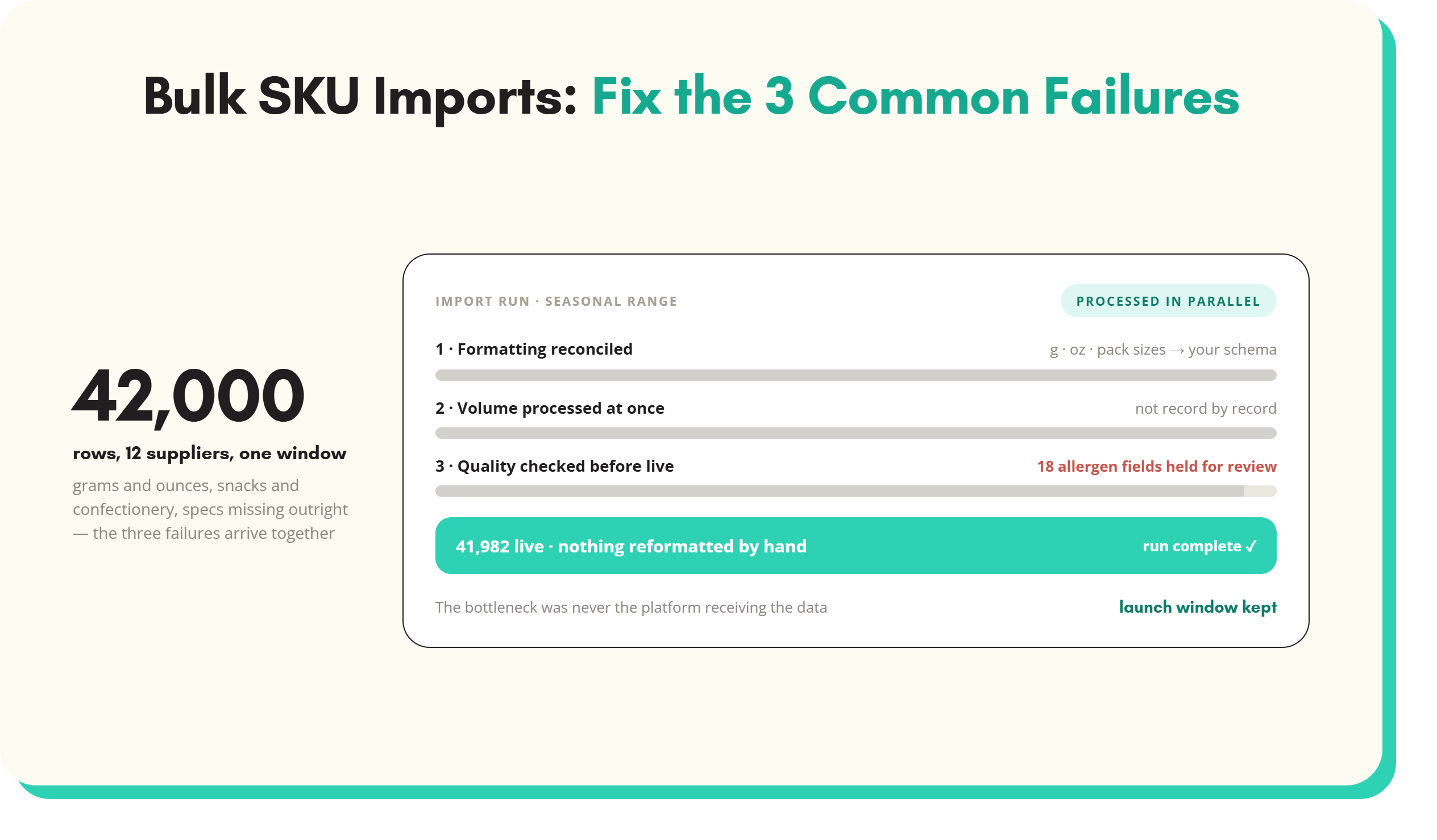
Three problems account for most of the delay. Formatting is inconsistent across suppliers. Processing systems cannot handle the volume a modern catalogue demands. Data quality was never checked before it arrived. Each one causes real damage on its own, and in practice they tend to show up together. A business without the tooling to fix one usually lacks the tooling to fix the other two as well.
Formatting and compatibility issues in bulk SKU imports
Product data rarely arrives in one format. Suppliers each have their own conventions for naming products, categorising them, and listing details. Without standardisation, those differences cause delays when integrating with an ERP system. They slow down product updates and push back launch dates that were set months in advance.
Take a hypothetical nationwide FMCG retailer bringing in data from a dozen suppliers. Some list weight in grams, others in ounces. Some write long, detailed descriptions, others keep it to a few words. Category names differ too: one supplier's "snacks" is another's "confectionery," and a third splits the two into separate categories entirely. None of that is wrong on its own, but none of it lines up either, and that mismatch is exactly what breaks an automated import. The result is manual correction, field by field, which is slow, tedious, and easy to get wrong under deadline pressure.
API-first connectivity addresses this at the source, syncing supplier data with a PIM, ERP, and marketplaces automatically rather than through manual uploads. A supplier onboarding platform built around this connection keeps product data current. Nobody has to reformat a spreadsheet every time a range changes. The mapping between a supplier's conventions and the merchant's schema is handled once, rather than re-solved by hand for every new file.
What slows down bulk SKU imports at scale
Many older product data systems were not built for the volume that businesses now need to process. As catalogues grow, these systems hit their limits, and the result is bottlenecks, delays, and rising costs. For a large retailer, that kind of delay can mean losing market share, or missing a seasonal window entirely. It can also mean watching a faster competitor launch first with the same product.
Consider a B2B wholesale distributor receiving product data from dozens of suppliers, each in a slightly different format and on a different schedule. On a manual or outdated system, processing and uploading that data takes longer with every new supplier added. That compounds delays, drives up cost, and increases the odds of an error slipping into a live listing. A rushed manual review under time pressure catches less than a careful one would.
AI-powered automation handles large volumes of data at once, rather than working through records sequentially the way a manual process does. That keeps imports moving at a consistent pace as a catalogue grows, instead of hitting the same wall every time volume increases. Scaling from a few hundred SKUs to several hundred thousand becomes a question of processing time. It stops being a question of whether the current process can cope at all.
Poor data quality
Incomplete or inaccurate product data is one of the most common problems in a bulk import, and one of the most expensive to leave unchecked. Suppliers send data with missing details, outdated prices, incorrect inventory counts, or errors in product specifications on a regular basis. Left unaddressed, that leads to more returns, frustrated customers, and lasting damage to brand reputation that outlasts the original data error by some margin.
For FMCG retailers in particular, accuracy is not optional. A food product listed with incorrect allergen information does not just create a poor customer experience. It can trigger a recall or a legal issue that goes well beyond the original import. No amount of fast processing elsewhere offsets that kind of risk.
The same principle applies more broadly, even where the stakes are lower than a recall. A mattress listed with the wrong dimensions generates a return rather than a legal problem. So does a tool listed with the wrong voltage rating. Multiplied across a catalogue of thousands of SKUs, that steady trickle of small errors adds up. It becomes a measurable drag on both margin and customer trust over time.
AI-driven validation and enrichment tools check for missing details, flag inconsistencies, and correct errors before a product goes live, rather than after a customer has already seen the listing. That turns bulk SKU imports from a source of risk into something a team can run with confidence, even against a tight deadline. The checks happen automatically, rather than depending on someone remembering to look.
What this looks like across business models
A hypothetical nationwide grocery retailer launching thousands of new seasonal SKUs, both online and in stores, needs to manage different pack sizes, nutritional information, and promotional prices at once. Standardising and validating that data before it reaches any platform means products list accurately everywhere from the outset. That beats a manual pass per channel to catch whatever slipped through the first time, particularly during a seasonal window where a channel-by-channel fix is too slow to matter.
A hypothetical industrial distributor handling thousands of SKUs faces a related but different problem: supplier data that is frequently missing technical specifications altogether. Automated validation combined with AI product data extraction can fill gaps like this rather than leaving them for someone to chase by email. That speeds up onboarding and keeps ERP integration from stalling on a handful of missing fields buried in an otherwise complete file.
Both examples share the same underlying pattern, even though the products, customers, and compliance requirements involved are very different. In each case, the bottleneck was never the platform receiving the data. It was the state the data was in before it arrived, and how much of that state had to be fixed by hand before the import could run cleanly.
Getting bulk SKU imports right
Formatting inconsistencies, processing limits, and poor data quality tend to show up together rather than as isolated problems. A business without the tooling to fix one of them usually lacks the tooling to fix all three, since the underlying gap is the same: nobody standardised, validated, or scaled the supplier onboarding process before volume made it unmanageable.
Addressing them as a single product data enrichment process, rather than three separate fixes applied after the fact, is what actually changes how bulk SKU imports perform at scale. That shift also tends to hold up as a catalogue grows, where three separate manual fixes would each get harder in turn rather than staying constant. For a broader look at where integration itself tends to break down, the product data integration guide covers related ground. A clean starting file is worth more than it sounds: the product catalogue template scores completeness per row against eight required fields, so sorting ascending hands you the enrichment backlog in priority order.
To see how SKULaunch handles a large supplier data set, request a demo.
See it in practice: bulk import tens of thousands of SKUs in one file, import products before you know their category and WooCommerce product import with variations that work.
See SKULaunch in action
Watch how we handle AI enrichment, supplier onboarding, and catalogue scale in a live 30-minute demo.


.avif)