

AI product data management replaces a specific kind of manual work. Continue reading to learn more!
AI product data management replaces a specific kind of manual work. It replaces the hours spent filling gaps, checking formats, and sorting products into the right categories by hand. None of that work is complicated in isolation. It is just repetitive enough, and high-volume enough, that doing it manually caps how fast a catalogue can grow. That holds regardless of how skilled the person doing it happens to be.
Why AI product data management is replacing manual work
Accurate product data underpins nearly everything downstream in ecommerce, from SEO rankings to conversion rates. When information is incomplete, inconsistent, or filed under the wrong category, the effects show up well beyond the original record.
Traditional product data management leans on manual input, spreadsheet handling, and internal systems that were never built to talk to each other. The results are familiar to most retail and distribution teams. Data looks different depending on which platform it lands on. SKU onboarding slows down every time a new supplier is added. Poor searchability follows from missing attributes and miscategorised products, and compliance risk builds from descriptions or specifications that were never checked.
Three areas in particular tend to consume the most manual effort, and each is where automation makes the most practical difference: enrichment, validation, and categorisation.
AI product data management: enrichment
Supplier data typically arrives with missing attributes, thin descriptions, and formatting that varies from one file to the next. Enhancing that data by hand is slow, and every manual pass introduces a fresh chance of human error. The downstream effects are concrete. Weak search rankings follow from missing metadata. Higher return rates follow from vague or inaccurate descriptions. Product pages simply fail to convert because they do not answer the questions a buyer actually has.
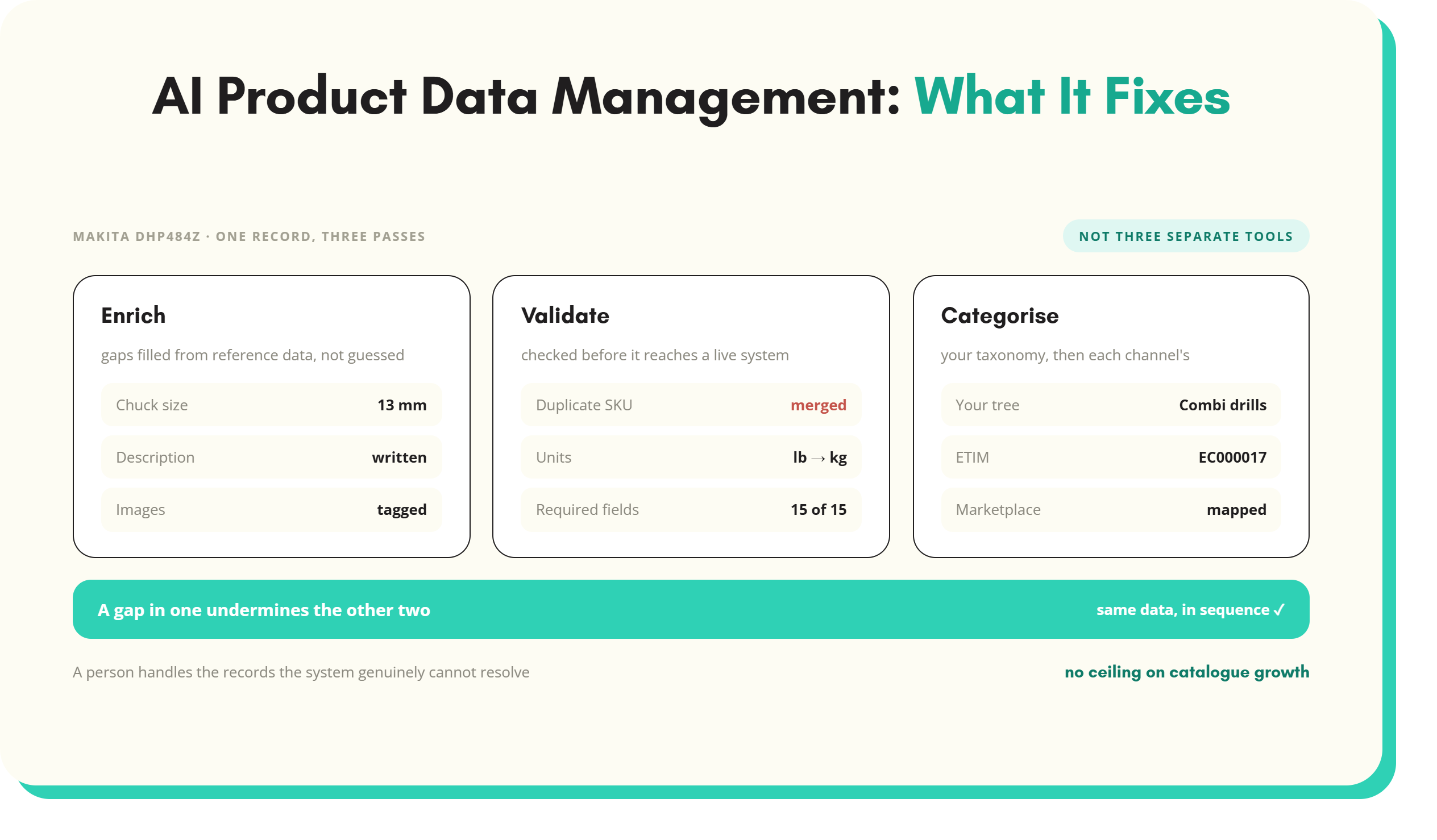
Automated attribute extraction identifies and fills missing fields, such as dimensions, materials, or technical specifications. It uses reference data and pattern recognition rather than a person searching for each value individually. This kind of AI product data extraction draws on structured reference sources rather than guessing at a plausible value. That distinction matters for anything a customer or a regulator might later check against the real product. Structured content generation produces descriptions built for both search visibility and readability, rather than a single generic paragraph reused across a whole category. Image tagging and classification labels product visuals automatically, so a catalogue's images are searchable and consistently described without someone tagging each one by hand.
A product data enrichment process built around these three functions closes most of the gap that manual enrichment leaves behind. What used to take a person an afternoon per supplier file becomes a pass that runs automatically the moment the file arrives. A person is only needed for the handful of records the system genuinely cannot resolve on its own.
AI-driven product data validation
Manually validating supplier data is slow and easy to get wrong under time pressure, particularly across inconsistent formatting, missing product codes, and duplicate SKUs. Each of those problems on its own causes a delay. Together, they tend to surface late, often only once a listing has already gone live with the error still in it.
Automated validation detects errors, duplicates, and inconsistencies before data reaches a live system, rather than after a customer or a channel has already flagged it. This layer works closely with AI product data extraction, since a field that was extracted or enriched automatically still needs checking before it is trusted, in the same way a person's work would be reviewed rather than assumed correct on the first pass. Standardisation aligns product data with the formatting each destination platform, whether a PIM, ERP, or ecommerce system, actually requires, rather than leaving that translation to whoever last touched the file. Real-time updates keep pricing, stock, and specifications current across every connected system, closing the gap that a batch process leaves open between updates.
For a closer look at what tends to go wrong without this kind of validation, the incomplete product data guide covers the failure modes in more depth, and the bulk SKU imports guide covers how the same problem plays out at higher volume.
AI-enhanced categorisation and syndication
Retailers and distributors need supplier data mapped to their own taxonomy, not the supplier's. Done manually, that mapping is slow and inconsistent enough that products end up harder to find on search engines and marketplaces than they should be, purely because of where they were filed rather than anything wrong with the product itself.
A supplier might list a product under one category, a distributor's internal system under another, and the marketplace it eventually reaches under a third again. Reconciling all three by hand, for every SKU, is exactly the kind of repetitive task that does not get easier as a catalogue grows; it just gets slower in direct proportion to the number of products involved.
Automated categorisation assigns SKUs to the correct category and subcategory based on their attributes and description, rather than a person guessing at the closest match under deadline pressure. Automated syndication then formats that same categorised data correctly for each sales channel it needs to reach, which matters more as the number of channels grows. The product data exports guide covers this side of the process in more depth, since correct categorisation is really the first step in a syndication process that continues well beyond it. Behavioural recommendation tools sit on top of accurate categorisation, since a recommendation engine can only suggest genuinely relevant products once the underlying data is structured well enough to support that comparison in the first place.
Getting AI product data management right
Enrichment, validation, and categorisation are not three separate tools bolted together. They work on the same underlying data, in sequence, and a gap in one tends to undermine the other two: an enriched record that was never validated can still carry an error into a live listing, and a validated record that was never categorised correctly is still hard to find.
A supplier onboarding platform built around all three functions, rather than one in isolation, is what actually changes how much manual work a growing catalogue demands. The alternative is not that the work disappears without automation; it is that it keeps growing in proportion to the catalogue, indefinitely, with no natural ceiling.
For a business still handling one of these three functions manually, the more useful question is usually not whether to automate, but which of the three is currently consuming the most staff time. That is typically the one worth starting with, since the other two tend to matter less until the first bottleneck clears.
To see how SKULaunch applies this to a real supplier data set, request a demo.
See it in practice: approve AI-generated product data before it goes live, find missing product data with AI web search and enrich products from just a part number and a name.
See SKULaunch in action
Watch how we handle AI enrichment, supplier onboarding, and catalogue scale in a live 30-minute demo.


.avif)