

Product data exports break down for a simple reason: every channel wants something slightly different.
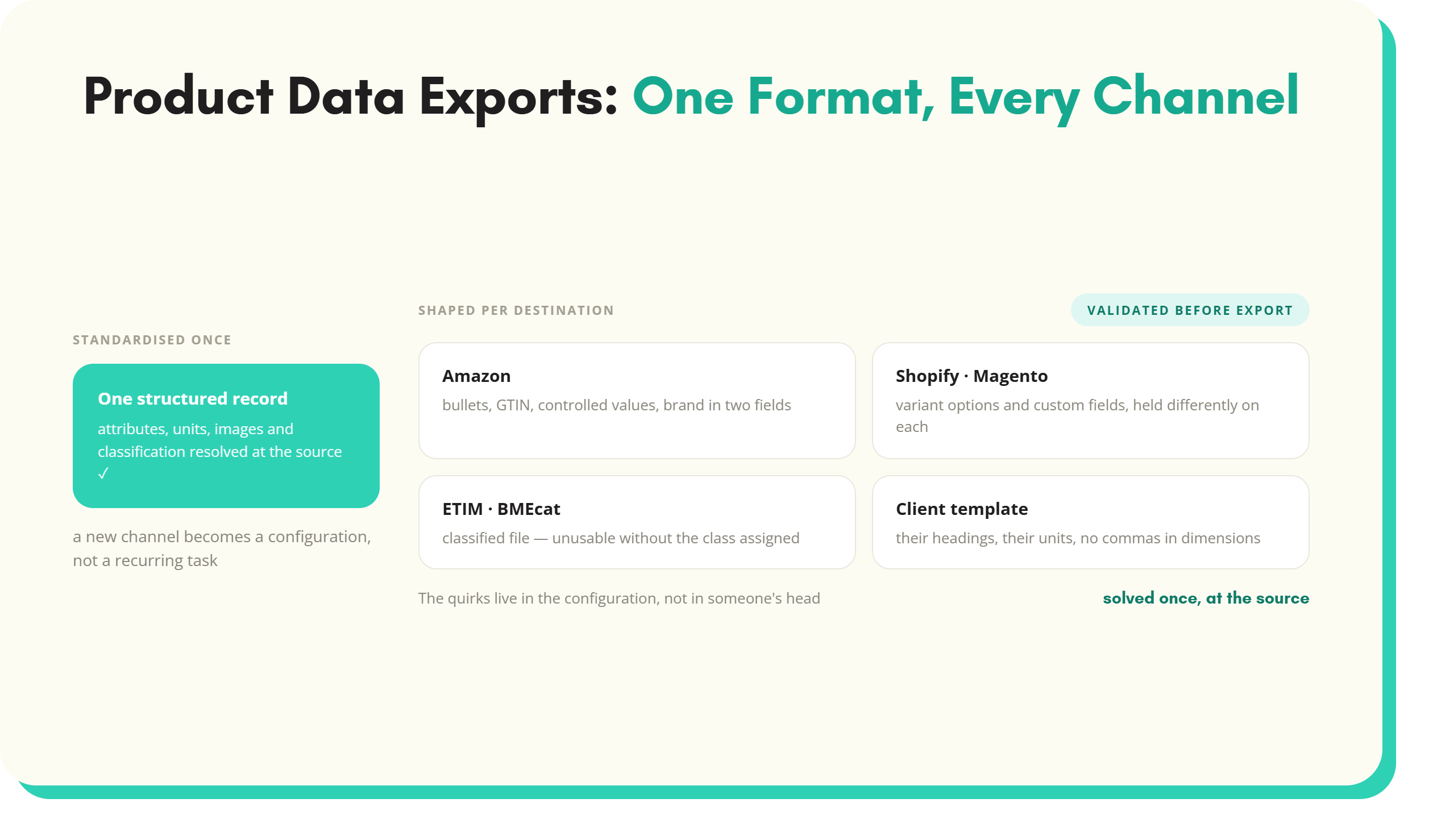
Product data exports break down for a simple reason: every channel wants something slightly different. A business selling through marketplaces, its own storefront or a customer catalogue feeds is not exporting one dataset once. It is reformatting the same catalogue repeatedly, once per destination, each with its own rules for attributes, images and categorisation.
Why product data exports break across channels
The destinations a catalogue actually has to reach each impose their own structure:
- Marketplaces: Amazon and Mirakl-powered marketplaces each enforce their own mandatory attributes, controlled values, image specifications and category schemas. A listing built for one will often fail validation on another purely on formatting grounds, even when the underlying product information is correct.
- Ecommerce platforms: Shopify and Magento hold products differently. Variants, option structures and custom fields do not map one-to-one, so the same product needs a different shape on each.
- Trade formats: technical distributors are increasingly asked for classified data in formats such as ETIM and BMEcat, where ETIM classification decides whether the file is usable at all.
- Client-specific feeds: wholesale customers ask for the catalogue in their own template, with their own column headings and units.
None of these requirements overlap cleanly with the others, which means a format that works well for one channel can actively work against another.
Doing this by hand means reworking the same base data multiple times, once per channel. It means doing that again every time a channel updates its own specification. That produces delays, inconsistent outputs, and a growing list of channel-specific quirks. Often, only the person who last touched the export actually remembers them. That becomes a real problem the moment that person is unavailable or moves to a different role.
The quirks are rarely written down anywhere. The Amazon feed needs the brand duplicated into two fields. One client template rejects commas in dimensions. Another wants pack quantity held as an attribute, not in the product name. Each rule exists only because an export once failed without it, and each one lives in somebody’s head.
Standardising supplier data upfront, before it reaches any single channel, changes the starting point of every export. Rather than reformatting a messy source file for each destination, AI product data extraction turns the source into one clean, structured dataset. That dataset can then be adapted into whatever shape each channel requires. That removes the need to solve the same formatting problem once per channel. It stays solved even as the catalogue changes.
Automating product data exports at scale
Manual formatting does not scale well past a handful of channels. Every manual intervention adds processing time, introduces a chance of error, and caps how fast a catalogue can grow without adding headcount to match. For a retailer with an extensive catalogue, that kind of delay affects time-to-market and, eventually, revenue. A product sitting in a formatting queue is a product that is not yet for sale anywhere. Adding a new channel under a manual process does not just add one more task. It adds a permanent, recurring one that has to be repeated for every future catalogue update, indefinitely, for as long as that channel stays live. Where the channel is Google, the Google Shopping feed template sets out the 27 attributes and marks which are conditionally required, which is usually where a first feed fails.
AI-powered automation handles the repetitive parts of this process directly. Mapping data to each channel’s schema, standardising attributes, and shaping content for the destination it is headed to all happen without manual input. Adding a new marketplace becomes a configuration step rather than a new ongoing task assigned to someone’s weekly workload.
AI-driven content generation extends the same logic to descriptions. A marketplace listing, a storefront product page and a technical description in a B2B catalogue feed each read differently. Reusing one generic description everywhere underperforms on most of them. Generating each version from the same structured source removes the need to write and maintain several by hand.
Keeping product data exports consistent
Data quality and consistency directly affect brand reputation, customer trust, and how much manual cleanup a team ends up doing after the fact. Poorly managed exports tend to produce inconsistent details, outdated information, or missing attributes, and customers notice all three. New customers get frustrated by an incomplete listing; existing ones are more likely to return a product that did not match what they expected. Either way, the cost lands on brand trust, not just on the original export.
The problem compounds across channels rather than staying contained to one. A wrong specification caught and fixed on one marketplace can still be live on the storefront, in the PIM and in three client feeds. That happens when the export process runs independently for each destination, rather than from one validated source. That is often how the same mistake ends up costing a business more than once for a single underlying error.
Automated validation catches this before it reaches a channel. Validation rules flag incomplete records and inconsistent values at the source, which keeps product data integrity consistent across every export destination, rather than relying on someone spot-checking a sample after the fact. Automated data enrichment works alongside validation, filling in missing attributes and correcting inaccuracies as part of the same pass, rather than as a separate manual step queued up after export.
What this looks like across business models
Consider a hypothetical omnichannel retailer exporting product data simultaneously to two marketplaces and a Shopify storefront. Automated workflows standardise and format thousands of SKUs to each destination’s specific requirements at once, rather than one destination at a time. That matters most under a tight seasonal deadline, where the alternative is choosing which channel launches late, since a manual process running sequentially through each channel eventually runs out of time before the last one is done.
The same retailer adding a channel mid-season, a Mirakl-powered marketplace, say, does not need to restart the process from scratch. Because the underlying data was standardised once, the new export is a matter of configuring the additional destination rather than reworking the whole catalogue again from the source files.
Consider also a hypothetical wholesale distributor exporting catalogues to several client-specific feeds, each with its own template, plus an ETIM-classified file for its largest trade customer. This is the same underlying challenge covered in product data management for distributors, just applied to the export side rather than the import side. A platform built on AI product data extraction can restructure and standardise complex datasets for each client automatically, cutting down the manual work that would otherwise arrive with every new client relationship. Each new client then adds a configuration, not a new manual export process to maintain indefinitely.
Getting product data exports right
Formatting, automation, and consistency are really one problem viewed from three angles: a catalogue that is clean and structured at the source exports more easily everywhere, regardless of how many channels it needs to reach. A supplier onboarding platform that gets the data right before export removes most of the channel-specific rework that would otherwise happen downstream, one destination at a time.
The channels a business exports to today are rarely the full list a year from now. A new marketplace, a new PIM, a new client-specific feed, each one adds another format to support. Solving that at the source, once, scales in a way that solving it channel by channel, repeatedly, does not.
To see how SKULaunch handles exports across multiple channels, request a demo.
See it in practice: export a filtered set of products to Excel, send product data to trade customers and buying groups and send different attributes to different channels.
See SKULaunch in action
Watch how we handle AI enrichment, supplier onboarding, and catalogue scale in a live 30-minute demo.


.avif)