

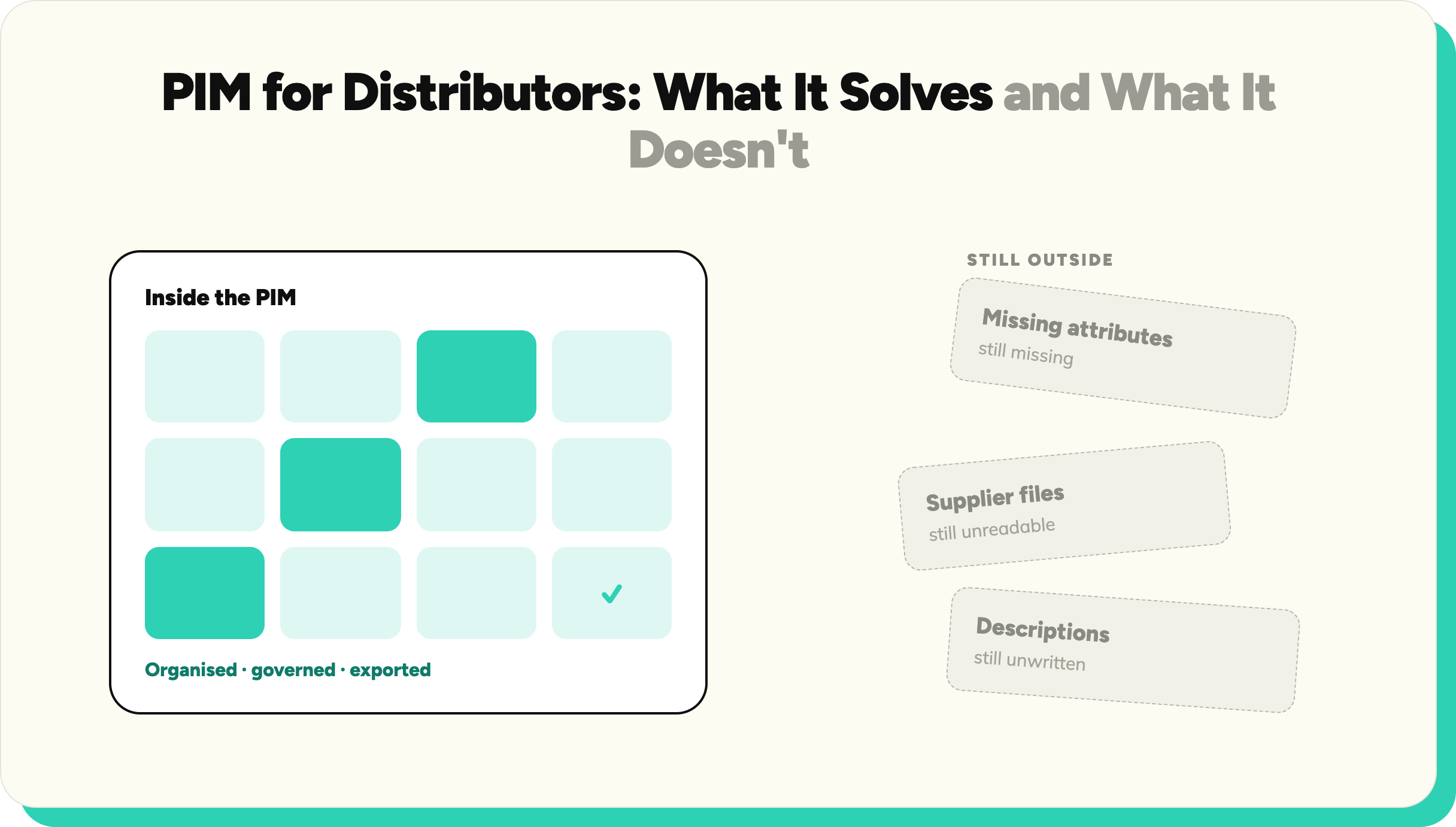
A PIM gives a distributor one governed home for product data. It does not fill itself.
Distributors evaluating a PIM are usually reacting to the same pressures: a customer demanding better data, a website whose filters do not work, or an ERP full of 30-character descriptions that were fine for invoicing and useless for ecommerce. A PIM for distributors solves a real problem, but a narrower one than the sales deck implies. Knowing where the PIM's job ends is the difference between a system that pays back and an expensive empty shelf.
What a PIM for distributors actually does
A PIM gives product data one governed home. For a distributor that means a single record per SKU holding the technical attributes, descriptions, images, and classifications, with workflow around who can change what, and syndication out to the website, marketplaces, customer portals, and print. The wins are real: no more competing spreadsheets, one place to fix an error, consistent data on every channel, and an audit trail. Distributors running tens of thousands of SKUs across a long tail of suppliers get genuine value from that consolidation alone.
Why distributor catalogues break generalist assumptions
Most PIM implementations are designed around a brand's catalogue: hundreds or thousands of products the company itself manufactures and knows intimately. Distribution is a different shape, in four ways.
- The data is not yours. A distributor's catalogue is assembled from dozens or hundreds of suppliers, each sending data in their own format: PDFs, spreadsheets with merged cells, images with the specification baked in. You do not control the source quality and never will.
- The attributes are technical. Voltage, thread pitch, IP rating, cable cross-section, material grade, compliance certification. Buyers filter and purchase on these values, and getting them wrong produces returns and, in some categories, safety issues.
- Classification is a requirement, not a choice. Electrical wholesale and industrial supply increasingly trade on ETIM classification, and marketplace and customer portals impose their own taxonomies on top.
- The volumes are unforgiving. Ranges of 30,000 to 100,000+ SKUs with hundreds of new lines a week. Any process that costs 30 manual minutes per SKU is arithmetically dead on arrival.
These four traits are why product data management for distributors is its own discipline rather than retail PIM with more rows.
What a PIM will not fix
A PIM stores, governs, and syndicates product data. It does not acquire it. The supplier PDF still has to be read, the attributes extracted, the units normalised, the product classified, and the description written, and none of that happens inside the PIM. This is the most common failure in distributor PIM projects: the platform goes live, the migration moves across whatever thin data the ERP held, and completeness sits at 40 to 60 percent with no mechanism to improve it. The team then does the maths on manually enriching 60,000 SKUs and quietly stops talking about the project. The pattern and its fixes are covered in distributor product data best practices.
Diagnose your actual bottleneck before buying. If data exists, is complete, and lives in too many places, the bottleneck is governance and a PIM addresses it directly. If the data does not exist in structured form yet, because it is trapped in supplier documents, the bottleneck is acquisition and enrichment, and a PIM alone will warehouse the gap rather than close it.
How to choose a PIM for distribution
Five criteria matter more for distributors than for the average PIM buyer.
- Attribute model depth: category-specific technical attributes with units, at your real catalogue scale. Test with your worst category, not the demo data.
- Standards support: ETIM and BMEcat handled natively if your sector trades on them, including version migration.
- ERP coexistence: the ERP stays the commercial system of record; the PIM must sync with it cleanly rather than fight it.
- Channel outputs: the website, marketplaces, customer portals, and print feeds you actually serve, without custom exports for each.
- An upstream data plan: the honest answer to "how does supplier data get into this, complete and classified?" If the answer is "your team keys it in", the project cost has a large hidden line.
Pair the PIM with an enrichment layer
The pattern that works treats acquisition and storage as separate jobs. An enrichment layer sits upstream: it ingests supplier files in whatever state they arrive, extracts and validates the technical attributes, classifies each product to ETIM or your own taxonomy, generates channel-ready descriptions from the verified values, and pushes complete records into the PIM. The PIM then does what it is good at: governing and distributing clean data. Bowens, an Australian building materials distributor, took PIM completeness from 30 percent to 94 percent with exactly this split; the detail is in the Bowens case study. For distributors starting from a mostly empty PIM, this sequencing, enrichment first, is the fastest route to a system that earns its keep, and it is the core of product data management for distributors done properly. For mid-sized distributors with no PIM yet, the same layer increasingly is the PIM: SKULaunch carries a built-in PIM layer, one governed record per SKU with variants and taxonomy, which does the system-of-record job without the implementation project.
Key takeaways
- A PIM for distributors consolidates, governs, and syndicates product data. Those are real wins at distribution scale.
- Distributor catalogues differ from brand catalogues in four ways: supplier-sourced data, technical attributes, mandatory classification, and unforgiving volume.
- A PIM does not acquire or enrich data. Launching one against incomplete supplier data produces a governed, half-empty system.
- Choose on attribute model depth, ETIM and BMEcat support, ERP coexistence, channel outputs, and a credible upstream data plan.
- The working pattern pairs the PIM with an enrichment layer upstream, so complete records arrive rather than get promised.
- Distributors without a PIM can run the enrichment layer as the system of record: SKULaunch's built-in PIM layer holds the governed record itself.
See SKULaunch in action
Watch how we handle AI enrichment, supplier onboarding, and catalogue scale in a live 30-minute demo.


.avif)