

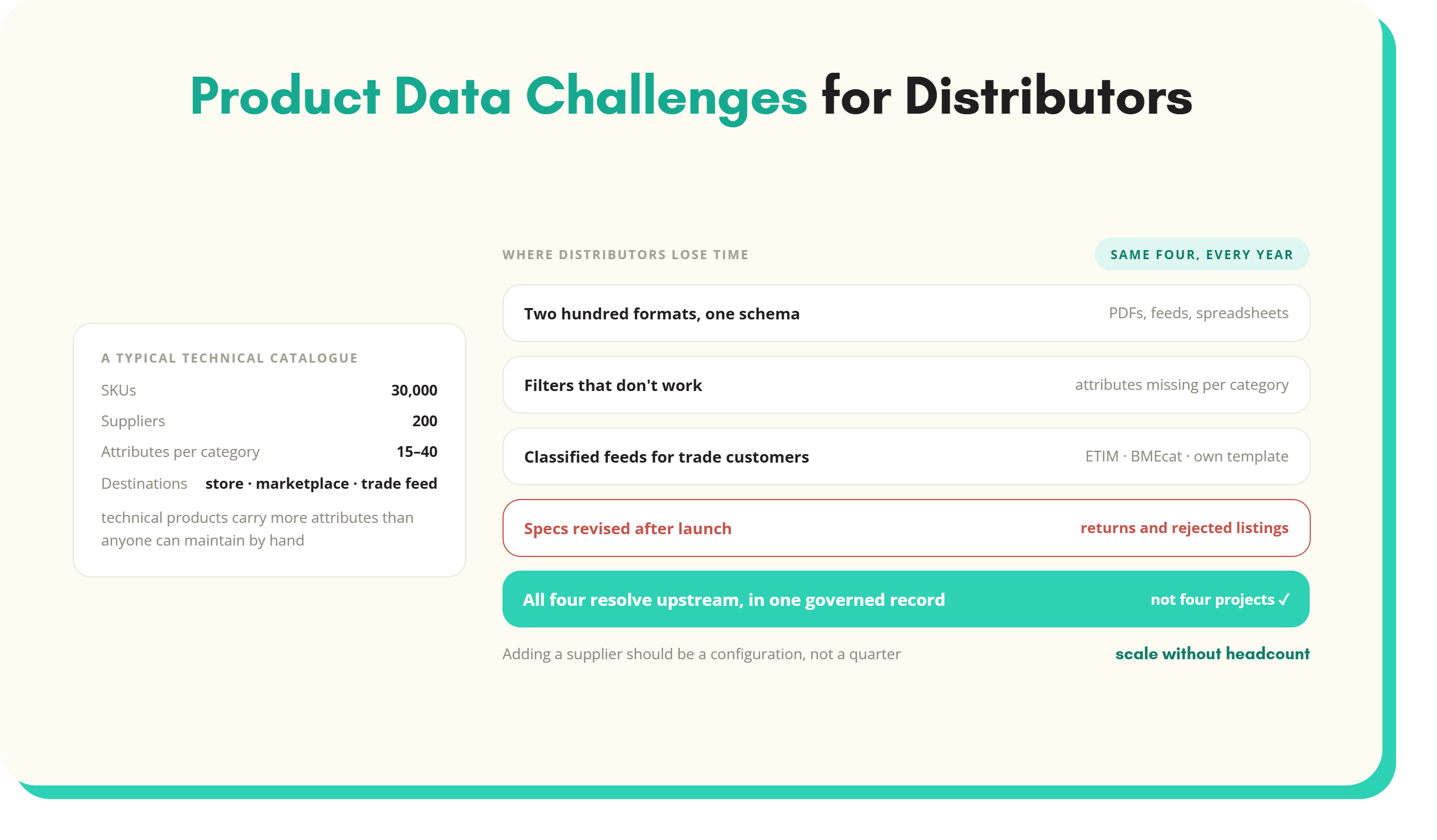
Generic product data advice, built around fashion and home goods use cases, doesn’t address any of this.
The product data challenges for distributors are different in kind, not just in scale, from what retailers face. A distributor with 150,000 active SKUs sourced from 400 manufacturers is dealing with supplier data which arrives with:
- 400 different formats
- Technical specifications that run to 80 attributes per product category
- Fitment and compatibility requirements that don’t exist in consumer retail
- Compliance obligations that attach legal risk to missing fields.
Generic product data advice, built around fashion and home goods use cases, doesn’t address any of this.
Why distribution is harder than retail for product data
Retail product data problems are mostly about completeness and presentation. A clothing retailer with 8,000 SKUs needs accurate descriptions, good images, and consistent sizing information. The data model is flat and the supplier base is manageable.
Distributor problems are structural. Five factors combine to make product data management in distribution significantly more challenging:
• Volume. 100,000 SKUs is the entry point in most technical distribution categories. Electrical wholesale, industrial supply, HVAC, and MRO distributors routinely carry 300,000 to 500,000 active lines. Manual enrichment stops being viable well below that threshold.
• Technical complexity. Where a retailer needs a product name, a description, and a handful of marketing attributes, a distributor needs mounting dimensions, thread pitch, IP rating, operating temperature range, and compatibility data. Electrical components or fluid power parts can require 50 to 150 attributes per SKU. Most PIMs are not configured to handle that depth out of the box.
• Supplier variance. A retailer may work with 50 suppliers, most using standardised trade feeds. A distributor with 400 manufacturers receives data in 400 different formats: PDFs with embedded specification tables, Excel files with bespoke column naming, proprietary portals, and product images where the only readable specs are inside the image itself.
• Regulatory and compliance requirements. Multiple elements of key information must be tracked at SKU level and kept current:
- Safety data sheets
- RoHS status
- REACH declarations
- CE markings
- Country-of-origin certificates
And more. Missing compliance data is a commercial and legal liability, not a data quality inconvenience.
• Standards fragmentation. ETIM, BMEcat, UNSPSC, and eClass all coexist in technical distribution. A single catalogue may need to support multiple classification systems simultaneously, and supplier data arrives in none of them.
The seven specific product data challenges distributors face
For each of these challenges there is:
- A distinct root cause
- A common attempted solution
- A pattern that actually works
1. The supplier data format problem
Every manufacturer sends data differently. One sends a 200-column Excel file with non-standard attribute names. Another maintains a product portal you can export from. A third sends printed datasheets or CAD drawings. A fourth emails a single consolidated catalogue image.
The usual response is a manual data entry team, a standard template sent out to suppliers, or both. Neither scales. Templates work for the 20% of suppliers willing to use them and technically capable of doing so. The other 80% fill them incorrectly, incompletely, or not at all.
What works
Ingestion tooling that accepts any input format without requiring suppliers to change how they work. The intake process needs to handle messy inputs and extract structure from them, not enforce clean inputs that most suppliers won’t provide.
2. The attribute depth problem
Product discovery in technical distribution depends on attribute filtering. For instance, a buyer searching for a cable gland needs to filter by:
- Thread size
- IP rating
- Cable diameter range
- Material
If those attributes are absent or inconsistent across the catalogue, the product becomes invisible in faceted search.
Most distributors try to address this through a manual enrichment backlog. At any significant volume, the backlog grows faster than the team can clear it. A distributor onboarding a new supplier with 4,000 parts cannot afford six months of manual attribute entry before those products are discoverable.
What works
AI-powered attribute extraction that reads supplier documentation, identifies the relevant attributes for each product category, and populates them at the point of ingestion rather than as a post-processing task.
3. The fitment and compatibility problem
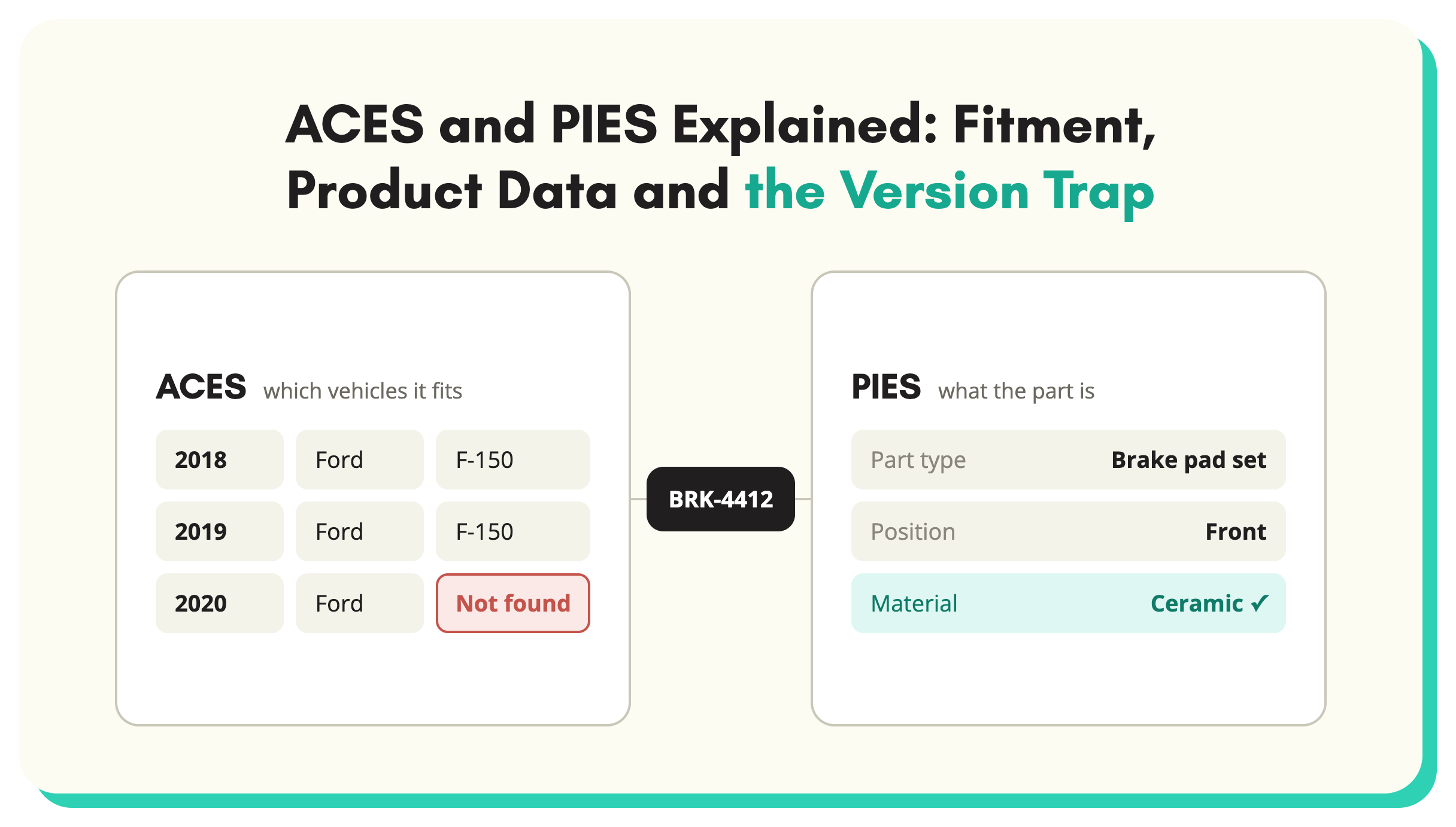
A parts distributor needs to answer a specific question: does this part fit that application? For automotive aftermarket it is make, model, year, and engine variant. For industrial fasteners it is thread standard, pitch, and tensile grade. For fluid handling it is connection type, pressure rating, and medium compatibility.
This data rarely arrives structured in supplier files. It exists in free text, in diagrams, and in compatibility charts that are not machine-readable. Extracting it requires understanding the product category well enough to know what to look for and how to represent it.
Retailers almost never deal with fitment data at this level of complexity. For a technical parts distributor, it is central to whether a customer can find and trust the right product.
4. The standards fragmentation problem
A distributor supplying contractors, industrial buyers, and facilities managers may need to output product data in ETIM format for some customers, UNSPSC codes for others, and a bespoke attribute format for their ERP or marketplace integration. These standards do not map neatly onto each other, and incoming supplier data is aligned to none of them.
Most distributors manage this through separate spreadsheets maintained per standard, or by reclassifying manually whenever a customer requests a specific format. Both approaches create version drift. A product classified in one spreadsheet gets updated; the equivalent record in the other does not.
See our guide to product data management for distributors for more on standards mapping and how to manage classification across multiple schemes simultaneously.
5. The governance-at-scale problem
With 100,000 or more SKUs sourced from hundreds of suppliers, data governance cannot be a periodic manual audit. It needs to be systematic:
- Validation rules that flag incomplete records automatically
- Enrichment workflows that trigger when a new supplier file arrives
- Quality dashboards that give the data team visibility before products reach the live catalogue
Most distributors don’t have this infrastructure. Typically, they have:
- A shared drive
- A spreadsheet tracking priority SKUs
- A backlog that never fully clears
Data quality is managed reactively: something breaks in search, a customer complains, the team investigates. The problem was present weeks earlier.
What works
Treating governance as an ongoing operational capability rather than a project with an end date. Validation rules and enrichment workflows should run continuously, not quarterly.
6. The multi-channel problem
Distributors increasingly sell across multiple channels. Generally:
- Their own ecommerce site
- Trade portals
- B2B marketplaces
- Direct API integrations with large customers
Each channel has its own data format requirements, attribute naming conventions, and content length limits.
Managing a single, enriched source of product data that feeds multiple outputs cleanly is architecturally different from enriching for a single storefront. It requires a structured data layer upstream of all destinations. Without it, enrichment work gets duplicated channel by channel, and inconsistencies compound.
For distributors connecting to platforms like Akeneo, Mirakl, or Plytix, building that upstream layer first is what makes channel-specific formatting manageable rather than a recurring manual task.
7. The compliance data problem
Safety data sheets, hazardous goods classifications, RoHS compliance status, REACH declarations, and country-of-origin records all need to be tracked at SKU level and updated when regulations change. This is not optional. Selling a product without the correct compliance data attached carries regulatory and commercial risk.
The scope of this challenge in technical distribution, particularly in electrical, chemical, or industrial product categories, is significantly larger than in consumer retail. Whereas a consumer goods retailer tracks allergen information and age restrictions, a technical distributor needs to track dozens of compliance attributes per product across multiple regulatory frameworks, each with different update cycles.
Why generic PIM advice fails distributors
Most PIM platforms were built around consumer retail use cases
- The default data models are shallow
- The supplier onboarding tooling assumes a small number of ‘well-behaved’ data feeds
- Classification frameworks are oriented towards consumer categories (or absent altogether)
This creates a recognisable failure pattern:
- A distributor implements a PIM
- It migrates its existing catalogue into it
- ...and six months later the system is live but the enrichment still hasn’t happened
The tools to do enrichment efficiently don’t exist inside the PIM. The team is still working from spreadsheets for anything that matters.
The same problem applies to the broader landscape of product data advice. Articles about writing better product descriptions and improving image quality are aimed at brands selling direct to consumers. They don’t address attribute depth requirements, fitment data extraction, or multi-standard classification, because those problems don’t exist in retail at the same scale or complexity.
A distributor reading standard PIM guidance is reading advice designed for a simpler problem. The distributor-specific workflows, the standards support, and the supplier ingestion requirements are treated as edge cases, if they are addressed at all.
What a distributor-first approach to product data looks like
Four principles separate a distributor-appropriate approach from a retail-adapted one.
1. Schema-first design
Define the attribute schema for each product category before configuring tooling:
How many attributes does a cable gland need?
What are the valid values for each?
Category managers who know the products should drive this work, not IT. A schema built on commercial knowledge of the catalogue will serve discovery far better than one imported from a generic data model.
2. AI-powered supplier ingestion
Ingestion tooling needs to handle any input format without requiring suppliers to change how they send data. AI extraction from PDFs, spreadsheets, and product images handles the reality of how manufacturers work. SKULaunch’s product data extraction capability is built specifically for high-volume, multi-supplier environments where format consistency is not an option.
3. Standards support built in
ETIM, BMEcat, and UNSPSC classification should be part of the enrichment workflow, not a post-processing step. Classification at the point of ingestion means the data is structured for any downstream output format from day one, rather than requiring rework each time a new channel or customer demands a specific format.
4. Governance as a continuous capability
- Data quality metrics,
- Validation rules
- Enrichment workflows
These all need to run continuously, not as periodic projects.
Treating governance as infrastructure rather than an initiative is what keeps the catalogue clean as supplier data changes, products are discontinued, and regulatory requirements are updated.
If you are carrying a growing enrichment backlog, running separate data processes per channel, or finding that your PIM is populated but your search is still broken, the problem is process and tooling architecture, not the size of your data team.
The distributor best practices guide covers how to prioritise the work if you are starting from a backlog. For a structured review of your current data practices, the SKULaunch solutions page for distributors covers what a practical improvement programme looks like.
Key takeaways
- Product data challenges for distributors are structurally different from retail: higher volume, greater technical depth, more supplier variance, stricter compliance requirements, and multi-standard classification demands.
- The seven core challenges are supplier format variance, attribute depth, fitment data, standards fragmentation, governance at scale, multi-channel output, and compliance data.
- Generic PIM tools and retail-focused advice are not built for distributor-specific workflows. Implementing them without modification produces the same result: a live system with an enrichment backlog that never clears.
- A distributor-first approach starts with schema design, uses AI for supplier ingestion, handles classification standards natively, and treats governance as a continuous operational capability.
- If your enrichment backlog is growing faster than your team can clear it, the bottleneck is process and tooling architecture, not headcount.
Contact us to discuss an audit of your product data practices so we can identify where the most significant improvements can be made.
See SKULaunch in action
Watch how we handle AI enrichment, supplier onboarding, and catalogue scale in a live 30-minute demo.


.avif)