

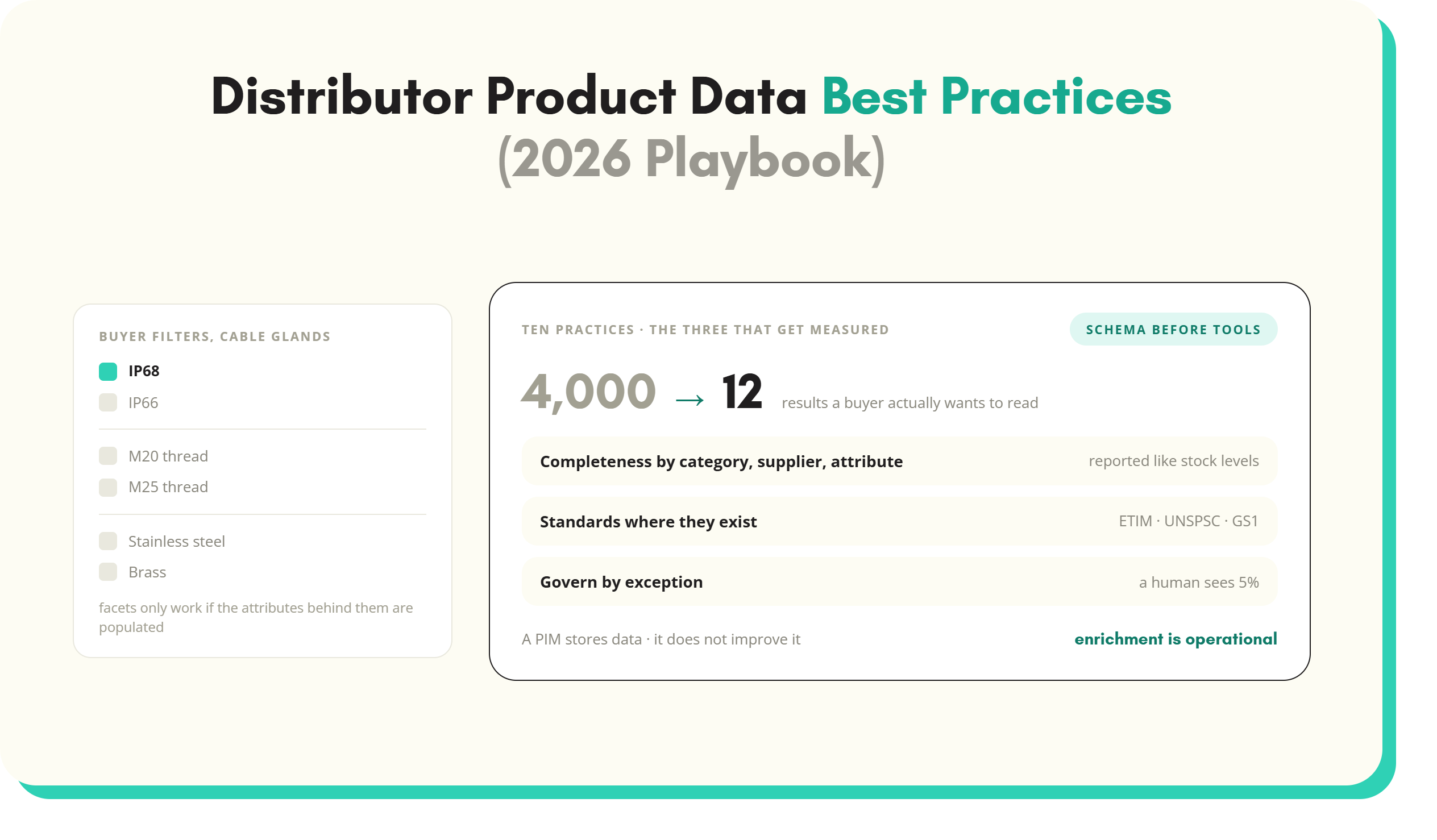
This playbook sets out ten practices that make the difference between a catalogue that supports growth and one that constrains it.
Most distributors with 20,000 or more SKUs share the same problem: Their supplier data arrives in inconsistent formats, the catalogue is incomplete in unpredictable places, and every new supplier onboarding cycle costs more than the last.
Distributor product data best practices are not complex in principle, but they are routinely skipped, usually because the team is too busy firefighting to build anything structural. This playbook sets out ten practices that make the difference between a catalogue that supports growth and one that constrains it.
Why B2B distributor data is different
Product data for distributors is not like retail. A fashion retailer managing 5,000 SKUs across a handful of own-brand suppliers faces a different problem from an industrial or electrical distributor managing 150,000 SKUs sourced from 400 suppliers, each with their own data format, terminology, and classification logic.
Four things make distributor data genuinely harder.
Volume and velocity. Catalogues of 50,000 to 500,000 SKUs are common. New products are added continuously, often in batches. A team that takes 45 minutes per SKU to enrich data manually is not just slow, it is structurally incapable of keeping up.
Technical depth. Electrical components, industrial fixings, fluid connectors, and agricultural parts require dozens of precise, verifiable attributes. A description and a price are not enough. A buyer needs the IP rating, thread pitch, cable cross-section, or equipment compatibility. Generic product content tools are not built for this.
Supplier variance. Supplier data arrives in all shapes and sizes:
- Supplier sends a 200-column spreadsheet
- The next sends a three-page PDF
- The one after that provides a URL and an account login
And so on. In fact, even within a single supplier, formats change between product ranges and catalogue updates.
Managing this manually does not scale.
Compliance and taxonomy. Distributors selling into regulated industries or across geographies face classification requirements, safety data obligations, and taxonomy standards such as ETIM, UNSPSC, and GS1 that retail does not. Getting this wrong creates legal risk, not just a poor customer experience.
For a deeper look at how to structure data operations for distribution specifically, see the guide to product data management for distributors.
10 distributor product data best practices
1. Define the schema before the tools
The most common error in a distributor data project is buying a PIM, then working out what data to put in it. The schema should come first: which attributes matter for each product category, what values are valid, what is mandatory versus optional, and how categories relate to each other.
Without a defined schema, teams load whatever data they have. Six months later the PIM is populated but not usable:
- Missing key attributes in some categories
- Inconsistent units across suppliers
- Filter values that do not align with what buyers search for
Build a draft schema for your top five product categories before evaluating any tool. Use it as the benchmark in every implementation conversation.
What goes wrong when this is skipped: the implementation team builds the PIM around the data structure that existed in the legacy spreadsheets, rather than the data structure the business actually needs.
2. Adopt industry standards where they exist
ETIM, BMEcat, UNSPSC, GS1: these standards exist because enough distributors faced the same interoperability problem and agreed on a solution. If you are in electrical, electronic, or industrial goods, ETIM classifies products with a precision that no custom taxonomy can match economically.
Ignoring them means building from scratch, then rebuilding when a customer or marketplace requires standard compliance. It also makes supplier data exchange harder: suppliers already producing ETIM-classified data cannot send it in a format you use.
What goes wrong when this is ignored: a distributor spends 18 months building a custom taxonomy for 80,000 electrical products, then wins a procurement platform contract that requires ETIM. The rework cost exceeds the original build. For teams evaluating classification tooling, the ETIM data mapping software page covers this in detail.
3. Treat suppliers as data partners, not data sources
Supplier data quality is the ceiling on your catalogue quality. You can enrich around the gaps, but there are limits. Distributors who get the best long-term results treat supplier data as a shared responsibility: defining what good looks like, communicating that standard clearly, and measuring compliance.
This means giving suppliers a data specification, not a blank template. It means tracking completeness rates per supplier and feeding that data back. A supplier sending well-structured, complete data saves your team hours per batch.
What goes wrong when this is ignored: a 400-supplier catalogue where 80% of the data quality effort is spent on 10% of the suppliers, because no one ever told the other 90% what the standard was.
4. Validate at entry, not at import
Catching data errors at the point of supplier submission is ten times cheaper than catching them after the data is in your system. Entry-point validation means checking:
- Format
- Completeness
- Unit consistency
- Classification accuracy
All before the data reaches your catalogue.
This can be automated. If a supplier sends a spreadsheet with 400 rows and 60 missing mandatory attributes, the system should reject the batch and tell the supplier what is missing, not pass the work downstream to your data team.
What goes wrong when this is ignored: a batch of 2,000 new products passes QA, goes live, and the customer service team starts fielding calls because technical specifications are in the wrong units or missing entirely.
5. Invest in enrichment as a continuous capability
Enrichment is not a project. It is an operational function, like procurement or logistics. Distributors who treat it as a one-off end up cleaning the same data repeatedly, because new supplier batches keep arriving in the same state.
A continuous enrichment capability means defined processes for handling new SKUs, standard tools for extracting attributes from messy sources, and ongoing quality monitoring rather than periodic fire drills. The distributors with the cleanest catalogues have embedded enrichment into the normal flow of catalogue management, not as a project team running in parallel.
What goes wrong when this is ignored: an improvement project delivers a visible gain, operations return to normal, and within 18 months new onboarding and catalogue decay have eroded most of it.
6. Measure data completeness and quality as KPIs
You cannot improve what you do not measure. Most distribution teams have a rough sense that their data needs work but do not have a number:
- Completeness rate per category
- Search conversion rate by attribute coverage
- Time to onboard a new supplier
The above are both measurable and consequential.
The baseline is often worse than expected. Completeness rates below 40% for key attributes are common in catalogues that have not been systematically managed. Knowing the number changes the conversation with leadership from:
“Our data could be better"
to
"37% of our SKUs are missing the primary filter attribute buyers use to narrow results."
Track completeness by category, by supplier, and by attribute type. Report it in the same business review as stock levels and fulfilment metrics.
7. Build faceted search from day one
Faceted search, the filter panels that let buyers narrow by attribute, is the primary navigation tool for technical product discovery. A buyer looking for a cable gland in IP68, M25 thread, stainless steel, does not want to scroll through 4,000 results. They want to filter to the 12 that match.
Faceted search only works if the underlying attribute data is consistent and well-populated. If you plan to support it, and you should, design your schema to support it from the start. The alternative is retrofitting filters onto inconsistent data, an exercise that usually reveals completeness gaps you did not know existed.
What goes wrong when this is ignored: a site launches with search and category browse but no filters, because the data is not clean enough to support them. The buyer experience is poor, search conversion is low, and fixing it requires a data project that takes months.
8. Govern by exception, not by hand-cranking
Data governance does not have to mean a team of analysts manually reviewing every record. For most distributors, the right model is:
- Define the rules
- Automate the checks
- Route exceptions to a human
The human reviews 5% of records, not 100%.
This requires good tooling and clear ownership, but it also requires that the governance rules are written down. Many distribution teams rely entirely on tacit knowledge. That knowledge walks out when the person holding it does. Build a governance model that does not depend on specific individuals: document the rules, automate the checks, let humans handle the genuine exceptions.
9. Separate data quality from system choice
A bad data project often follows this sequence: the team selects a PIM, spends nine months implementing it, loads existing data, then discovers the data is in no state to support the catalogue they intended to build. The PIM becomes a container for the same quality of data that was in the spreadsheets before.
The PIM doesn’t improve the data. It stores and distributes it. Enrichment happens upstream. Getting this sequence right matters: clean and structure the data to a defined schema, then import it into the system that will manage it.
This is the single most common structural error in distributor product data management, and the most avoidable. See product data management for distributors for a detailed breakdown of how these functions relate.
10. Plan for multi-channel from the start
Distributors increasingly sell through their own site, marketplace listings, customer-specific portals, and EDI feeds, often simultaneously. Each channel has different data requirements: different attribute sets, different description formats, different classification standards.
If the catalogue is built for one channel, expanding to a second is a significant rework project. Building multi-channel into the schema from the start costs very little. Bolting it on after the fact is expensive.
- Know which channels you plan to use in the next three years
- Build the data model to support the broadest requirement
- Produce channel-specific outputs from a single source of truth
The three biggest mistakes distributors make
Most distribution data problems reduce to three patterns. Understanding them is the fastest way to avoid repeating the same expensive cycles.
1. Hoping the PIM will fix everything
A PIM manages product data; it does not improve it. Teams that buy a PIM expecting it to resolve a data quality problem are disappointed within 12 months. The PIM is the right tool for the right job, but it is downstream of the enrichment and governance processes that determine quality. See solutions for distributors to learn more about how structured enrichment fits into this.
2. Under-investing in governance
Governance sounds like an overhead, and it is, but so is fixing preventable errors at scale. Distributors who do not:
- Define data standards
- Assign ownership
- Set up regular quality checks
End up spending more on remediation than they would have spent on governance. The investment in governance compounds positively; the absence of it compounds negatively.
3. Treating enrichment as a one-off
A distributor recognises the problem, funds a clean-up project, achieves a visible improvement, then returns to normal operations. Within 18 months, new supplier onboarding, catalogue expansion, and normal data decay have eroded most of the gains. Enrichment is operational, not project-based.
What good looks like
Three distributors using SKULaunch offer concrete benchmarks for what a well-run catalogue operation delivers.
APS Industrial: This Australian industrial distributor reduced per-SKU processing time from 45 minutes to under five minutes by automating attribute extraction from supplier PDFs. Catalogue accuracy improved and supplier onboarding time dropped substantially.
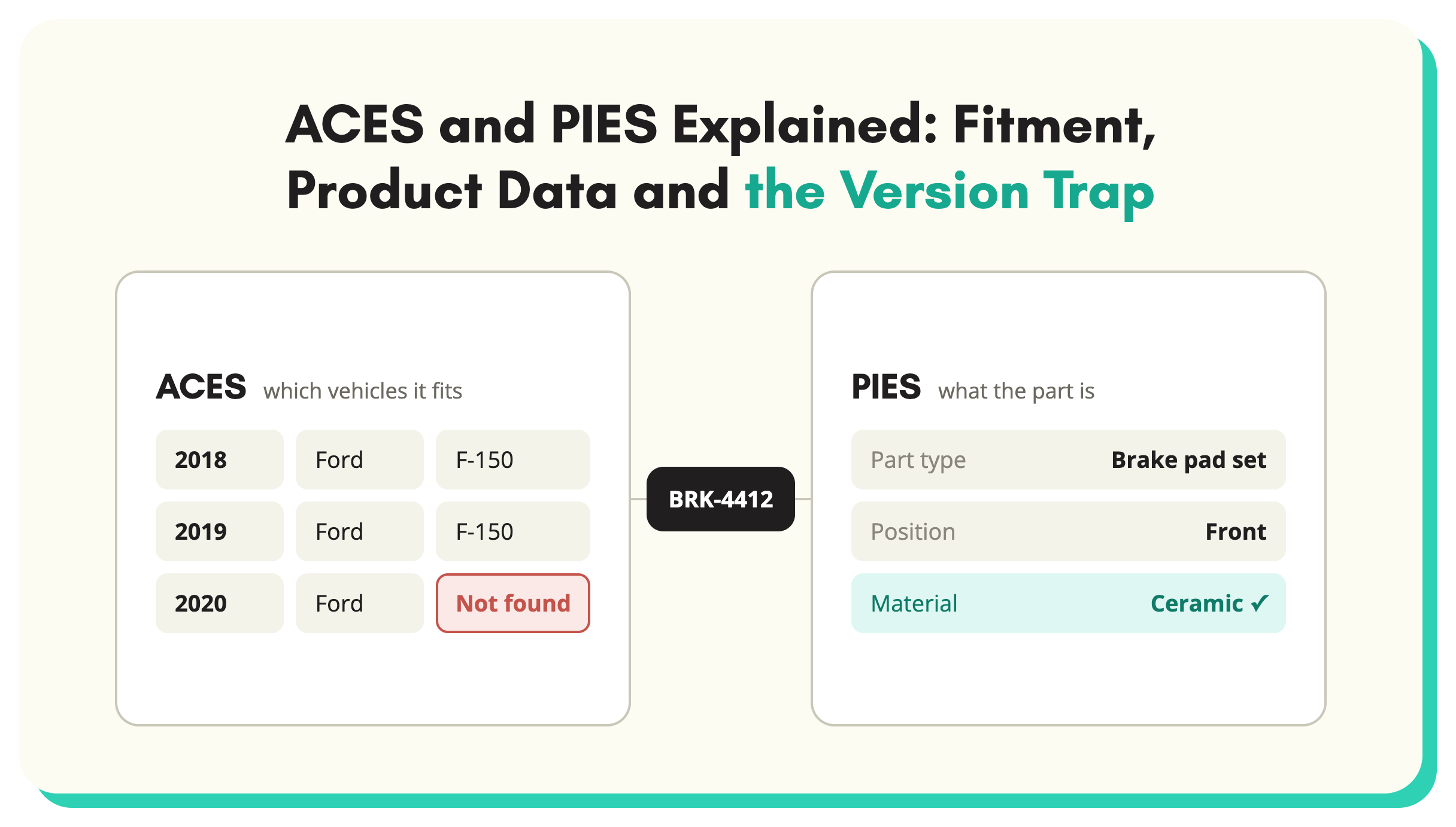
Maxiparts: This parts and aftermarket distributor used structured enrichment to improve search findability across a large catalogue where fitment data and compatibility attributes are critical to purchase confidence. Buyers found the right part faster; return rates fell.
These results aren’t exceptional. They are what a structured, repeatable approach to product data management for distributors delivers. For full details on any of these, Learn more from these case studies.
Key takeaways
- Distributor data is harder than retail data: more volume, more technical depth, more supplier variance, more compliance complexity.
- Define the schema before evaluating tools. The data model comes first; the system is second.
- Adopt industry standards such as ETIM, UNSPSC, and GS1 where they apply. Building a custom taxonomy in a standards-covered vertical is expensive twice.
- Enrichment is an operational function, not a project. Teams that treat it as a one-off run the same clean-up cycle repeatedly.
- Completeness rate, time to onboard, and search conversion are the three metrics that tell you whether your distributor product data best practices are working.
Next Steps
If you want to see how SKULaunch handles distributor product data in practice, including supplier PDF extraction, attribute classification, and direct output to your PIM or ecommerce platform, book a demo and we'll walk you through a live example using your own catalogue data.
See SKULaunch in action
Watch how we handle AI enrichment, supplier onboarding, and catalogue scale in a live 30-minute demo.


.avif)