

A catalogue that was accurate at launch can drift out of date within months if nothing is actively keeping it current.
Product data updates do not stop once a listing goes live. Suppliers revise specifications, replace discontinued lines, reissue datasheets and change packaging on their own schedule. Every one of those changes needs to reach every channel a product is sold on, not just the file it arrived in. A catalogue that was accurate at launch can drift out of date within months if nothing is actively keeping it current.
Why product data updates lapse after launch
Most of the attention in product data work goes to getting a catalogue right at onboarding. Fewer processes exist for keeping it right afterwards. Suppliers change specifications, discontinue lines, swap materials and update compliance documentation on their own timetable. None of it reaches a merchant’s catalogue automatically unless something is built to catch it.
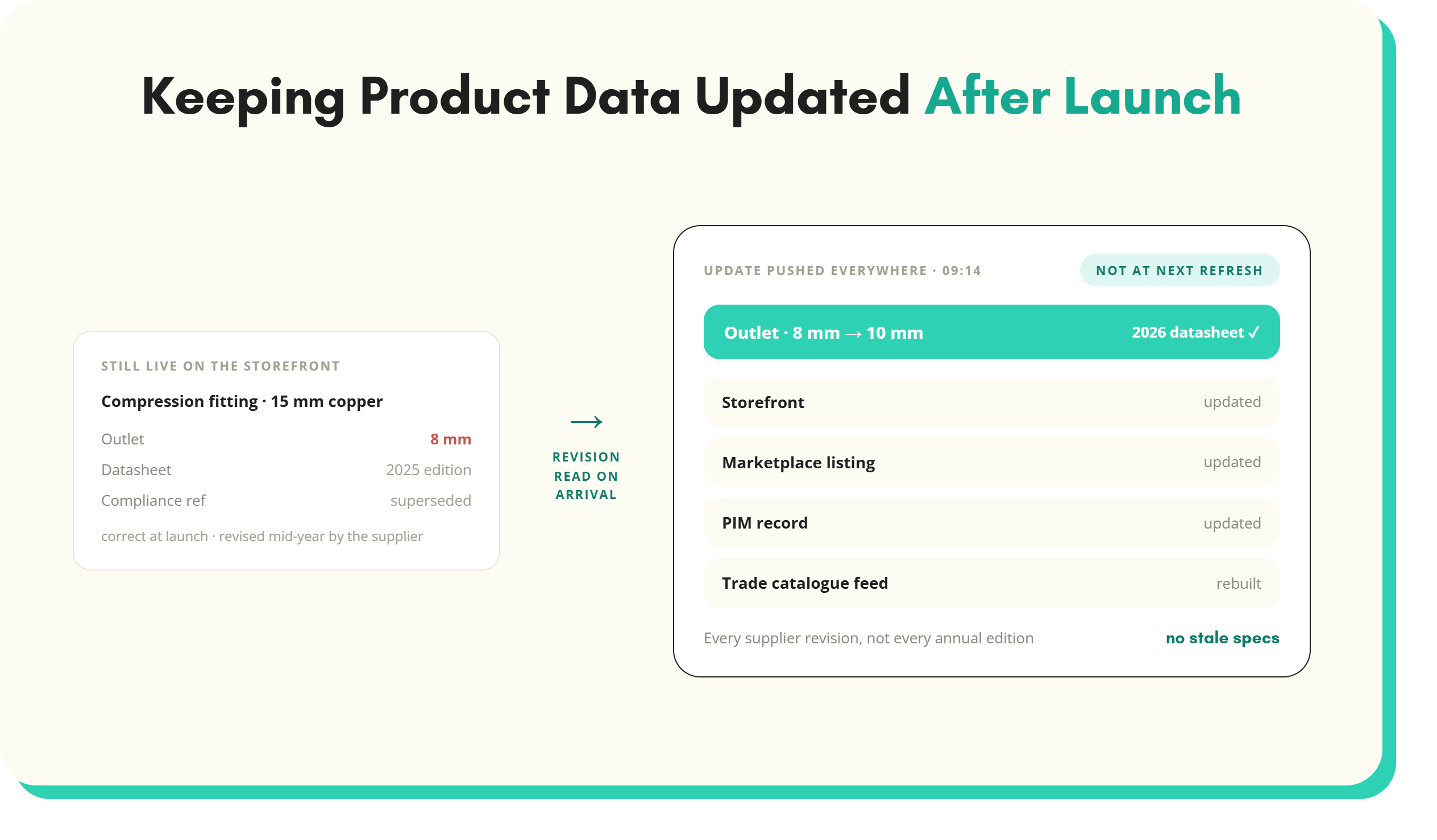
A specification revision illustrates the risk clearly. A supplier changes a fitting from 8mm to 10mm in a mid-year product revision and updates its own datasheet. The listing still says 8mm. A buyer orders against the old specification, receives a part that does not fit, and sends it back. The product was right and the data was stale, and the retailer pays for the return anyway.
Discontinuations behave the same way. A supplier replaces a line with a successor SKU that has different dimensions or a different material. If the old product page is simply repointed at the new item, every attribute on it is now describing a product that no longer exists. One wrong specification is also enough to make a buyer doubt the rest of the page.
Manual checking cannot keep pace with this at any real scale. A team re-reading datasheets by hand across dozens of suppliers and several sales channels is always working from stale information. It reflects what was accurate at the last check, not the current revision. The gap between those two points is where the returns and the queries accumulate, and it grows with every supplier or channel added.
Automating product data updates
An AI-powered product data onboarding platform removes most of the manual burden by keeping supplier data current after onboarding, not just clean at the start of it. Revised datasheets, updated spec sheets and new catalogue editions are processed the same way the originals were. A change arrives as structured data, not as a PDF someone has to read. New SKUs preload into the catalogue with minimal manual setup.
AI-powered enrichment keeps descriptions, specifications and attributes complete as new data arrives, rather than only at the point of initial onboarding. Standardisation converts formats, units and naming conventions automatically on every update. A supplier that switches from millimetres to centimetres in this year’s catalogue edition does not require manual translation before the data can be trusted.
Continuous product data updates versus the annual refresh
Many distributors only refresh product content when the supplier issues a new catalogue edition, often once a year. Everything that changes between editions drifts: revised technical drawings, updated safety documentation, new pack sizes, replacement images, reclassified products. The listing does not show the current product. It shows the product as it existed at the last refresh.
Requirements also move between refreshes. Marketplaces revise their mandatory attributes and category structures during the year, and classification standards such as ETIM release new versions. A listing that was compliant in January can be incomplete by June without anything changing on the merchant’s side. A calendar-driven refresh cannot catch a requirement that changed between calendars. That is the case for processing updates as they arrive, not on a schedule.
The same applies downstream. AI product data extraction turns a revised supplier document into updated attributes, and those attributes then need to flow to every ecommerce platform and PIM the product is listed on. An update that reaches the PIM but not the marketplace has only moved the inconsistency, not fixed it. For a broader look at where integration itself tends to go wrong, the product data integration guide covers related ground from the onboarding side rather than the ongoing maintenance side covered here.
Where inconsistent supplier data resurfaces after launch
Product data spread across multiple platforms, such as a marketplace, a storefront, a PIM and the supplier’s own database, tends to drift apart even after a clean initial onboarding. Suppliers use inconsistent naming conventions from one update to the next, sometimes without meaning to, simply because the person sending the update this month is not the same person who sent it last time. Different platforms each expect their own attribute structure for the same underlying field. Updates handled manually and ad hoc across several systems inevitably reach some systems before others, which is enough on its own to create a real conflict between what two platforms say about the same product.
Without a structured process to keep this in sync, the result is data conflicts between sales channels, incorrect images or specifications on some platforms but not others, and delays in listing updates that cost conversions on whichever platform is running behind. None of these are dramatic failures individually. They are small, cumulative drifts that only become visible once a customer notices the mismatch, usually by comparing the same product across two channels and finding the details do not agree.
Take a distributor with 50,000 technical SKUs across forty suppliers. If each supplier revises even a tenth of its range in a year, that is thousands of changed records arriving in mixed formats, none of them announced. The ones that get missed do not fail loudly. They sit on the product page as quietly wrong dimensions and superseded compliance references until a customer, or a marketplace audit, finds them first.
Keeping product data updates accurate long-term
Maintaining product data quality is an ongoing discipline, not a one-time project completed at launch and then left alone. Automated updates, continuous enrichment and managed support for the suppliers who need it work together to keep a catalogue accurate long after the initial onboarding is finished. A business that treats data quality as solved at launch will watch it degrade steadily afterwards, one unread spec revision and one stale attribute at a time, until the gap becomes visible to customers rather than just to the team managing the catalogue.
The businesses that avoid this are not the ones with the cleanest launch. They are the ones that kept treating data accuracy as an ongoing job well after the launch date had come and gone, with the same attention applied months later that went into the original onboarding.
To see how SKULaunch keeps product data current after launch, request a demo.
See it in practice: request product data updates from suppliers, use the most trusted source when product data sources disagree and set validation rules on product attributes.
See SKULaunch in action
Watch how we handle AI enrichment, supplier onboarding, and catalogue scale in a live 30-minute demo.


.avif)