
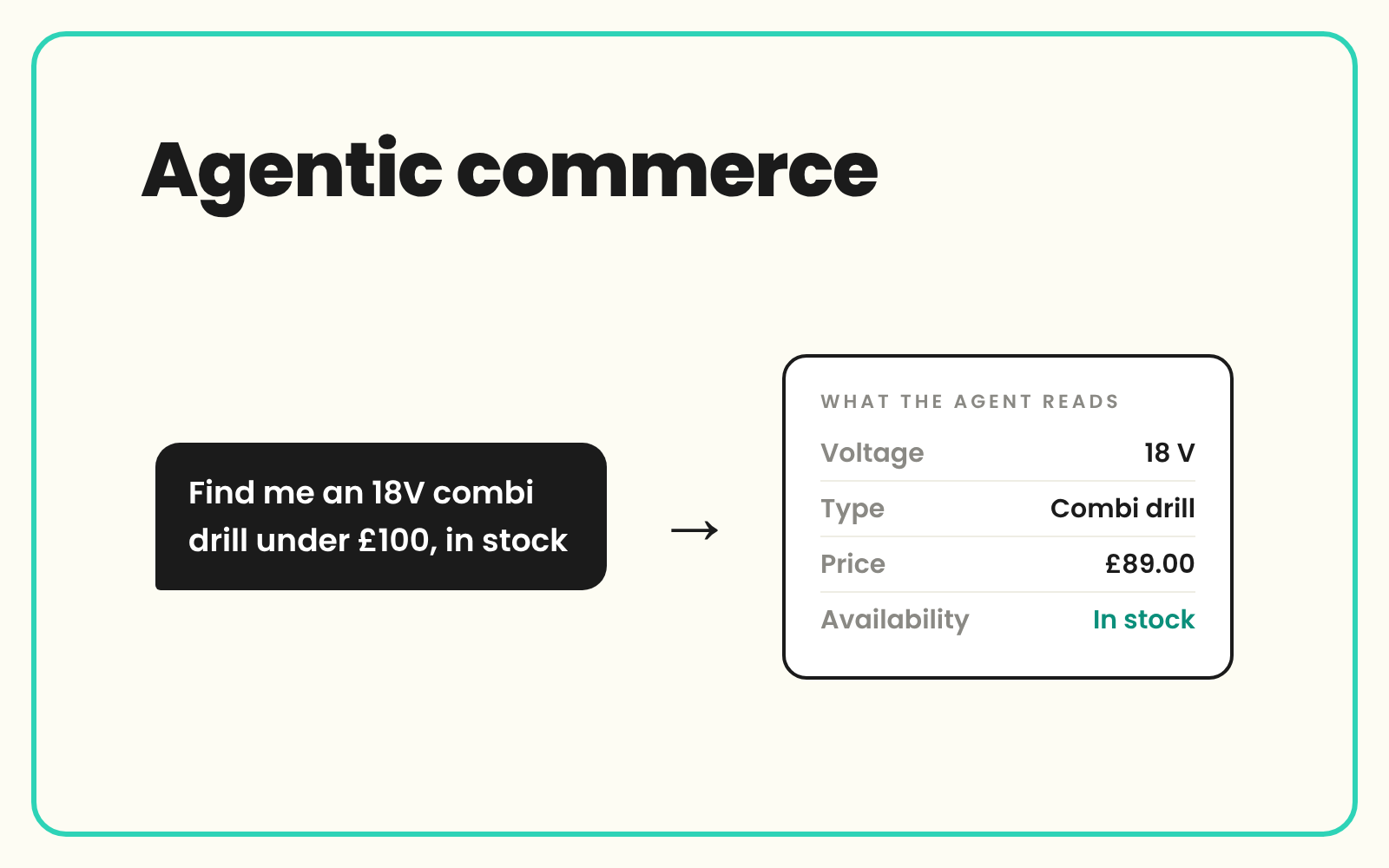
Agentic commerce is shopping where an AI agent searches, compares and in some cases buys on a shopper's behalf. Those agents choose products from data, not from your best photography, so complete structured attributes, clear identifiers and accurate price and availability decide whether your products are considered at all. SKULaunch prepares that product data across the catalogue and exports it in the feeds you send to your channels.
The problem
Most product data was built for a person browsing a page. The hero copy is good, the photography is good, and the specs are in a PDF or missing. Variants sit in one text field. Weight is blank because nobody filtered on it.
An agent working on a request such as "a waterproof jacket under 400 g that packs into its own pocket, in stock in medium" needs values it can check. If the weight is missing, it cannot confirm the jacket qualifies, so it moves on to one that does. If the feed says in stock and the shop says sold out, the purchase fails. Neither failure is visible to you. You just do not get picked.
Before and after
An illustrative example from an outdoor clothing retailer.
Before: the product as it stands
Title: "The Summit Shell, our lightest ever." Description: "Built for wild weather, this featherweight jacket keeps you dry when it matters." Weight: blank. Waterproof rating: blank. GTIN on the parent only. Sizes listed in one text field.
After: prepared in SKULaunch
- Title: Summit Shell men's waterproof jacket, packable, hooded
- Weight: 310 g in size M
- Waterproof rating: 20,000 mm hydrostatic head
- Packable: yes, into its own chest pocket
- Variants: sizes S to XXL, each with its own GTIN
- Description rewritten from the approved attributes, so copy and data agree
How it works in SKULaunch
- Audit what agents will read. Measure completeness by category against the attributes shoppers actually ask about.
- Fill and normalise the gaps. Extract specs from supplier files, datasheets, images and the web, then normalise values and units.
- Generate factual titles and descriptions. Content is written from approved attributes, so the copy never claims what the data does not support.
- Export the feeds. Send structured data to your storefront, marketplaces and feed channels in the format each one specifies.
What agentic commerce needs from product data
- Identifiers. GTIN, MPN and brand, so an agent can match your product to the same item elsewhere.
- Structured attributes with units. Weight, dimensions, materials, capacity and compatibility as values, not phrases.
- Clear titles. What it is, who it is for and the key spec. Not a slogan.
- Properly modelled variants. Each size or colour with its own identifier, attributes and availability.
- Current price and availability. These usually come from your commerce platform or ERP, and they need to reach feeds often.
- Plain policies. Shipping, returns and warranty terms stated in words an agent can quote.
- Images that show the product, with descriptive alt text.
Why marketing copy alone fails
Copy persuades a person who has already landed on the page. An agent is filtering a long list against constraints. "Featherweight" cannot be compared with 310 g. When the number is missing, the agent either skips the product or picks a competitor whose data answers the question. Copy still matters for the person who checks the shortlist, but it should be generated from the attributes, not written instead of them.
Protocols and product feed specifications
OpenAI has published a product feed specification and, with Stripe, an Agentic Commerce Protocol for buying inside ChatGPT. Other AI platforms and payment providers are publishing their own approaches. The detail differs and is still changing, but the core asks are consistent: identifiers, structured attributes, variants, images, price, availability and policies, refreshed often. If your product data covers those well, meeting a new specification is an export job, not another data project.
Common mistakes
- Starting with the feed format. A perfect file full of blank attributes still loses. Fix the data, then map it.
- Different facts in different places. If the website, a marketplace and the feed disagree on weight or size, an agent has no reason to trust any of them.
- Specs only in PDFs or images. Values locked in a datasheet are invisible unless they are also held as attributes.
- Stale availability. A feed refreshed weekly will offer products you cannot ship.
What changes
Your products answer the questions agents ask, copy and attributes agree, and every feed carries the same complete record. Completeness is the lever: Bowens moved PIM completeness from 30% to 94%.
Common questions
What is agentic commerce?
Shopping where an AI agent acts for the shopper: searching, comparing and sometimes completing the purchase, based on the product data merchants provide.
What product data do AI shopping agents need?
Identifiers, structured attributes with units, clear titles, properly modelled variants, current price and availability, plain policies and good images.
What is a ChatGPT product feed?
A structured product file supplied in the format OpenAI has published, so products can be found and, where enabled, bought inside ChatGPT. The quality of the data in it matters more than the file format.
Does SKULaunch integrate directly with ChatGPT or agentic checkout?
SKULaunch prepares product data and exports feeds. It does not claim a native agentic checkout integration. Confirm with us whether a specific feed format is supported for your set-up.
How is agentic commerce different from answer engine optimisation?
Answer engine optimisation is about being cited in AI answers. Agentic commerce is about an agent acting on them. Both rest on the same complete, structured product data.
Where should we start?
With the categories that sell most online and the attributes shoppers filter on. Fill those gaps first, then extend across the range.
More on answer engine optimisation for products, making products easier for AI assistants to understand, what answer engines need from your catalogue, filling missing product attributes and modelling product variants.

.avif)