

AEO and GEO need structured attributes, not better copy.
AEO (answer engine optimisation) and GEO (generative engine optimisation) are the new acronyms for the same job: making sure product content is structured well enough that an LLM can answer a buyer question with your data, not someone else’s. The difference between ranking on Google and being cited by ChatGPT, Perplexity, or Gemini comes down to whether your attributes are structured, clean, and machine-readable. Most catalogues are not, which is why product content for AEO and GEO is now a real piece of work, not a tweak to existing SEO.
What AEO and GEO actually mean
AEO stands for answer engine optimisation. The "answer engines" are the systems that respond to a user query with a synthesised answer, not a list of links. ChatGPT, Perplexity, Google’s AI Overviews, and Gemini all qualify. The optimisation work is what gets your product content used as a source in those answers.
GEO stands for generative engine optimisation and overlaps with AEO almost entirely. Some practitioners distinguish them: AEO covers retrieval and citation, GEO covers being included in the generated text itself. In practice, the work that makes a catalogue legible to one makes it legible to the other, so the distinction matters less than the underlying preparation.
Both terms are early. The lexicon is still being settled, which is part of why content optimised for AEO and GEO ranks faster than content optimised for traditional SEO; the competition is thinner.
Why answer engines are different from search engines
Search engines return links. The buyer reads the snippets, picks one, and lands on the page. The page does the convincing.
Answer engines return answers. The buyer reads the synthesised response, sometimes follows a citation, often does not. The page has to be useful as a source before it can be useful as a destination. If the LLM cannot extract the technical detail it needs from your product content, your catalogue gets cited by someone else’s site that has the data in a more usable form.
The shift in optimisation target is from ranking to being legible. A catalogue can rank on Google for a query and be invisible to an answer engine asking the same question, because the LLM cannot reliably extract structured information from the page.
What answer engines need from product content
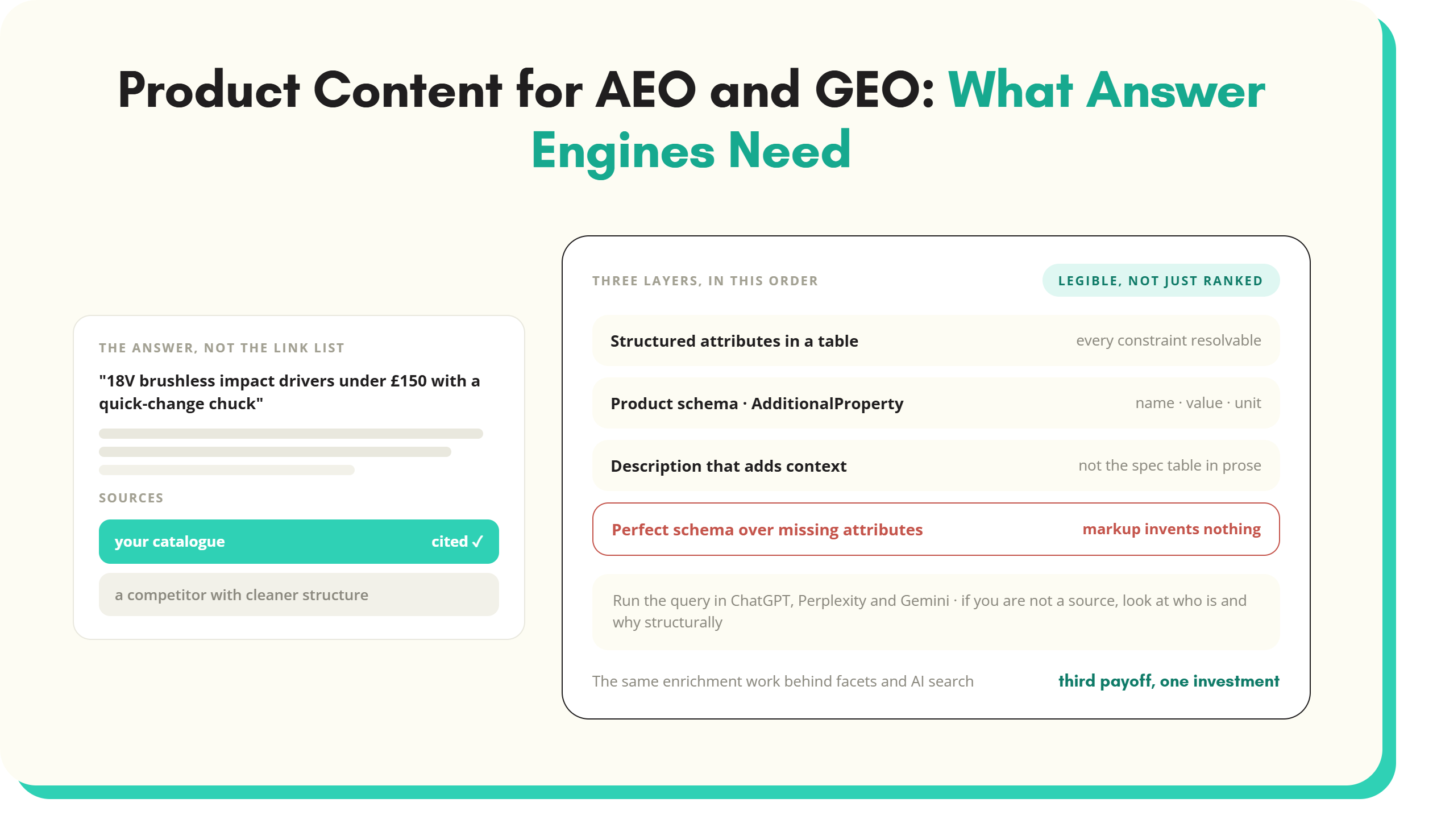
Three things, in roughly this order. First, the structured attributes that match the query. Second, the schema markup that confirms what the page is about. Third, the descriptive content that gives the LLM context for nuance.
A query like "show me 18V brushless impact drivers under one hundred and fifty pounds with a quick-change chuck" has four constraints. An answer engine looking for a citation needs each constraint resolvable from the page. If the voltage is in a structured attribute table, the LLM finds it. If the voltage is buried in a description paragraph, the LLM might find it, or might not, depending on the model and the cleanness of the prose.
Schema markup (specifically Schema.org Product, with structured AdditionalProperty entries for technical attributes) makes the LLM’s job deterministic. The data is in a format the model has been trained to recognise. Skipping the schema does not make the page invisible, but it makes citation less reliable.
The structured attribute output answer engines reward
Answer engines reward catalogues where every product has a structured attribute table that mirrors the query patterns buyers use. Voltage as a discrete field with a unit. Weight as a number with a unit. Materials as a controlled vocabulary. Compatibility as structured product relationships, not free text.
The shift from descriptive prose to structured attributes is the single biggest change for AEO and GEO. The same change drives faceted search, comparison views, and AI-ready product search; the answer-engine benefit is the third payoff on the same investment, not a separate workstream. The SKULaunch piece on AI-ready product search covers the practical attribute audit.
Schema, structured data, and why they’re necessary but not sufficient
Schema.org Product markup, JSON-LD, breadcrumb structured data, FAQ structured data, all of it helps. Most modern ecommerce platforms emit at least basic Product schema by default. Distributors and B2B catalogues often have weaker schema coverage because their platforms are older.
Three schema patterns matter most for AEO and GEO. Product schema with name, brand, and offers (price, availability, currency). AdditionalProperty entries for every technical attribute, with name, value, and unit code. ImageObject entries for images with descriptive alt text. Sites that get all three right are materially easier for answer engines to cite than sites that emit only the basic Product schema.
Schema is necessary but not sufficient because the LLM still has to find the data underneath the markup. A page with perfect schema and missing attributes is still missing attributes; the schema does not invent data. The AEO work is the same enrichment work that drives the rest of the catalogue, exposed in the right format.
How to audit a catalogue for AEO and GEO readiness
A practical audit runs five checks per category. Pick a high-traffic category, sample twenty SKUs, and run them.
- Structured attribute table on every PDP: not buried in description prose, not only in the bullet list, but in a structured table or its equivalent.
- Schema.org Product markup with AdditionalProperty entries: for technical attributes, with name, value, and unit. Use Google’s Rich Results Test.
- Attribute completeness against the buyer’s likely query patterns: cover the attributes buyers query on, not just the ones the supplier sent.
- Description content that contextualises rather than duplicates: descriptions add use-case context the structured attributes cannot, instead of repeating the spec table in prose.
- Citation-test: run a sample query in ChatGPT, Perplexity, and Gemini and check whether your domain appears as a source. If it does not, look at which sites do and reverse-engineer what they are doing structurally.
The fifth check is the one most catalogues skip and the one that surfaces the actual gap. The competitor cited as a source is rarely the one with the best SEO; it is the one with the cleanest structured data.
Five practical changes you can make this quarter
AEO and GEO work compounds. The five changes below are ordered by impact.
- Move technical attributes from description prose into structured tables. Same data, different surface, materially different machine-readability.
- Add Schema.org AdditionalProperty markup for every structured attribute. Most ecommerce platforms support this through theme customisation or PIM-driven templating.
- Run a completeness audit by category and fill the gaps. Missing attributes is the single largest cause of being skipped as a source.
- Add use-case context to descriptions rather than duplicating spec data. The description should answer "what is this for, and what is it good at" in a form the attribute table cannot. SKULaunch handles this through structured-attribute-driven content generation.
- Track citation appearance in ChatGPT, Perplexity, and Gemini for your top categories. Treat it as a measurable channel, not a curiosity.
Key takeaways
- AEO and GEO are early acronyms for an established job: making product content legible to LLMs.
- Answer engines reward structured attributes, schema markup, and useful descriptive context.
- Most catalogues fail on the structured-attribute layer; schema without underlying data does not help.
- The work is the same enrichment work that drives faceted search and AI-ready product search.
- Citation tracking in ChatGPT, Perplexity, and Gemini is now a measurable channel for product catalogues.
Where to go next
For the broader enrichment context, see the SKULaunch overview of product data enrichment. For the search-side work that overlaps with AEO and GEO, the AI-ready product search piece covers the practical audit. For the foundational explainer on what enrichment means and why it matters, the "what is product data enrichment" guide is the entry point.
See SKULaunch in action
Watch how we handle AI enrichment, supplier onboarding, and catalogue scale in a live 30-minute demo.

.avif)