
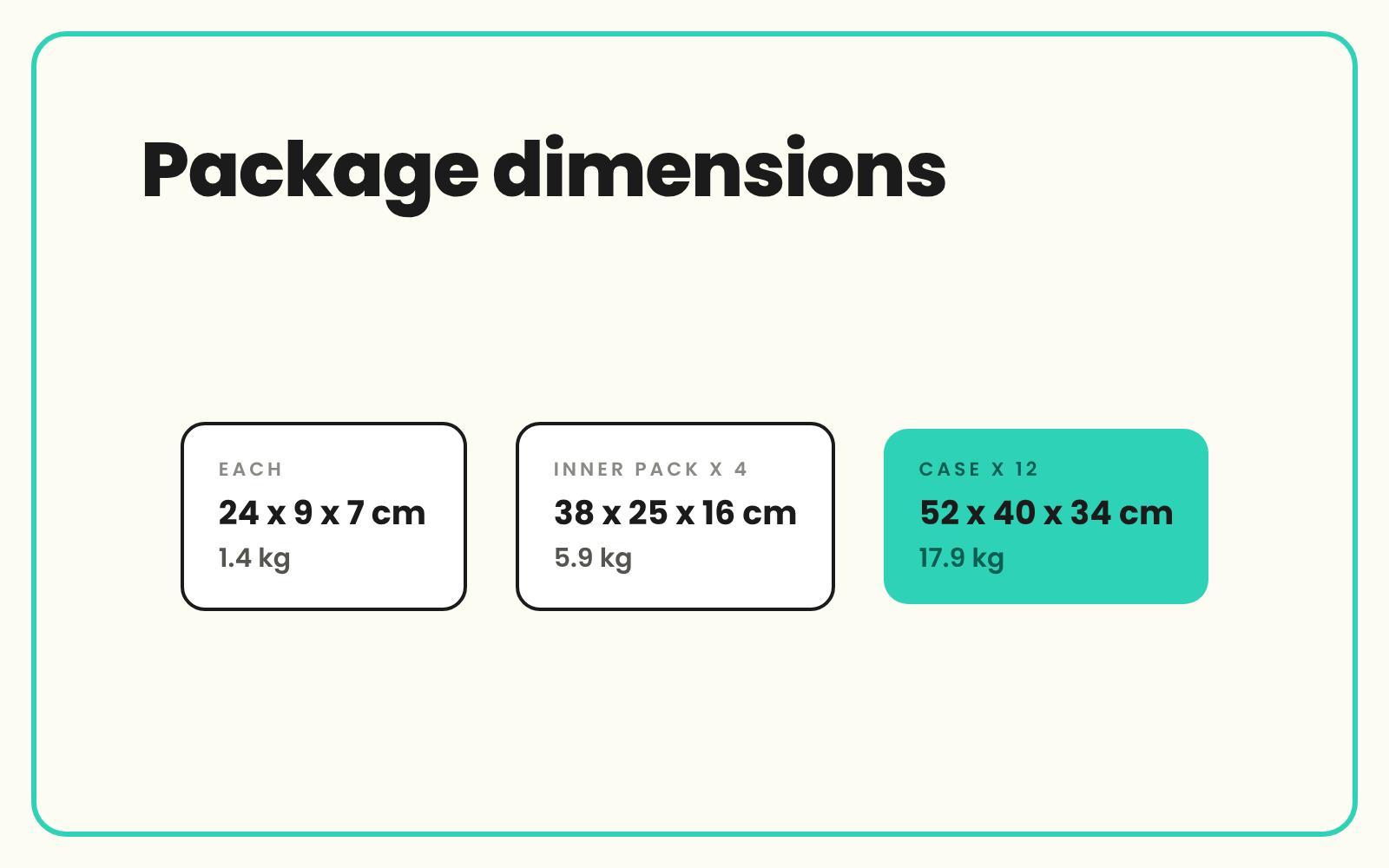
Package dimensions and case pack data tell carriers, warehouses, marketplaces and trade customers how big and heavy a product is once packed, and how many units come in each inner and outer case. Suppliers send them inconsistently, with mixed units and product measurements in packaged fields. SKULaunch collects them per packaging level through the supplier portal, normalises the units and checks them before they reach any channel.
The problem
Logistics data is the part of the new line form nobody owns. The buyer wants the range live, the supplier fills in what they have, and the warehouse finds out when the first delivery arrives. Dimensions come in centimetres in a millimetre field. Weight is in grams with "kg" in the header. The size of the kettle goes in where the size of the box was asked for. The case quantity is there but the inner pack is missing, so the warehouse breaks the wrong carton.
Each error costs money somewhere else. Parcel quotes are wrong, carriers add surcharges, slotting puts bulky items in small bins, marketplace fulfilment fees come in higher than expected, and trade customers order in quantities that do not match a case.
Before and after
An illustrative example from a housewares distributor's supplier file.
Before: what the supplier sent
Dimensions: 12 x 8 x 25 (product or box?). Weight: 620. Case: 49 x 49 x 26.5cm, 15.6kg, qty 24. Inner: 6.
After: captured in SKULaunch
- Each, packaged: 120 x 80 x 250 mm, 0.62 kg gross, confirmed with the supplier as box dimensions
- Inner pack: 6 units
- Outer case: 4 inners, 24 units, 490 x 490 x 265 mm, 15.6 kg gross
- Weight adds up: 24 x 0.62 kg is 14.88 kg, below the 15.6 kg case weight
- Volume adds up: 24 units of 2.4 litres is 57.6 litres, inside a 63.6 litre case
How it works in SKULaunch
- Set fields per packaging level. Supplier templates ask for each, inner and outer case values separately, with the unit stated on every field.
- Normalise units. Values given in centimetres, inches, grams or pounds are converted to your standard units on import.
- Validate the values. Validation rules check required fields and plausible ranges per category, so a 2,500 mm kettle box is caught at entry.
- Track completeness by channel. See which products are missing what each carrier, marketplace or trade customer needs.
The packaging levels in package dimensions data
- Each, or consumer unit. The item as sold, in its retail packaging. Needs packaged length, width, height, gross weight and its GTIN. Unboxed product dimensions belong in separate attributes.
- Inner pack. A sleeve or shrink-wrapped multiple inside the case. Needs the number of eaches, plus dimensions and weight if it is picked or sold as a unit.
- Outer case. The shipping carton. Needs units per case, inners per case if used, dimensions, gross weight and often its own GTIN-14.
- Pallet. Needs cases per layer, layers per pallet, total height and total weight. Mainly asked for by trade customers and retail distribution centres.
Checks that catch most errors
- Case weight is at least unit weight times units per case.
- Case volume is at least unit volume times units per case.
- Inner quantity times inners per case equals units per case.
- Packaged dimensions are at least as large as product dimensions.
- Values sit in a plausible range for the category. A kettle box 2,500 mm tall means millimetres went into a centimetre field.
- Packed levels carry gross weight, not net.
Required fields and ranges are standard validation rules. Some of the checks above compare values across levels; how far those are automated depends on your rule set-up, so talk to us about the ones you need.
Why volumetric weight makes this expensive
Parcel carriers usually charge on whichever is greater, the actual weight or the volumetric weight: length times width times height divided by a factor the carrier sets. A box recorded at half its real size is quoted at the wrong rate, and the difference turns up later as a surcharge on the carrier invoice. Marketplace fulfilment fees work in a similar way, banded by packaged size and weight. Accurate package dimensions are cost control, not admin.
What changes
Every product arrives with dimensions, weights and pack quantities per level, in one set of units, and the numbers have been checked before the warehouse or a carrier relies on them.
Common questions
What is the difference between product dimensions and package dimensions?
Product dimensions measure the item itself. Package dimensions measure it in its retail packaging, which is what carriers, warehouses and marketplaces need.
What is a case pack?
The number of units in a shipping case, along with that case's dimensions and weight. It sets order multiples for trade customers and how the warehouse receives and picks stock.
What is the difference between an inner pack and an outer case?
An inner pack is a smaller multiple inside the case, such as a sleeve of six. The outer case is the shipping carton that holds the inners.
Which units should we store package dimensions in?
Pick one length unit and one weight unit, such as millimetres and kilograms, and convert everything on the way in. Convert again on export if a channel asks for centimetres or inches.
How do we get suppliers to send case pack data?
Ask for it per level, with the unit in every field label, and make it required for lines sold to trade customers. A portal that will not accept a blank case quantity gets better data than a spreadsheet that will.
Do trade customers need different logistics data from marketplaces?
Usually. Trade customers and buying groups want case quantities and outer dimensions. Marketplaces mostly want the packaged each.
More on normalising units of measure, validation rules on attributes, supplier templates built per category, product data for trade customers and buying groups and the supplier portal.

.avif)