

For retailers and distributors, product data onboarding is one of the most persistent operational bottlenecks in the business.
For retailers and distributors, product data onboarding is one of the most persistent operational bottlenecks in the business. Supplier product data often arrives incomplete, inconsistent, or formatted for a different system. Someone then has to clean it before a single SKU can go live. That work rarely stays a quick task. It tends to swallow days or weeks of a small team's time before anything reaches the catalogue. SKULaunch, built by Start with Data, is designed to shorten that gap by validating, structuring and enriching supplier data as it arrives.
Why product data onboarding stalls for retailers and distributors
Supplier data rarely arrives ready to use. A new product range typically lands as some combination of unstructured spreadsheets, PDFs, and zipped folders of images. File names are often generic, like "image1.jpg." Attributes are missing or incomplete, and naming conventions vary from one supplier to the next. Compliance or technical fields rarely map cleanly to the merchant's own schema either.
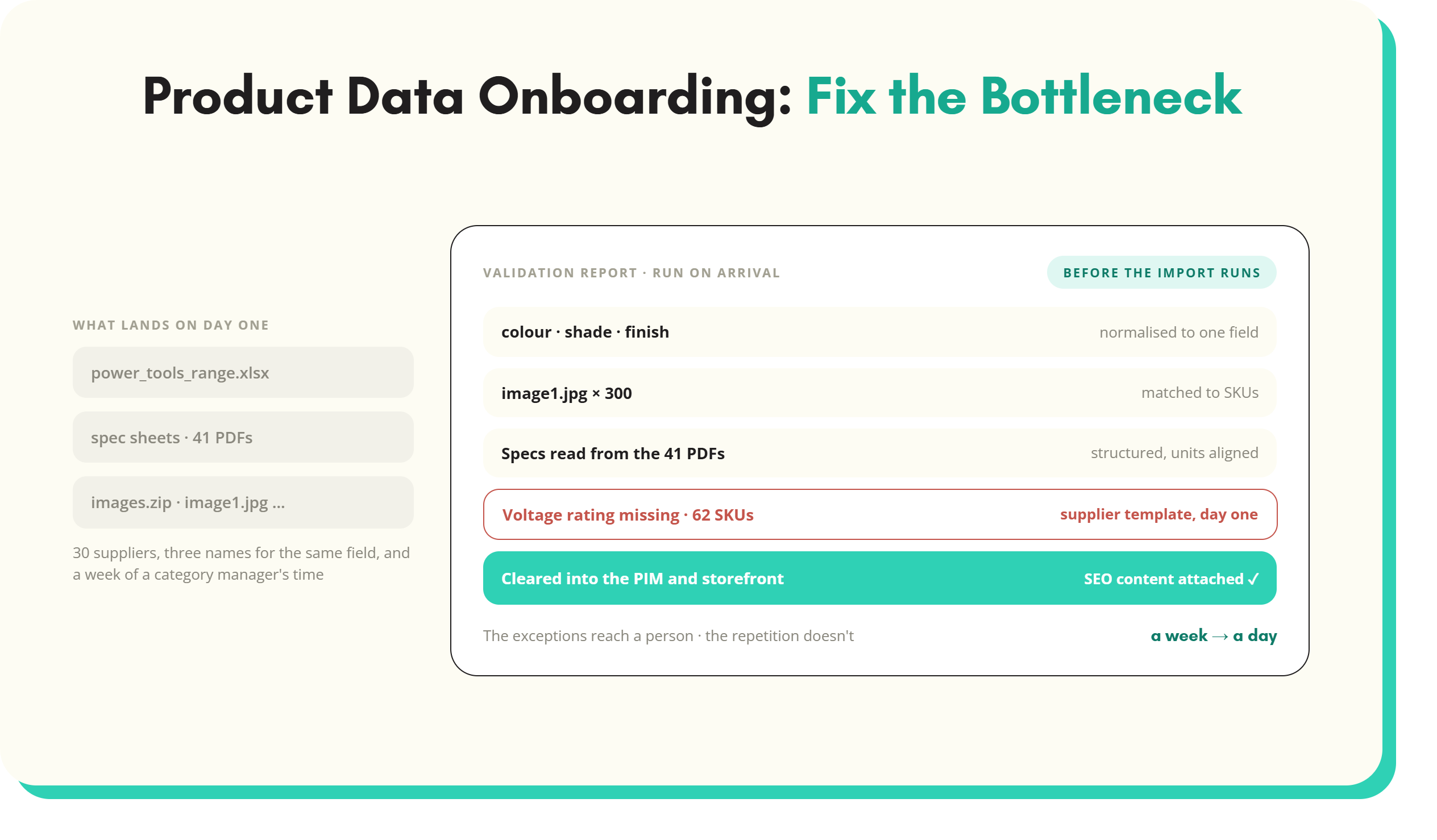
Multiply that across five, ten, or twenty suppliers, and the workload compounds fast. Take a distributor with 50,000 SKUs sourced from thirty suppliers. Even a modest error rate per supplier translates into thousands of records needing manual attention before launch. One supplier might label a field "colour." Another calls it "shade." A third skips the attribute entirely. The merchant is left to reconcile three conventions before the catalogue import will even run. In technical sectors such as building supplies, the problem deepens further still. Classification standards and compliance data both have to line up correctly before products can be listed at all.
Small teams end up doing the same work on repeat. They copy-paste fields, rename files, chase suppliers by email for missing specs, and check imports line by line. Errors often only surface once a file fails to load. None of this adds value to the business. It simply has to happen before real work, such as merchandising or supplier development, can start.
The cost of slow product data onboarding
Left unaddressed, this bottleneck has a direct cost, not just an inconvenience.
Delayed revenue: every day spent reworking supplier data is a day products are not on sale. This matters most for seasonal ranges with a narrow selling window.
Competitive disadvantage: retailers who list new ranges faster capture demand first, particularly where several merchants carry the same supplier catalogue.
Resource drain: staff who could be building supplier relationships or improving the catalogue are instead stuck cleaning spreadsheets. It is often the same small group every time a new range lands.
Eroded customer trust: incomplete or inconsistent product data leads to poor search visibility and higher return rates from mismatched expectations. Shoppers abandon listings that look unreliable.
Manual rework does not fix the underlying problem. It just delays it to the next supplier shipment. Without a structured process for product data management for distributors, the same bottleneck resurfaces with every new range. The team never gets ahead of it.
How SKULaunch structures the onboarding process
SKULaunch approaches the problem as a supplier onboarding platform, rather than a single tool bolted onto existing spreadsheets. Its core functions cover each stage of the process:
Automated validation and enrichment. SKULaunch flags missing or malformed fields and fills structural gaps before records reach a PIM or ecommerce platform. This catches errors earlier than a manual review typically would.
AI-powered mapping and normalisation, using AI product data extraction to map supplier fields to the merchant's own schema. This standardises naming conventions and removes a large share of the manual relabelling work during migrations from legacy spreadsheets.
Supplier enablement, through structured templates and guided workflows that let suppliers enrich and describe their own products. This cuts down the email back-and-forth normally needed to chase missing attributes.
Integrated sourcing tools, which let a team run web searches for missing specifications. Images and reference URLs can be pulled in from within SKULaunch itself, rather than switching between several separate tools mid-task.
Platform integrations with systems such as Shopify, Plytix, and a range of PIMs and ERPs. Enriched data lands directly in the systems a team already uses daily. For merchants weighing an enrichment platform against a traditional PIM, product data enrichment vs PIM sets out where the two approaches differ.
AI-driven content generation, producing SEO-ready product titles and descriptions as part of the product data enrichment process. This supports product discoverability without a separate copywriting step.
What a structured onboarding workflow looks like
In practice, the shift is from a single manual pass over a spreadsheet to a staged process. Data comes in from the supplier in whatever format they use. Validation runs first, flagging missing fields, malformed values, and attributes that do not match the merchant's schema. Mapping and normalisation follow next, aligning supplier naming conventions to the merchant's own categories, rather than leaving that reconciliation to a person.
Where information is still missing, one of two things happens. Either the supplier fills the gap through a structured template, or the team uses integrated sourcing tools to find it. That replaces an open-ended email thread. Once records pass validation, they move into the PIM, ERP, or ecommerce platform automatically, with SEO-ready content already attached.
The difference is not that the work disappears. It is that the repetitive, error-prone parts of it are handled by the platform, the parts that consume most of a team's time without building anything. That leaves people free to deal with genuine exceptions and supplier relationships instead.
Consider a hypothetical hardware distributor bringing on a new supplier of power tools. Under the old process, a category manager might spend the better part of a week on the file. Spec sheets need reconciling, three hundred image files need renaming, and the supplier gets emailed four separate times for missing voltage ratings. Under a structured workflow, validation flags the missing ratings on day one. The supplier fills them in through a template rather than an email chain. The finished records reach the ecommerce platform without the category manager touching a spreadsheet at all.
What efficient product data onboarding looks like in practice
When onboarding runs on a structured process rather than manual rework, the effects show up across the business, not just in the time a task takes:
Faster time-to-market, since seasonal ranges and new SKUs can go live while demand is still high, rather than weeks after a launch window has passed.
Fewer errors at import, because automated validation catches problems before data reaches internal systems, when they are far cheaper to fix.
Lower operational cost, as automation removes repetitive, error-prone manual work from the process, rather than simply reassigning it to different staff.
Scalable onboarding, so catalogues can grow from a few hundred SKUs to several hundred thousand without a matching increase in headcount.
Smoother supplier collaboration, since structured templates and automated checks reduce the back-and-forth needed to resolve missing or incorrect data on both sides.
Higher data quality overall, with product content that is accurate, consistent, and enriched for search. This supports both conversion and customer trust over time.
Key takeaways
Product data onboarding does not have to be a recurring drain on a retail or distribution team's time. The bottleneck comes from unstructured, inconsistent supplier data meeting systems that expect something cleaner. Addressing it with a structured supplier onboarding software approach, rather than repeated manual cleanup, changes what product data does for the business. It turns a cost centre into groundwork for faster, more reliable launches.
To see how SKULaunch handles your product data, request a demo.
See it in practice: onboard a new supplier range in days, not months, new product introduction without the new line form chase and collect package dimensions and case pack data from suppliers.
See SKULaunch in action
Watch how we handle AI enrichment, supplier onboarding, and catalogue scale in a live 30-minute demo.


.avif)