

Many eCommerce teams buy a PIM expecting it will fix their product data problem.
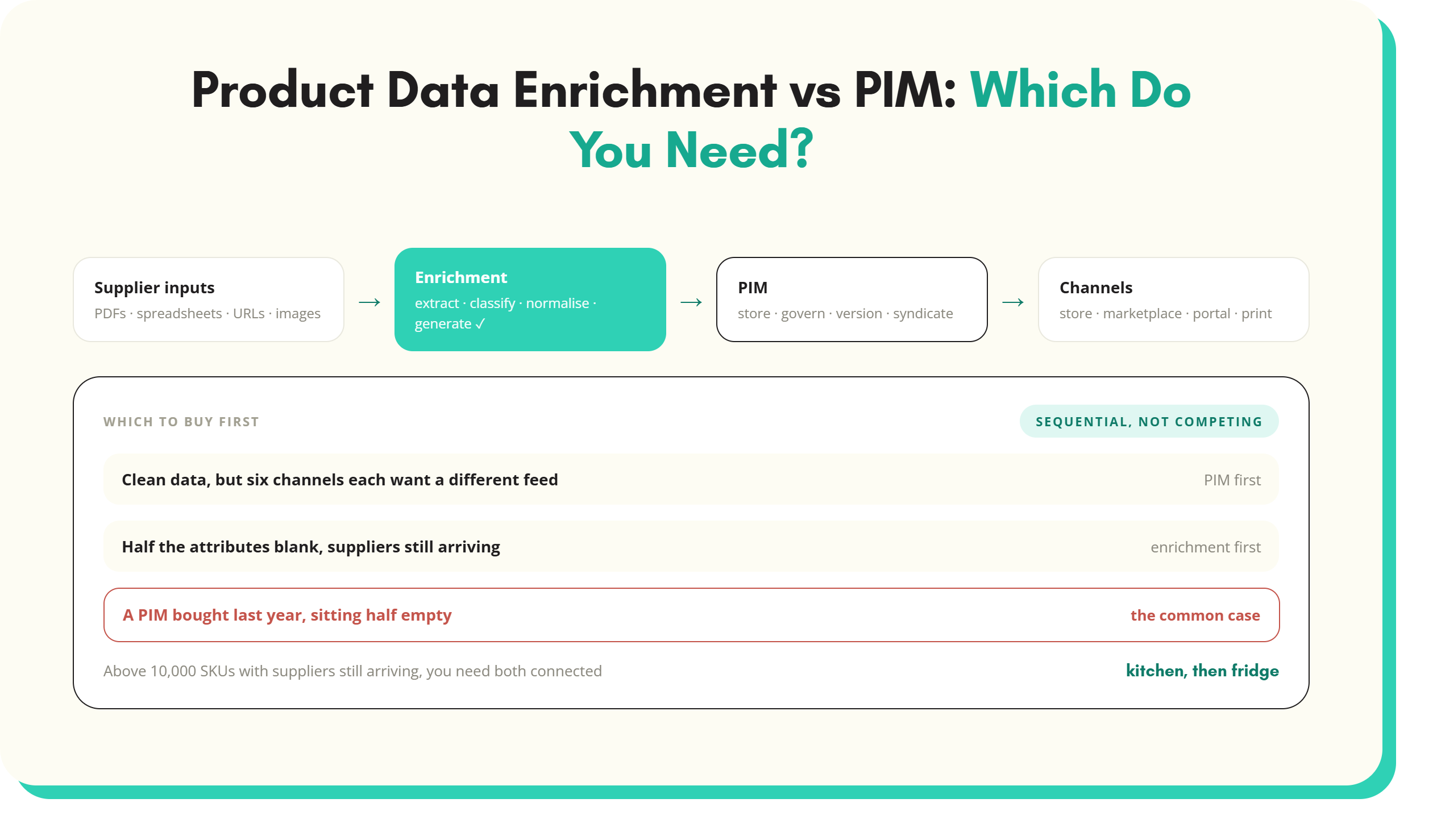
Many eCommerce teams buy a PIM expecting it will fix their product data problem. Then, six months after go-live the system sits half empty. The catalogue is still riddled with missing attributes, inconsistent values, and supplier descriptions that read like they were written for an internal warehouse system. The frustrating part is the PIM is doing exactly what it was designed to do. Nobody told the team they also needed product data enrichment. Product data enrichment vs PIM is not a choice between two competing products. They solve different problems, and most catalogues over a certain size need both.
What is a PIM?
A Product Information Management system, or PIM, is a system of record for product data. It stores attributes, manages workflows, governs data quality, and syndicates clean records to wherever you sell. Think of it as the master library for everything you know about a SKU.
The core jobs a PIM does well:
• Stores a single canonical version of every product, with versioning and audit trails.
• Manages workflows for who owns which fields, when records can publish, who can override taxonomy.
• Governs business rules, validation, mandatory attributes per category, approval gates.
• Syndicates feeds to eCommerce platforms, marketplaces, print catalogues, distributor portals.
Common examples of PIM vendors include Akeneo, Plytix, inRiver, Salsify, and Syndigo.[1] Each has different strengths. Akeneo is open source and developer friendly. Plytix is lighter and aimed at smaller catalogues. Salsify and Syndigo focus on retail and brand syndication. inRiver sits in the middle with a strong workflow engine. If you are still working out where each one fits, the breakdown of PIM, DAM, and MDM in the PIM vs DAM vs MDM guide is a useful sister read.
Here is the limitation. A PIM assumes the data going into it is already clean and structured. It does not extract attributes from a supplier PDF. It does not classify a product into a taxonomy from a free-text description. It does not generate a marketing description from a list of bullet specs. If the data is messy when it arrives, a PIM will hold that mess just as faithfully as it holds clean records. Garbage in, governed garbage out.[2]
What is product data enrichment?
It is the process of turning raw, unstructured supplier inputs into clean structured records ready for downstream systems. It sits upstream of the PIM. Where the PIM stores and syndicates clean data, enrichment is what makes the data clean in the first place.
The core jobs an enrichment platform does:
• Extract: pull attribute values out of supplier PDFs, spreadsheets with merged cells, scraped product URLs, and product images. A 12-page technical datasheet contains specifications. The enrichment job is to read it and pull out, say, voltage, current rating, IP rating, and dimensions as discrete fields.
• Classify: assign products to your category taxonomy. Whether you use ETIM, UNSPSC, or your own internal hierarchy, classification places each new SKU in the right place automatically.
• Generate: write descriptions, titles, bullet points, and SEO copy from the structured attributes. Done well, this reads consistently across the catalogue and is tuned to the channel. Done badly, it reads like every other piece of AI marketing copy on the internet.
• Normalise: make sure that "10mm", "10 mm", and "0.01m" all become the same value. That "Black", "BLK", and "black/jet" all map to a single colour. Check that units of measure are consistent across suppliers.
Done as a continuous capability, product data enrichment handles the work the PIM cannot do. Without it, the team is left with manual data entry: the kind of work that produces a 12% completion rate after six months and an inbox full of "can you add the IP rating to these 400 SKUs" requests.
How product data enrichment and PIM work together
The sequence is straightforward.
1. Suppliers send product data in whatever format they have. PDFs, spreadsheets, images, URLs.
2. The enrichment platform ingests that input, extracts attributes, classifies products, and produces structured records.
3. The PIM receives those structured records. From there it manages the workflow, the governance, and the syndication.
4. Commerce channels receive clean syndicated data from the PIM: Shopify, Magento, Amazon, marketplaces, distributor portals, print.
A useful analogy. Enrichment is the kitchen. The PIM is the fridge. The kitchen turns raw ingredients into prepared meals. The fridge stores them, organises them, and hands them out at mealtime. You can have a beautiful fridge and still go hungry if the kitchen is not working. You can have a great kitchen and waste everything you produce if you have nowhere to store it. Enrichment without a PIM works for small catalogues. A PIM without enrichment works for catalogues that arrive clean. Most retailers and distributors[3] are not in either situation.

In practice the enrichment platform writes directly into the PIM through an API or a scheduled feed. SKULaunch pushes structured product records into Akeneo, Plytix, Shopify, Magento, and Mirakl through native integrations. The PIM does not need to know whether the data was originally a PDF or a spreadsheet. It just receives clean, schema-compliant records.
Product data enrichment vs PIM: which do you need first?
This is where most teams get stuck. The honest answer depends on what your catalogue looks like today.
If your catalogue is clean and structured but syndication is hard
Buy the PIM first. The data work is largely done, but pushing consistent records to multiple channels is breaking. A PIM solves this. A direct-to-consumer brand with 2,000 SKUs, all attributes populated by the merchandising team, but six channels each demanding slightly different feeds, has a PIM problem. Enrichment is a smaller piece of the puzzle.
If your catalogue is messy, half empty, or growing fast through new suppliers
Buy enrichment first. You can run an enrichment platform without a PIM: SKULaunch holds the governed record itself through a built-in PIM layer, and pushes directly to your eCommerce platform. A distributor with 50,000 SKUs across 200 suppliers, but with half the attributes blank, will get more value from enrichment in the first six months than from a PIM. The PIM can come once the data is in shape.
If you have already bought a PIM and it sits half empty
This is the most common scenario. Enrichment fills the PIM. Without it you are looking at hiring three more people and another year of manual entry. Plug an enrichment platform into the PIM and the completion rate moves from low double digits to north of 90% in weeks rather than years. Bowens, an Australian building supplies retailer, took PIM completeness from 30% to 94% by adding enrichment upstream of an existing Akeneo deployment, written up in the Bowens case study.
Volume matters too
Below 5,000 SKUs with stable suppliers, a PIM and a small data team is often enough. Between 5,000 and 50,000 SKUs, enrichment becomes the bottleneck. Above 50,000 SKUs, or with ongoing supplier churn at any volume, you need both.
Common product data enrichment vs PIM failure modes
Three patterns repeat across product data enrichment vs PIM decisions.
Buying a PIM and expecting it to do enrichment.
The PIM vendor demo shows clean data flowing through nice workflows. The team assumes the PIM will also clean their existing mess. It will not. A PIM is a system of record, not a data factory. Six months in, the launch is delayed because the records are not ready, and the conversation turns to whether the PIM was the wrong choice. The PIM was probably fine. The missing piece was upstream.
Trying to enrich inside the PIM using manual processes.
Some teams recognise the data is messy and try to clean it inside the PIM after import. This puts product managers into spreadsheet-like editing screens, hand-fixing thousands of records. It scales badly, demoralises the team, and produces inconsistent results because two people will categorise the same product differently. The PIM is the wrong tool for this job.
Running enrichment as a one-off project.
The team brings in consultants, cleans the catalogue once, and considers the job done. Three months later, 5,000 new SKUs have arrived from new suppliers and the data is messy again. Enrichment is not a project. It is a continuous capability. New products keep arriving, supplier formats keep changing, your taxonomy keeps evolving. There are more ways for these projects to come unstuck, covered in why product data enrichment projects fail.
When you need both product data enrichment and a PIM
Most retailers and distributors above 10,000 SKUs need both[4]. The four signals:
• Continuous supplier onboarding. New suppliers send product data in their own formats every month. You need enrichment to ingest and structure it, and a PIM to govern and publish it.
• Multi-channel commerce. Selling on Shopify, Amazon, a marketplace, and through distributor portals means a system has to syndicate consistent records to each channel, with the right schema. That is the PIM. But the records have to start clean, which is enrichment.
• Technical catalogues. Industrial parts, electrical components, building products, and similar categories carry 30 to 200 attributes per SKU. No team is going to type those in by hand. You need enrichment to extract them and a PIM to govern them.
• Taxonomy depth. Anything using ETIM, UNSPSC, or a deep internal hierarchy needs classification at scale, which is an enrichment job, and a PIM to enforce that classification at publish time.
The two systems are not competitors. They are sequential. Enrichment produces the structured records. The PIM stores, governs, and distributes them. Skipping either one creates a known and predictable failure pattern.
The SKULaunch Enrichment Studio handles the upstream work. It pushes directly into Akeneo, Plytix, Shopify, Magento, and Mirakl, so the PIM receives data that is already clean and the merchandising team regains the time they used to spend on manual data entry.
Key takeaways
• A PIM is a system of record. It stores, governs, and syndicates clean product data. It does not clean data itself.
• Product data enrichment turns messy supplier inputs into clean structured records. It sits upstream of the PIM.
• Most teams need both jobs done. The PIM cannot do the enrichment job, and a one-off enrichment project does not replace a PIM. An enrichment platform with a built-in PIM layer, such as SKULaunch, covers both.
• Buy the PIM first if your catalogue is already clean and structured. Buy enrichment first if your data is messy, growing, or your PIM is sitting half empty.
• For catalogues over 10,000 SKUs with continuous supplier onboarding, you need both, and you need them connected.
For more on the upstream side of the stack, see the full guide to product data enrichment.
Next step
Not sure whether you need enrichment, a PIM, or both? Book a 30-minute stack audit and we will map your data flow, identify the bottleneck, and tell you which to invest in first. Even if the answer is not SKULaunch.
See SKULaunch in action
Watch how we handle AI enrichment, supplier onboarding, and catalogue scale in a live 30-minute demo.


.avif)