

Dated timeline of the EU digital product passport, what a passport has to carry, and the product data work behind it. Updated September 2026.
Last updated 21 September 2026. This page tracks the EU digital product passport as it moves from regulation to obligation. It covers what has been adopted, what is scheduled, what a passport has to carry, and the product data work underneath all of it. Changes are logged by date at the end.
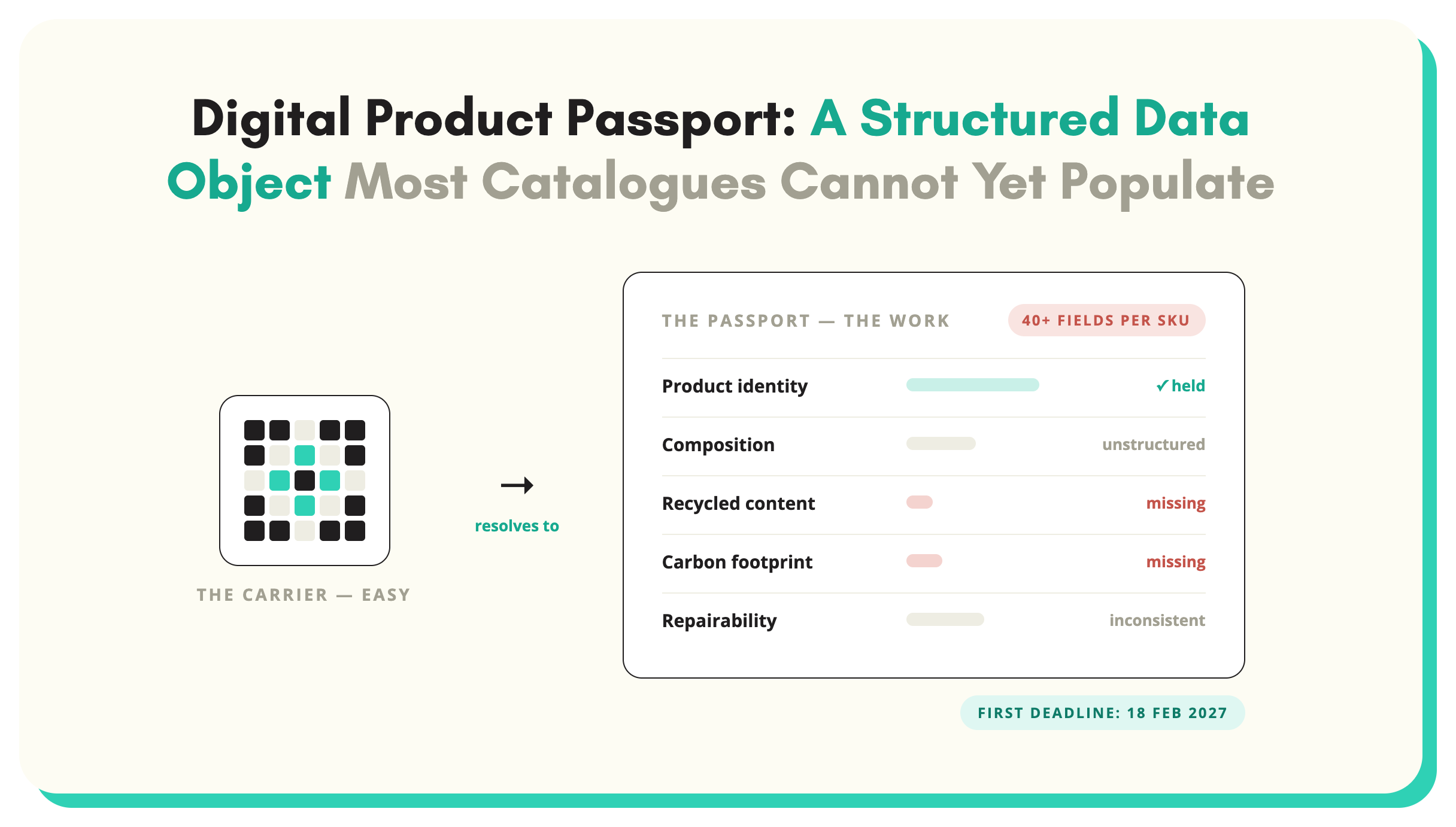
Four things are now fixed. The digital product passport registry has been live since 20 July 2026. The six European standards that define how a passport works were cited in the Official Journal on 15 July 2026. The implementing regulation that sets out how the registry checks a passport at registration has been in force since 6 August 2026. And the first mandatory passports arrive on 18 February 2027, for electric vehicle, light means of transport and industrial batteries. Most coverage of the digital product passport stops at the dates. The harder problem sits underneath them: a passport is a structured data object, and most catalogues cannot currently populate one.
Digital product passport timeline
Every date below is labelled by how firm it is. Fixed means it is in an adopted legal act or has already happened. Indicative means it comes from the European Commission's own published timeline, which the Commission itself labels as indicative and subject to publication requirements. Derived means it is calculated from a rule in the regulation rather than stated anywhere. Sources are listed at the end of the page.
| Date | What happens | Status |
|---|---|---|
| 18 July 2024 | ESPR, Regulation (EU) 2024/1781, enters into force. It is a framework: no product is yet obliged to carry a passport. | Fixed |
| 16 April 2025 | First ESPR working plan, COM(2025) 187, names the priority product groups and the sequence of delegated acts to 2030. | Fixed |
| 15 July 2026 | Six harmonised passport standards (EN 18216, 18219, 18220, 18221, 18222 and 18223) cited in the Official Journal by Implementing Decision (EU) 2026/1736. | Fixed |
| 20 July 2026 | The digital product passport registry becomes operational, with a testing environment. | Fixed |
| 6 August 2026 | Implementing Regulation (EU) 2026/1778, which sets the rules for the registry, enters into force. | Fixed |
| 21 August 2026 | Commission guidance on battery passport content published: 71 data points, each marked mandatory, optional or conditional. | Fixed |
| September 2026 | Implementing decision on the remaining two standards, EN 18239 and EN 18246. Not in the Official Journal as of 21 September. | Indicative |
| Q4 2026 | Delegated act for iron and steel. Implementing act on battery passport access rights. | Indicative |
| 18 February 2027 | Battery passports mandatory for EV, light means of transport and industrial batteries above 2 kWh. Member States appoint national registry administrators. | Fixed |
| Q2 2027 | Passport requirements for construction products. | Indicative |
| Q2 to Q3 2027 | Rules for digital product passport service providers. | Indicative |
| Q3 to Q4 2027 | Delegated acts for textiles and apparel, aluminium and tyres. | Indicative |
| 2028 | Delegated act for furniture. Mid-term review of the working plan. | Indicative |
| 2029 | Delegated acts for mattresses and for recycled content in electrical and electronic equipment. | Indicative |
| Delegated act plus 18 months | Earliest date a product group's requirements can apply, under Article 4(4). Earlier application is allowed in duly justified cases. For iron and steel that means no earlier than mid-2028 if the act lands in Q4 2026. | Derived |
The pattern to read from the table: the horizontal machinery arrived in a six-week window in summer 2026 (standards, registry, registry rules) and the product-specific obligations follow one group at a time from late 2026. That is by design. A delegated act is the point at which a product group gets its field list and its clock.
What a digital product passport actually is
A digital product passport is a structured, machine-readable record of a product, linked to the physical item through a data carrier such as a QR code, an RFID tag or an NFC chip. Scanning the carrier resolves to the passport, which holds information about the product's identity, composition, origin, repairability, environmental performance and end-of-life handling.
The European Commission describes it as a digital container for products, components and materials. The operative word is container. A passport does not generate information about a product. It carries information that someone has already collected, structured and verified.
That distinction decides how much work a DPP programme is. Buying a platform that serves passports is a procurement decision that takes weeks. Producing forty structured, unit-consistent, category-appropriate attributes for every SKU in a catalogue is a data programme that takes considerably longer.
The regulation behind it: ESPR and the delegated acts
The legal basis is the Ecodesign for Sustainable Products Regulation, Regulation (EU) 2024/1781, usually shortened to ESPR. It has applied since 18 July 2024. ESPR is a framework regulation. On its own it imposes no passport obligation on any specific product. The obligations arrive through product-specific delegated acts, each covering one product group and setting its own information requirements and dates.
The first ESPR working plan, COM(2025) 187, adopted on 16 April 2025, sets the order. It names six priority product groups: four final products (textiles and apparel, furniture, tyres, mattresses) and two intermediates (iron and steel, aluminium). It adds two horizontal measures that cut across product groups: repairability, including a repairability score, and recycled content and recyclability of electrical and electronic equipment. A separate programme covers energy-related products. The Commission's current timeline puts iron and steel in the fourth quarter of 2026, textiles, aluminium and tyres in the second half of 2027, furniture in 2028 and mattresses in 2029.
The gap between a delegated act and the obligation is Article 4(4) of ESPR. The date of application of a delegated act cannot be earlier than 18 months from its entry into force, except in duly justified cases, where an earlier date may be set. That 18 month floor is the planning window, and it is a floor with an exception, not a guarantee. It sounds generous until it is measured against the time needed to re-specify an attribute schema and collect the missing values from several hundred suppliers.
Batteries sit on a separate legal track but share the same infrastructure. The battery passport is mandated by the Batteries Regulation, (EU) 2023/1542, not by an ESPR delegated act, and it is the first hard date in the calendar: 18 February 2027, for each EV battery, each light means of transport battery and each industrial battery above 2 kWh placed on the market. Battery passports are nonetheless registered in the ESPR registry; the registry regulation names them in its scope. A mid-term review of the working plan is scheduled for 2028, at which point the Commission may adjust timings or add product groups.
The digital product passport registry, and what it checks
This is the part that turned from policy into specification over the summer. Implementing Regulation (EU) 2026/1778, adopted on 16 July 2026 and in force from 6 August, lays down how the digital product passport registry works. The registry itself went live on 20 July 2026 with a testing environment, technical documentation and a helpdesk. Its scope covers products under ESPR delegated acts, batteries, and construction products, toys and detergents under their own legislation.
The regulation describes the registry as a website with a secure user interface, an API for registering passports, a verification platform, a scheme for generating unique registration identifiers, a store for at least the unique identifiers and commodity codes, a semantic repository and a log system. The parts that matter to a product data team are what happens at registration:
- Who can register. A legal entity is verified with a qualified electronic seal under the eIDAS regulation, a natural person with a qualified electronic signature. Verification lasts at most three years. Repairers, refurbishers and recyclers are verified the same way, and only verified actors get access.
- What is checked automatically. On registration the registry checks the semantic conformity of the data, the granularity level declared (model, batch or item), the validity of the commodity code, and the link to the backup copy hosted by a digital product passport service provider. It then issues a unique, persistent registration identifier.
- What is kept. Proof of registration is available for 90 days. A registration is deleted ten years after it was made unless a delegated act says otherwise. The semantic repository is free to use through publicly documented APIs.
- Who administers it nationally. By 18 February 2027 every Member State must appoint a designated national administrator.
Read that list as a product data specification. Every SKU that will carry a digital product passport needs a valid commodity code against it, a decision on whether it is identified at model, batch or item level, and a record that passes a machine conformity check rather than a human review. A registration either conforms or it is rejected. Two pieces are still missing from the Commission's side: the Article 14 web portal, through which the public will look passports up, and the rules for passport service providers, which the Commission's timeline now places in the second and third quarters of 2027. A consultation on service providers ran from April to July 2025 and no draft act has followed yet.
What data a digital product passport has to carry
The exact fields are set per product group by the relevant delegated act, so no complete list exists yet for groups whose act has not been adopted. Annex III of ESPR lists the kinds of information a passport can be required to hold. A simplified grouping, consistent across ESPR and the batteries regime:
- Product identity: unique identifiers at model, batch or item level, the commodity code, and identifiers for the economic operator and the facility.
- Composition and materials: what the product is made of, including substances of concern, which Annex III names explicitly.
- Origin and supply chain: where components and materials came from.
- Environmental performance: carbon footprint, recycled content, and similar measured values.
- Repairability and durability: spare part availability, repair documentation, expected lifetime.
- End of life: disassembly guidance and recycling routes.
- Compliance and user documentation: declarations, certificates and test reports, plus user manuals, instructions, warnings and safety information.
Read that list as a product data specification rather than a policy summary. Every item on it is an attribute. Not a document filed against a product record, but a named field with a defined type, a unit where one applies, and a controlled list of permitted values. A carbon footprint that lives in a supplier PDF is not a passport field. The same number, extracted, converted to the required unit and stored against the SKU, is.
The first real field list: batteries
The battery passport is the first digital product passport with a published field list, and it is worth studying whatever you sell, because it shows the shape of what is coming. On 21 August 2026 the Commission published guidance on battery passport data points by category: 71 data points, each marked mandatory, optional, applicable only in specific circumstances, or not required to be completed or displayed as of February 2027. The guidance says it may be developed further as implementation progresses. Seventy-one typed fields, with conditionality, for a single product type, is the scale to plan for.
What the next field lists look like
For the product groups behind batteries, the Commission's Joint Research Centre publishes the preparatory work, and it is the best available preview of the fields a delegated act will require.
- Iron and steel. The JRC's passport content proposal of March 2026 covers five representative intermediate products (hot rolled coil, wire rod, galvanised cold rolled coil, electrical steel and stainless steel) and groups content into product identification and classification, producer identification and origin, material compliance and substances of concern, and environmental and circularity information. It recommends a granularity aligned with existing industrial traceability practice. A second stakeholder consultation ran in April 2026. There is no draft delegated act yet.
- Textiles and apparel. The JRC's study on passport content for apparel, dated May 2026, scopes apparel with at least 80 per cent textile fibres by weight across ten product categories, puts the delegated act tentatively in 2027, and names an open stakeholder consultation as the next step.
For everything else on the working plan there is no published field list. That is not a reason to wait, because the categories above are stable and most of the fields inside them can be predicted.
The standards that decide how a passport works
The technical rules for the digital product passport come from CEN and CENELEC's joint committee JTC 24, working under the Commission's standardisation request M/604. Six of its eight standards were cited in the Official Journal on 15 July 2026 by Implementing Decision (EU) 2026/1736, which gives products built to them a presumption of conformity with Articles 10 and 11 of ESPR:
- EN 18216:2026: data exchange protocols.
- EN 18219:2026: unique identifiers, for products, operators and facilities.
- EN 18220:2026: data carriers, the physical-to-digital link through optical codes, RFID and NFC.
- EN 18221:2026: data storage, archiving and persistence.
- EN 18222:2026: application programming interfaces for passport lifecycle management and searchability.
- EN 18223:2026: system interoperability.
The remaining two, EN 18239 on access rights management, information system security and business confidentiality, and EN 18246 on data authentication, reliability and integrity, had not been cited in the Official Journal as of 21 September 2026. The Commission's timeline lists an implementing decision on them for September 2026. An international mirror, ISO/IEC JTC 5 on the digital product passport, was created in 2026.
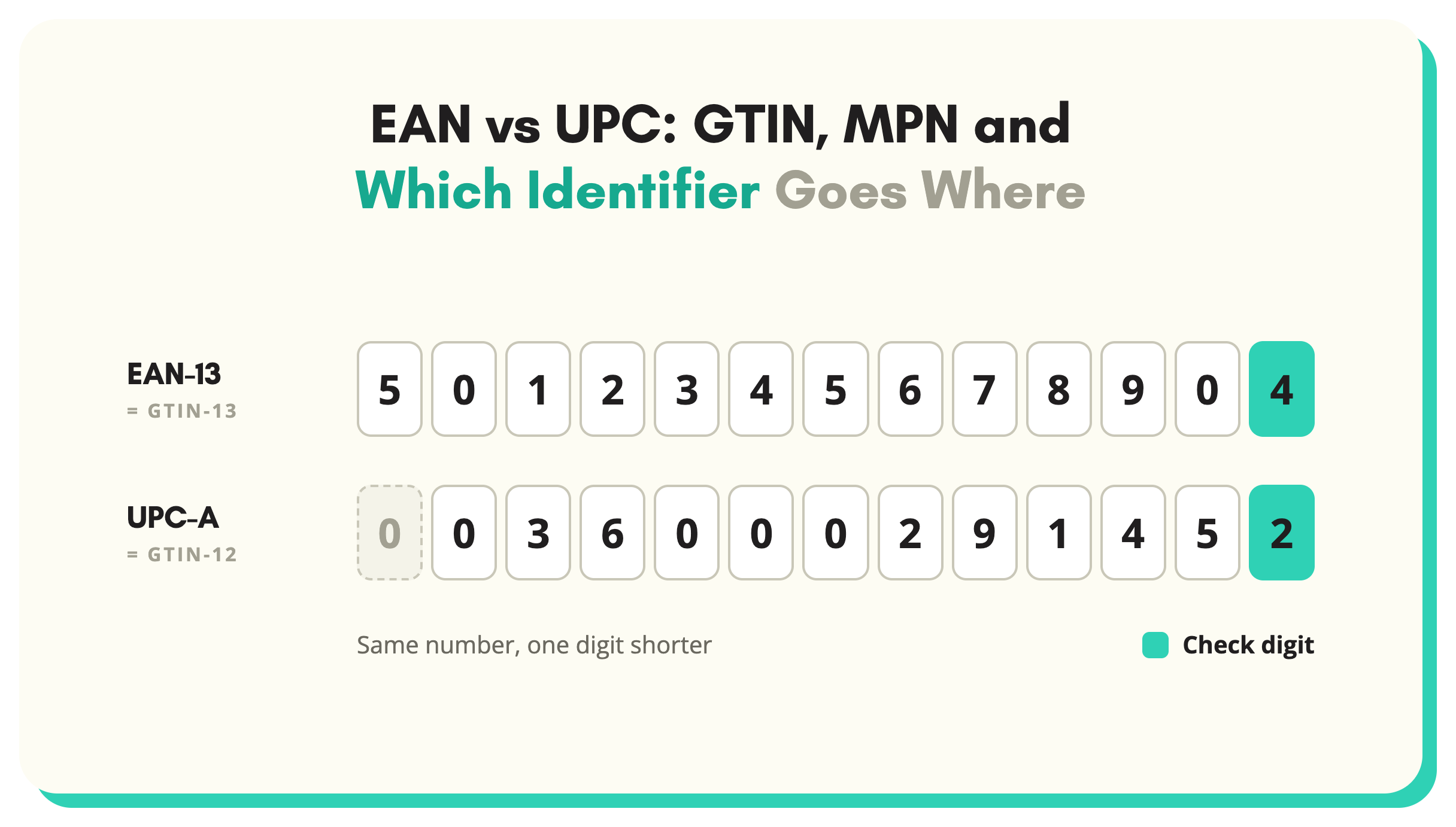
For a product data team, EN 18219 and the registry's semantic conformity check are the two that bite hardest. The first makes product, operator and facility identifiers foundational rather than administrative. The second requires that an attribute means the same thing wherever it appears. Catalogues that carry the same SKU under three different internal references, or that use one attribute name for two different measurements across categories, fail both tests before any sustainability data is even considered. The guide to GTINs, MPNs and which identifier goes where covers the identifier layer.
Where the digital product passport sits alongside systems already in place
A digital product passport is not a new system category so much as a new output from systems most organisations already run.
PIM
A PIM stores and governs product data. The digital product passport is an output of it. This is also the clearest predictor of how hard a DPP programme will be: a PIM populated to 40 per cent completeness will produce passports that are 40 per cent complete, and the registry does not accept partial records.
GS1 Digital Link
GS1 Digital Link turns a GTIN into a resolvable web address, which is increasingly how a data carrier resolves to a passport. Organisations already using GS1 identifiers have a shorter route to EN 18219 compliance than those relying only on internal part numbers.
Classification standards
ETIM, UNSPSC and eCl@ss give attributes shared meaning within a product category, which is the kind of shared meaning a semantic conformity check depends on. Teams that have already mapped a catalogue to a classification standard have done a meaningful share of the work. The guide to ETIM classification and data mapping covers how that mapping works in technical product categories.
ERP and PLM
Bills of materials, material declarations and supplier records usually sit here rather than in the PIM. Most passport programmes need a route from these systems into the product record, because composition data rarely lives with marketing content.
What a digital product passport is not
Five misconceptions cause most of the wasted effort on early digital product passport programmes.
- It is not a QR code. The carrier is the smallest and cheapest part of the job. EN 18220 covers it in one standard out of eight. The data behind the carrier is the work.
- It is not a sustainability report. Corporate sustainability reporting is annual, aggregated and written for humans. A passport is item-level, continuous and written for machines.
- It is not a one-off compliance project. A digital product passport has to stay accurate for the life of the product, through supplier changes, reformulations and new production batches. A programme that ends at go-live produces records that are wrong within a year.
- It is not only a manufacturer problem. The obligation attaches to placing a product on the EU market. Importers and distributors who put their own name on a product, or who bring in goods from outside the EU, can carry the responsibility even though they made none of it. This catches distributors who assumed their suppliers would handle it.
- It is not being quietly shelved. The Commission's Environmental Omnibus of 10 December 2025 proposes repealing the separate SCIP reporting duty for substances of very high concern and says that data will be brought into the passport's scope instead. No proposal on the table changes ESPR's dates or the passport obligations. The passport is picking up duties from other regimes, not losing them.
The part most programmes underestimate: attribute-level readiness
A typical distributor catalogue carries a product name, a description, a price, a few images and perhaps a dozen structured attributes per category. A digital product passport for the same product may need forty or more, each with a defined unit and a permitted value list, sourced from suppliers who currently send specification data as PDFs and spreadsheets in their own formats. The battery guidance, at 71 data points, is the first published confirmation of that order of magnitude.
Three gaps show up repeatedly, and they are three different jobs:
- Attributes that do not exist yet. Recycled content percentage, substance declarations and disassembly instructions are rarely held today. This is a supplier data acquisition problem, and it is the slowest of the three because it depends on other organisations.
- Attributes that exist but are unstructured. The value is present in a specification sheet or buried in a description as free text. This is an extraction problem, and it is the most automatable of the three.
- Attributes that exist but are inconsistent. Weight recorded in kilograms for one supplier and grams for another, or a material described five different ways across the same category. This is a normalisation problem, and it is what a semantic conformity check will not tolerate.
Sequencing matters. Extraction and normalisation can start immediately against data already held, and both reduce the size of the acquisition problem by revealing which attributes are genuinely missing rather than merely unstructured. Starting with supplier requests, before knowing which fields are actually absent, produces a long questionnaire that suppliers ignore.
This is ordinary product data enrichment work, applied to a new set of required fields. The mechanics are unchanged: define the schema per category, extract what exists, normalise it to consistent units and values, and fill the gaps. What the regulation changes is that the output has a legal deadline, a defined recipient and a machine at the door.
What to do before the delegated act lands
The delegated act for a given product group arrives with an 18 month minimum runway in the normal case. Six things are worth doing before it does, because none of them depend on knowing the final field list.
- Establish which product groups the catalogue sells into, and therefore which delegated act applies and when. Iron and steel is due first, in the fourth quarter of 2026; textiles, aluminium and tyres follow in 2027; construction products have their own track from 2027.
- Define the attribute schema per category now. Most passport fields are predictable from the ESPR information requirements and the JRC preparatory work, and a schema built early can be extended when the act is published. Schema and attribute definition is the foundation everything else attaches to.
- Audit what is actually held, measured as completeness per attribute per category rather than as an overall percentage. Catalogue-level completeness figures hide the categories that will fail. A product data quality check by attribute is the right shape for this.
- Fix identifiers and commodity codes first. EN 18219 makes product, operator and facility identifiers foundational, the registry validates the commodity code on every registration, and identifier problems block everything downstream.
- Change supplier intake so new products arrive structured rather than being retrofitted later. Every product onboarded to the old standard adds to the backlog.
- Decide where digital product passports will be generated and served from, confirm that the system holding the product record can export to the formats in EN 18216 and EN 18222, and plan to test registrations against the registry's testing environment rather than discovering conformity failures on the live system.
For distributors specifically, the acquisition problem is larger than for manufacturers, because the data belongs to several hundred suppliers rather than to one production process. The distributor product data approach covers how intake at that supplier count is usually structured, and AI extraction from supplier documents is what makes the second of the three gaps tractable at catalogue scale.
The UK position
The UK has not adopted a digital product passport and has not said whether it will recognise the EU one. What exists is a call for evidence on a digital product record policy, published on 27 July 2026 and closing on 21 September 2026. It asks whether a UK scheme should be interoperable with the EU system or tailored to the Great Britain market, and notes that the EU passport will apply in Northern Ireland under the Windsor Framework. No government response has been published.
Two practical consequences. A UK business placing products on the EU market is in scope of the EU rules regardless of what the UK decides. And any Great Britain scheme is years behind the EU one, so building to the EU standards now is the only version of the work that cannot be wasted.
Key takeaways
- A digital product passport is a structured, machine-readable product record reached through a data carrier. The carrier is the easy part; the structured data behind it is the work.
- ESPR, Regulation (EU) 2024/1781, is a framework. Obligations arrive through product-specific delegated acts: iron and steel first, due in the fourth quarter of 2026, then textiles, aluminium and tyres in 2027, furniture in 2028, mattresses in 2029.
- The first hard deadline is 18 February 2027 for batteries, under the separate Batteries Regulation (EU) 2023/1542, registered in the same ESPR registry.
- The registry has been live since 20 July 2026 and its rules, Implementing Regulation (EU) 2026/1778, have applied since 6 August. Registration is machine-checked for semantic conformity, granularity level, commodity code validity and the service provider backup link.
- Six CEN and CENELEC standards were cited in the Official Journal on 15 July 2026. EN 18219 on identifiers matters most to product data teams. Two more standards are still to be cited.
- Article 4(4) gives an 18 month minimum between a delegated act entering into force and its requirements applying, with an exception for duly justified cases.
- The obligation can attach to importers and distributors, not only manufacturers.
- Digital product passport readiness is attribute readiness. Missing, unstructured and inconsistent attributes are three separate problems requiring three different fixes.
Where to go next
The practical first move is an attribute completeness audit per category, because it converts a regulatory deadline into a countable backlog. Once the gap is measured, the extraction and normalisation work can start against data already held, without waiting for the delegated act to confirm the final field list. The overview of product data enrichment covers how that work is structured, and standards and feeds covers the export side once the records are complete.
Change log
- 21 September 2026. Added the dated timeline with status labels. Added the digital product passport registry implementing regulation and what it checks at registration. Corrected the standards section: the six standards were cited in the Official Journal on 15 July 2026 by Implementing Decision (EU) 2026/1736 (an earlier version of this page gave a June publication date), standard titles now match the Decision, and EN 18239 and EN 18246 are recorded as not yet cited. Added the battery passport data point guidance of 21 August 2026, the JRC content proposals for iron and steel and for textiles, the Environmental Omnibus position, the Article 4(4) exception, and the UK call for evidence.
- 25 August 2026. First published.
Sources
- Regulation (EU) 2024/1781, Ecodesign for Sustainable Products Regulation
- COM(2025) 187, ESPR and Energy Labelling Working Plan 2025 to 2030
- Commission Implementing Decision (EU) 2026/1736 on harmonised standards for digital product passports
- Commission Implementing Regulation (EU) 2026/1778 on the digital product passport registry
- European Commission, Digital Product Passport, including the indicative timeline
- European Commission, The Digital Product Passport Registry is now live, 20 July 2026
- European Commission, guidance on the digital batteries passport, 21 August 2026
- CEN and CENELEC, digital product passport standards cited in the Official Journal, 15 July 2026
- Joint Research Centre, ESPR preparatory study for iron and steel
- Joint Research Centre, study on digital product passport content for textile apparel products, May 2026
- COM(2025) 980, Environmental Omnibus, 10 December 2025
- UK Government, call for evidence on digital product record policy, July 2026
See it in practice: collect compliance documents from suppliers, against every product, capture country of origin for every SKU and request product data updates from suppliers.
See SKULaunch in action
Watch how we handle AI enrichment, supplier onboarding, and catalogue scale in a live 30-minute demo.


.avif)