

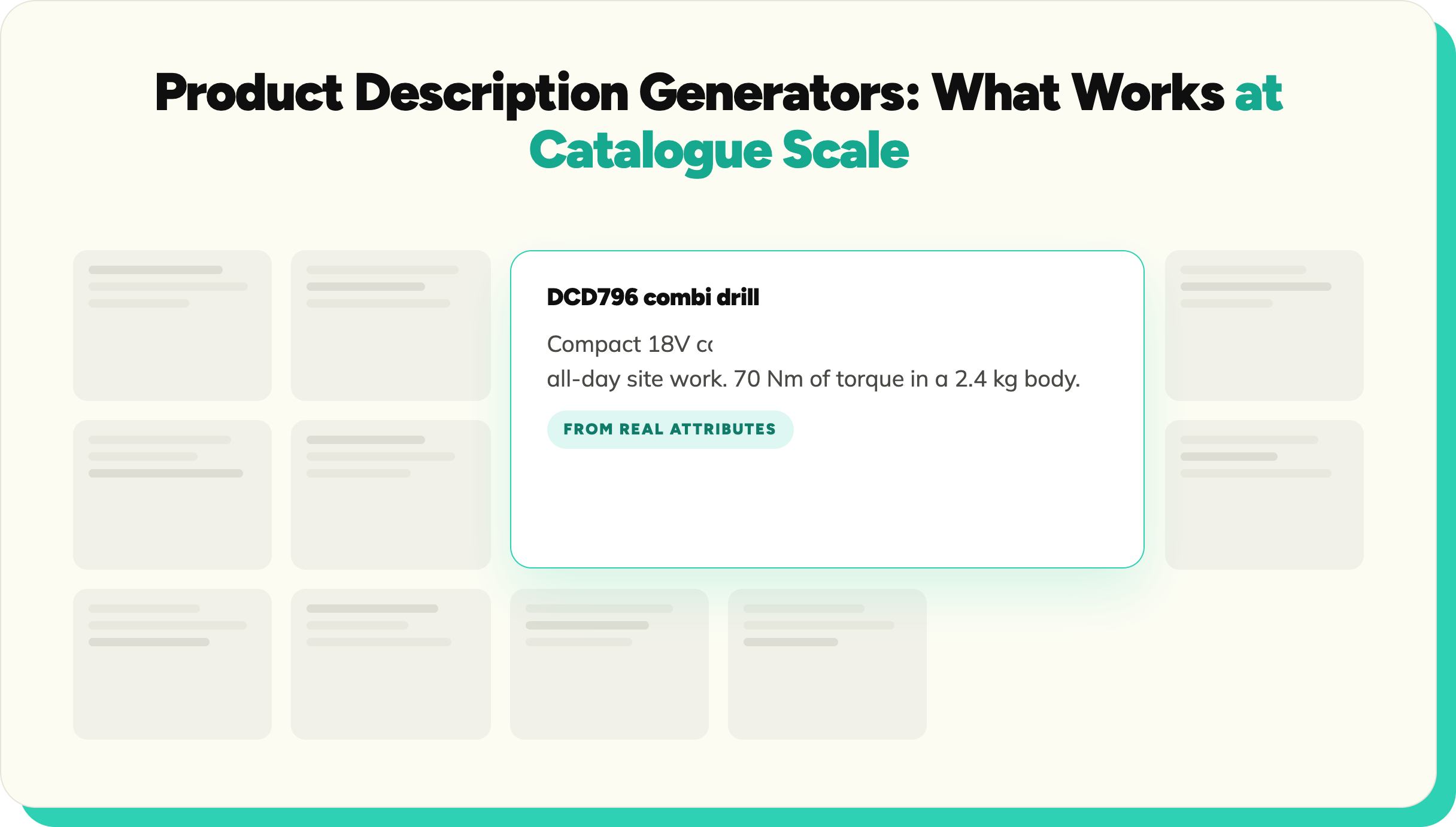
Generic generators write fluent descriptions from thin inputs. At catalogue scale, fluency without verified attributes is a liability.
A product description generator promises the same thing everywhere: paste in a product name and a few details, get back fluent copy. For a handful of products, that works. For a retailer or distributor with 20,000 SKUs of supplier data in PDFs and spreadsheets, the generic version of the tool creates a new problem while solving an old one. The copy reads well and the facts drift, because the generator never had the facts in the first place.
What a product description generator does
Any product description generator, from a free web tool to the generation layer inside an enrichment platform, does the same core job: it takes product information as input and produces prose as output. The differences that matter are all on the input side. What does the tool know about the product before it writes? Where did that knowledge come from? Has anyone verified it? The writing itself stopped being the hard part when large language models arrived. Feeding the writer accurate, structured facts is the hard part now.
Why generic product description generators disappoint at catalogue scale
Teams that run a generic generator over a real catalogue hit the same three walls.
1. No grounding, so the model fills gaps by inventing
Give a generator a product name and a category and ask for 150 words, and it will produce 150 words. If it does not know the material, the dimensions, or the compatibility, it writes around the gaps or, worse, fills them plausibly. A description that confidently states the wrong voltage is worse than a thin one, because a customer trusts it, buys on it, and returns the product when reality disagrees. At catalogue scale nobody proofreads 20,000 outputs, so invented details ship.
2. One product at a time does not survive contact with a catalogue
Copy-paste workflows are fine for ten SKUs. They collapse at hundreds. The work of gathering each product's details into the prompt is exactly the manual data work the tool was meant to remove, and it has to be repeated for every channel variant and every revision. What a catalogue needs is bulk generation driven by structured records, where the description updates when the underlying attributes do.
3. Consistency fails across variants and channels
A family of 40 near-identical SKUs needs descriptions that vary where the products vary (size, colour, rating) and hold steady everywhere else. Generic tools, prompted one product at a time, drift in tone, structure, and claims across the family. Channels make it worse: the website wants 150 words, the marketplace wants 80 with mandatory attribute mentions, and the print feed wants a single line. Without a structured source of truth per SKU, each variant is a fresh roll of the dice.
What to do instead: generate from verified attributes
The reliable pattern inverts the workflow. Extract and verify the product's structured attributes first, then have the model write from those attributes and nothing else. This is how content generation works inside a product data enrichment pipeline: attributes are pulled from supplier PDFs, spec sheets, and images, validated against the category schema, and only then passed to generation, so every claim in the description traces to a verified field. SKULaunch's content generation works this way, writing titles, descriptions, and bullets per channel from the enriched record, in bulk, with the attribute set as the guardrail.
The practical differences show up quickly.
- Accuracy is inherited, not hoped for. The description can only state what the verified record contains. Fix the record and every downstream description regenerates correctly.
- Scale is native. Generation runs across the catalogue in bulk, not through a paste-in box. A 40-variant family gets 40 consistent descriptions in one pass.
- Channels are formats, not rewrites. The same record renders as 150 web words, an 80-word marketplace description, and a one-line feed entry, each within its channel's limits.
- Tone is enforced once. Voice and structure rules apply at the pipeline level rather than per prompt, so the catalogue reads like one brand wrote it.
The upstream half of this pattern, getting trustworthy attributes out of messy sources, is covered in AI product data enrichment explained.
If you just need a quick product description generator
Sometimes the honest answer is that a generic tool is fine. A dozen products, a one-off landing page, a marketing team drafting copy a human will edit anyway: no pipeline required. If that is your situation, three habits remove most of the risk.
- Feed it verified facts, not a product name. Paste the actual specification into the prompt and instruct the tool to use only what you provided. The less it has to guess, the less it invents.
- State the channel limits in the prompt. Word count, mandatory mentions, banned claims. Generators comply well with explicit constraints and badly with implied ones.
- Ban superlatives. Instruct it to avoid unverifiable claims (best, premium, industry-leading). What remains is the factual copy you actually wanted.
The moment the workload becomes recurring, multi-channel, or bigger than a few hundred SKUs, the paste-in workflow is costing more time than it saves, and the attribute-grounded route through catalogue enrichment is the better economics.
Key takeaways
- Every product description generator writes fluently; the differences that matter are what it knows about the product and whether that knowledge is verified.
- Generic tools fail at catalogue scale in three ways: invented details, one-at-a-time workflow, and inconsistency across variants and channels.
- The reliable pattern is attribute-grounded generation: verify the structured record first, generate from it second, per channel.
- Generic tools remain fine for small, one-off jobs if you paste in real specifications, state channel limits, and ban superlatives.
- Recurring, multi-channel, or high-volume description work belongs in an enrichment pipeline, not a paste-in box.
See SKULaunch in action
Watch how we handle AI enrichment, supplier onboarding, and catalogue scale in a live 30-minute demo.

.avif)