

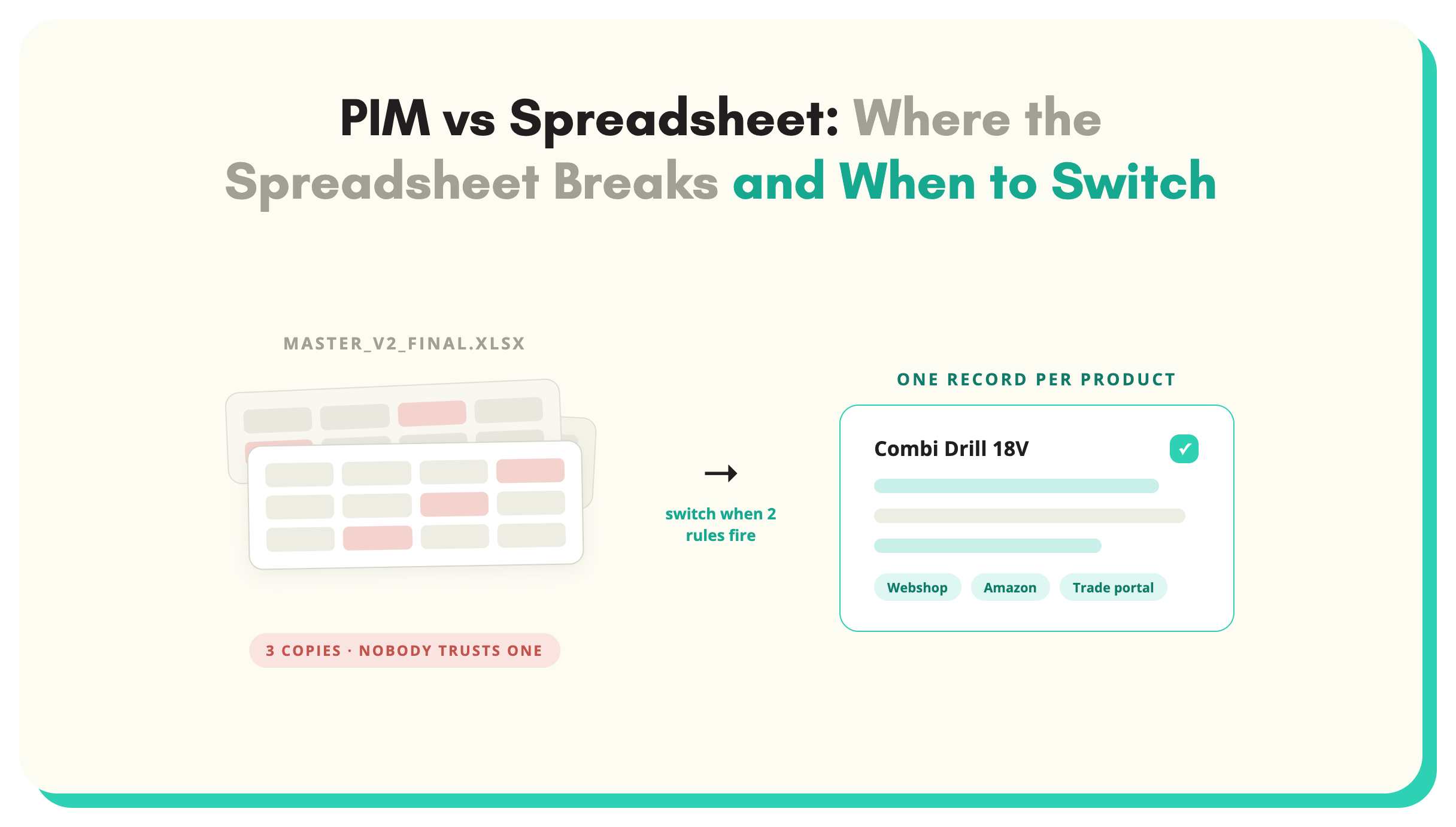
Every catalogue starts in a spreadsheet, and the spreadsheet is usually right, until five specific things break.
Every product catalogue starts in a spreadsheet, and for a while the spreadsheet is right. It is free, everyone can use it, and it bends to whatever the catalogue needs this week. The PIM vs spreadsheet question is really a timing question, because the spreadsheet's costs are invisible until they arrive all at once, usually in the month a second channel, a big new supplier or a second editor shows up. Here is where the spreadsheet genuinely wins, the five places it breaks, and the decision rules for when to switch.
PIM vs spreadsheet: what the spreadsheet does well
Credit where due. A spreadsheet costs nothing, needs no training, and imposes no structure you did not choose. For a catalogue of a few hundred stable products with one owner and one channel, a disciplined master file is not a compromise, it is the correct tool. Discipline is the operative word: one master, one owner, columns defined per category, and every channel export generated from the master rather than edited on its own. Run like that, a spreadsheet can carry a small catalogue for years.
Where the spreadsheet breaks
Five breaking points, and most catalogues meet them in the same order.
1. It forks. Every "Save As" creates a competing version of the truth. Six months in, the buying team, the web team and the marketplace team each maintain their own copy, and nobody can answer what the product actually weighs.
2. Variants become rows. A product in twelve sizes is twelve rows repeating the same brand, material and description, differing in one column. Change the description and you change it twelve times, or eleven times, which is how inconsistencies are born.
3. Completeness is invisible. A spreadsheet cannot tell you that the drills category averages 18 of its 30 required attributes. The gap surfaces downstream instead, as filters that return nothing and listings a channel rejects.
4. Channels multiply copies. Amazon wants one format, the webshop another, the trade portal a third. Each export gets hand-adjusted, each adjustment sticks, and soon every channel has its own quietly diverging catalogue.
5. Supplier volume compounds it. Fifty suppliers means fifty layouts to translate into the master by hand, every range refresh, forever. This is the point where the spreadsheet stops costing nothing and starts costing a headcount.
What a PIM changes, and what it does not
A PIM gives the catalogue one record per product that everything reads from. Variants are modelled once, parent and children. A schema per category validates what goes in, so units and values stay consistent. Channel outputs are generated from the record rather than maintained beside it. Completeness becomes a number per category instead of a surprise. What a PIM does not change: messy supplier data stays messy, just in better screens, because PIM software stores product data rather than creating it. If the spreadsheet's real job was absorbing badly shaped supplier files, a PIM inherits that job unsolved.
PIM vs spreadsheet: the decision rules
Switch when any two of these are true: you sell through more than two channels; the catalogue has passed a few thousand SKUs; more than one person edits product data every week; more than fifty suppliers feed the catalogue; or someone in the business keeps a private copy because they do not trust the master. If none of them are true, keep the spreadsheet and run it with discipline. Buying structure before the catalogue needs it is how implementation projects happen to businesses that did not need one.
The middle ground the PIM vs spreadsheet debate misses
The choice is not binary. An ecommerce platform's built-in catalogue covers single-channel ranges. A lightweight PIM adds proper structure without the enterprise machinery. And an enrichment platform with a built-in PIM layer covers the case the others skip, where the data itself is the problem: SKULaunch reads the supplier spreadsheets you already receive, extracts and normalises the attributes, and holds the result as governed records in its built-in PIM layer, set up self-service in days. For distribution-scale catalogues, where supplier intake is the whole game, the wider discipline is set out in product data management for distributors.
How to move off the spreadsheet without a project
The migration that works is staged, and none of the stages is a rewrite. Export the master and freeze it. Define the schema for your worst category first: fields, types, units, accepted values. Import that category, validate against the schema, and fix what fails. Repeat category by category, worst first. Then demote the spreadsheet permanently: supplier files keep arriving as spreadsheets, and that is fine, but they become an input format that gets imported and validated, never the record itself. The team keeps receiving spreadsheets and stops living in them.
Key takeaways
- The spreadsheet is the right tool early: free, flexible, universally understood. Run it with one master, one owner, generated exports.
- It breaks in five predictable places: forking, variants, invisible completeness, channel copies and supplier volume.
- A PIM fixes structure, not data. Messy supplier files stay messy unless something extracts and normalises them.
- Switch when two or more decision rules fire: channels, SKU count, editors, suppliers, or a trusted-copy problem.
- Migrate category by category, worst first, and demote the spreadsheet to an input format rather than the system of record.
See SKULaunch in action
Watch how we handle AI enrichment, supplier onboarding, and catalogue scale in a live 30-minute demo.


.avif)